


The skyscraper index
What do you think? Will China ever complete the Shanghai tower? The rarely discussed “skyscraper index” is highly correlative with a nation’s hubris and failed monetary policy.
Although the cyclic nature of construction is described as “whimsical,” Wikipedia says: “Business cycles and skyscraper construction correlate in such a way that investment in skyscrapers peaks when cyclical growth is exhausted and the economy is ready for recession.”
Look back to the then-tallest Singer Building following the panic crash of 1907. Later, the Empire State Building and others should have been red flags that these new super-tall buildings were part of an overheating economy.
The market crash of 1929 followed soon thereafter.
From the Sears Tower in 1997 to the Petronas Towers in Malaysia during the middle of the Asian financial crisis, the world’s tallest buildings do not exactly have a sterling reputation.
Even the current-tallest Burj Dubai is facing criticism for being wasteful and extravagant.
Property markets around the world are collapsing. It is a minefield for investors.
Sadly, at the same time there are many homeless, displaced people and refugees with nowhere to call home on this Earth, whether they are on the border with Lebanon, Christmas Island, or trafficked refugees dying on boats in perilous waters.
These are the downsides of bank financing and unsound money. Hubris will be the demise of mankind.
That said, what does the skyscraper index say about our iconic Taipei 101? Has Taiwan dodged a bullet? So far, yes.
However, property values in Taiwan are over-valued by at least 65 percent and the biggest problem is most of the new apartments are palaces for the super-rich. Investors should sell at this current peak in property prices.
Young workers are advised to rent the cheapest place they can while saving and wait for the inevitable price correction. Gold is the recommended savings vehicle of choice, especially because it is still on sale thanks to price manipulation.
If you experienced vertigo watching the “Shanghai Tower Climb” on YouTube, you will understand my dread that the inevitable disaster-in-waiting that mankind has built over our finite planet is more precarious than ever.
China’s economy is just as fragile. Look at the preposterous corporate debt-to-GDP ratio, which is much higher than Taiwan’s, which is also a shocking figure.
Japanese Prime Minister Shinzo Abe’s policies are financially insane from any balance-sheet viewpoint.
The US is devolving into terminal decline, and the rest of the planet is so ridden with gangsters, crime, nepotism, corruption, outright sectarian warfare and environmental pollution that it’s hard to see a light at the end of the tunnel.
What makes me sad is that all of Taiwan’s political parties seem to be willfully ignoring the macro factors amid partisan squabbling over minutiae. What gives me hope is that I live in Taiwan amid the energetic students here.
Any worst-case scenario means that Taiwan needs to produce its own food and energy in preparation for crisis, including typhoons, earthquakes and other unavoidable disasters.
The dominoes are lined up on a house of cards that is balancing on the backs of a circle of black swans. Invest wisely out there.
Torch Pratt
Yonghe, New Taipei City

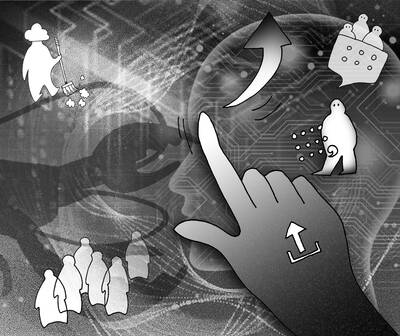
Weeks into the craze, nobody quite knows what to make of the OpenClaw mania sweeping China, marked by viral photos of retirees lining up for installation events and users gathering in red claw hats. The queues and cosplay inspired by the “raising a lobster” trend make for irresistible China clickbait. However, the West is fixating on the least important part of the story. As a consumer craze, OpenClaw — the AI agent designed to do tasks on a user’s behalf — would likely burn out. Without some developer background, it is too glitchy and technically awkward for true mainstream adoption,
A delegation of Chinese Nationalist Party (KMT) officials led by Chairwoman Cheng Li-wun (鄭麗文) is to travel to China tomorrow for a six-day visit to Jiangsu, Shanghai and Beijing, which might end with a meeting between Cheng and Chinese President Xi Jinping (習近平). The trip was announced by Xinhua news agency on Monday last week, which cited China’s Taiwan Affairs Office (TAO) Director Song Tao (宋濤) as saying that Cheng has repeatedly expressed willingness to visit China, and that the Chinese Communist Party (CCP) Central Committee and Xi have extended an invitation. Although some people have been speculating about a potential Xi-Cheng
Chinese Nationalist Party (KMT) Chairwoman Cheng Li-wun (鄭麗文) is leading a delegation to China through Sunday. She is expected to meet with Chinese President Xi Jinping (習近平) in Beijing tomorrow. That date coincides with the anniversary of the signing of the Taiwan Relations Act (TRA), which marked a cornerstone of Taiwan-US relations. Staging their meeting on this date makes it clear that the Chinese Communist Party (CCP) intends to challenge the US and demonstrate its “authority” over Taiwan. Since the US severed official diplomatic relations with Taiwan in 1979, it has relied on the TRA as a legal basis for all
The ongoing Iran conflict is putting Taiwan’s energy fragility on full display — the island of 23 million people, home to the world’s most advanced semiconductor manufacturing, is highly dependent on imported oil and gas, especially that from the Middle East. In 2025, 69.6 percent of Taiwan’s crude oil and 38.7 percent of liquified natural gas were sourced from the Middle East. In the same year, 62 percent of crude oil and 34 percent of LNG to Taiwan went through the Strait of Hormuz. Taiwan’s state-run oil company CPC Corp’s benchmark crude oil price (70 percent Dubai, 30 percent Brent)


 RSS
RSS