


“Flexible diplomacy” and a “diplomatic truce” with China, two policies that President Ma Ying-jeou’s (馬英九) administration has been following, have clearly reached a dead end. On Thursday last week, the Gambia, one of Taiwan’s four African diplomatic partners, announced that it was cutting diplomatic ties with the Republic of China in what the official statement called its “strategic national interest.” However, Gambian President Yahya Jammeh said that his countrymen wished to “remain friends with the people of Taiwan.”
The most worrying thing about this incident is that nobody in the Ma administration had any idea that Jammeh was going to cut ties. Even Taiwan’s embassy in the Gambia was caught unawares.
The government is completely out of touch, and this latest incident cannot be called anything but a dismal failure on its part. How many more of Taiwan’s diplomatic partnerships are calm on the surface, but with treacherous currents flowing below? The question is a worrying one.
Judging by its reaction the day after the Gambia’s announcement, the government was completely caught off balance and is at a loss about what to do next. The Ministry of Foreign Affairs in Taipei took the Gambian flag down and then put it back up again. It was not until Monday that the government announced it was cutting diplomatic ties with Banjul.
In his remarks on Friday, Premier Jiang Yi-huah (江宜樺) said that although the Gambia had unilaterally terminated relations with Taiwan, it had not announced that it was establishing ties with the People’s Republic of China. Since there had been no such sequence of events, Jiang judged that Banjul’s decision would not set off a domino effect.
Chinese Ministry of Foreign Affairs spokesperson Hong Lei (洪磊) said that China had learned about the Gambia’s decision from foreign media and that it had not had any contact with the country prior to the announcement. These remarks are just beating around the bush.
Ma and Jiang do not want to admit that although the Gambia has not followed up its termination of relations with Taiwan by establishing ties with China, it has nevertheless cleared the way for Beijing to score a gain in its diplomatic war with Taipei.
During the more than five years that the government has been maintaining a “diplomatic truce” with China, the nation has neither gained nor lost any diplomatic partners. While this may seem to be an achievement, it is an illusory one because it depends on Beijing “politely declining” any overtures from Taiwan’s diplomatic allies, rather than reflecting firmer friendships between Taipei and its partner countries.
A “truce” of this kind cannot be expected to hold up under pressure. If any of the nation’s diplomatic partners, or China, wants to twist Ma’s arm, the illusion of a truce can be broken straight away.
On this occasion the government rushed to declare that China did not have anything to do with the incident. Ma’s anxiety that Taiwanese might “misunderstand” Beijing’s motives is obvious. If any of Taipei’s diplomatic partners insist on cutting relations with Taiwan even though they know that China will “politely decline” any overtures they may make, does that not put Taiwan in an even more embarrassing situation?
China has on several occasions expressed its impatience over the cross-strait service trade agreement, which was signed in June, but has not been approved by the legislature. Ma thought he could remove a stumbling block and get the agreement approved more quickly by sidelining Legislative Speaker Wang Jin-pyng (王金平), but the mess he made of that sent his approval rate down to a new low of 9.2 percent and made Taiwanese even more suspicious about the pact.
No matter whether the Gambia broke off diplomatic relations of its own accord or under external pressure, it will only increase the pressure on Ma, who already needs Beijing’s help to get the service trade agreement approved as soon as possible. It is quite possible that Jammeh acted on his own, hoping to gain favor with China.
Given that Ma can hardly take any more blows to his ailing prestige, he may be hoping that China will politely advise the Gambia to reconsider its move.
It remains to be seen whether the Gambia’s severance of diplomatic ties will set off a domino effect.
Nonetheless, the incident proves that as long as Ma goes on talking about Taiwan and China as being two areas of the same country, complying with China’s policies, which are aimed at annexing Taiwan, and maintaining the so-called “diplomatic truce,” Taipei’s other diplomatic partners could follow in the Gambia’s footsteps at any time, in the interests of their respective “strategic national interests.”
If China desists for the time being from luring Taiwan’s diplomatic allies away, it is nothing for Ma to gloat about. It only means that Beijing is maintaining an appearance of calm while getting up to its old tricks under the surface.
While making sure that Ma keeps his guard down and forgets who the main opponent really is, China is working away at winning over the nation’s diplomatic allies. When the moment arrives, it can scoop them up all in one go, and Taiwan’s status as a nation will go up in smoke.
While Hong made it look as though the Gambia’s move had nothing to do with China, one thing he said is worthy of special attention. After saying that there had been no contact between China and the Gambia, Hong immediately added: “There is only one China in the world. Adherence to the ‘one China’ principle is a common understanding of the international community, and supporting peaceful reunification between the two sides of the Taiwan Strait is the general trend of the times.”
The implication was that the Gambia’s severance of diplomatic ties with Taiwan was an expression of a general global consensus, and that would be the ultimate conclusion to draw from Ma’s claim that cross-strait relations are not international relations. It could be that some of Taiwan’s 22 remaining diplomatic partners will decide to follow Banjul’s example even if they do not declare that they are establishing diplomatic ties with China.
That would make it easy for China to deny any responsibility, while strengthening its hand to put pressure on Ma at the same time. That would be the inevitable outcome of Ma’s “diplomatic truce,” and if that happens the “truce” will end up as a “diplomatic heart attack” for Taiwan.
Translated by Julian Clegg
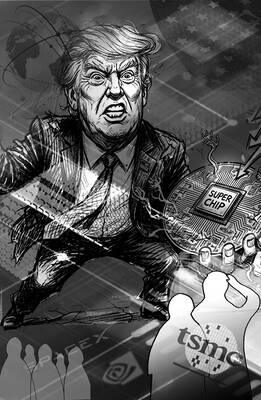
The White House’s decision to take a 9.9 percent stake in Intel Corp is looking like very shrewd business indeed. Since the government bought in at US$20.47 a share last August, the US chipmaker’s surging stock price has delivered the US a US$43 billion return. One of the reasons the investment has so far proved so sound is that the White House has made sure of it. According to The Wall Street Journal, Howard personally pushed deals on Intel’s behalf with some of the most lucrative clients imaginable. They include Nvidia Corp, the company at the heart of the AI
A single photograph can cut through a lot of noise, but it can also be used to misrepresent the truth. At the very least, it can concentrate the mind on something that requires further investigation. On Monday last week, Ma Ying-jeou Foundation CEO Tai Hsia-ling (戴遐齡) and former National Security Council secretary-general King Pu-tsung (金溥聰) held a news conference in which they showed a photograph of former foundation CEO Hsiao Hsu-tsen (蕭旭岑), now Chinese Nationalist Party (KMT) deputy chairman. In the image Hsiao is seated next to Xiamen Taiwan Businessmen Association chairman Han Ying-huan (韓螢煥). The two men were holding
I first met Professor Ray Jiing (井迎瑞) as a film and documentary student at Shih Hsin University’s (SHU) Department of Radio Television and Film in 1988. The following year, he went on to become the director of the Chinese Taipei Film Archive — forerunner of the Taiwan Film and Audiovisual Institute (TFAI). Over his eight-year tenure, Jiing rescued and restored over 200 classic Taiwanese films. In 1997, he established the Graduate Institute of Studies in Documentary and Film Archiving at Tainan National University of the Arts (TNNUA), and I joined the program in his third cohort of students. Beyond a
A recent report concerning a student who is suing his teacher posed the question in its headline: Does failing a student in two subjects constitute bullying? The college student in Chiayi County apparently sought NT$2 million (US$63,603) in state compensation, but a court dismissed the case. The first reaction of many might have been to ask: What has happened to students nowadays? Some say that teachers have lost their authority, while others say students are overindulged. Some even start reminiscing over the days when “whatever the teacher says goes.” However, the real issue might be overlooked if emotional reactions like that are the


 RSS
RSS