


May 20 marked President Ma Ying-jeou’s (馬英九) fifth year in office. Instead of seeing Ma give a speech like a president normally would on such an occasion, the public saw him nodding off at a Central Emergency Operation Center meeting.
However, if people could just show a little more sympathy and look at things from his perspective, the reason no speech was forthcoming was that the president did not really have any political achievements worthy of celebrating with the public.
Looking back over the past year or so, apart from a number of so-called “political reforms” that failed to win over the public, the most prominent things to have happened were the string of corruption scandals involving some of the president’s closest and most trusted aides.
These happened like a stack of dominos falling, with a shocking speed and number of people implicated.
Among the scandals that have affected his regime, the one attracting the most heated discussion was the ruling by the court of first instance on the corruption case involving former Executive Yuan secretary-general Lin Yi-shih (林益世).
This was because the verdict handed down by the three Taipei District Court judges on April 30 was a blatant attempt to protect a corrupt official and get him off the hook.
Under heavy pressure from the public, the Special Investigation Division of the Supreme Prosecutors’ Office appealed the sentence last month.
In their legal brief, prosecutors said that the nation should not be turned into a haven for elected representatives to promote their own greedy interests while using the excuse they are “serving voters.”
The brief also stated that the verdict could open the way for other legislators to follow in Lin’s footsteps because they believe they can do so with impunity.
Indeed, the judges who presided over Lin’s first hearing believed he was exempt under the Anti-Corruption Act (貪污治罪條例), because they said his lobbying actions had nothing to do with his official duties. This was even though he first served as the ruling Chinese Nationalist Party’s (KMT) caucus whip and then was promoted to Cabinet secretary-general, after failing to be re-elected.
Even more ridiculous was the judges’ decision that the more than NT$30 million (US$1 million) in alleged bribes were “gifts” to Lin and that the money should therefore be returned to him.
Such a verdict is tantamount to setting a recommended price for lobbying by legislators. They might as well put up a sign saying “price for lobbying” on the entrance to the legislature, and maybe even offer discounts to people who have more than one thing they need the help of a legislator to “settle.”
In 2011, Citizen’s Congress Watch published a special report on stopping corruption in the legislature, because legislators are more often than not the group easiest to entice with bribes.
This is why all policymaking processes and any political donations that legislators receive should be made transparent. This is the only way to stop corruption.
If a second ruling on Lin’s case were to uphold the same verdict, this could well indicate all levels of representative bodies are corruption bases from which elected representatives can accept openly as many bribes as they want.
If this happens, Ma will go down in history as having achieved nothing but bad, and the nation might as well post a slogan at the Taiwan Taoyuan International Airport that reads: “Welcome to the Republic of Corruption (ROC) — Taiwan.”
Ku Chung-hwa is a standing board member of Citizen’s Congress Watch.
Translated by Drew Cameron
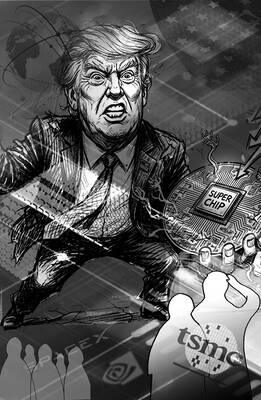
The White House’s decision to take a 9.9 percent stake in Intel Corp is looking like very shrewd business indeed. Since the government bought in at US$20.47 a share last August, the US chipmaker’s surging stock price has delivered the US a US$43 billion return. One of the reasons the investment has so far proved so sound is that the White House has made sure of it. According to The Wall Street Journal, Howard personally pushed deals on Intel’s behalf with some of the most lucrative clients imaginable. They include Nvidia Corp, the company at the heart of the AI
A single photograph can cut through a lot of noise, but it can also be used to misrepresent the truth. At the very least, it can concentrate the mind on something that requires further investigation. On Monday last week, Ma Ying-jeou Foundation CEO Tai Hsia-ling (戴遐齡) and former National Security Council secretary-general King Pu-tsung (金溥聰) held a news conference in which they showed a photograph of former foundation CEO Hsiao Hsu-tsen (蕭旭岑), now Chinese Nationalist Party (KMT) deputy chairman. In the image Hsiao is seated next to Xiamen Taiwan Businessmen Association chairman Han Ying-huan (韓螢煥). The two men were holding
I first met Professor Ray Jiing (井迎瑞) as a film and documentary student at Shih Hsin University’s (SHU) Department of Radio Television and Film in 1988. The following year, he went on to become the director of the Chinese Taipei Film Archive — forerunner of the Taiwan Film and Audiovisual Institute (TFAI). Over his eight-year tenure, Jiing rescued and restored over 200 classic Taiwanese films. In 1997, he established the Graduate Institute of Studies in Documentary and Film Archiving at Tainan National University of the Arts (TNNUA), and I joined the program in his third cohort of students. Beyond a
President William Lai Ching-te’s (賴清德) May 20 second-anniversary address was not just a routine policy review; it was damage control. US President Donald Trump’s remarks — that he did not want to see anyone move toward independence and that the delivery of a major Taiwan arms package could depend on the progress of US-China relations — unsettled Taiwan’s public and created an opening for opposition parties to question whether Taiwan was being treated as a bargaining chip in Washington’s dealings with Beijing. Lai’s speech was designed to close that opening. The address covered the expected ground: sovereignty, cross-strait relations, defense spending,


 RSS
RSS