


An important place to visit for all locals and foreigners interested in Taiwan’s history is the Jingmei Human Rights Memorial and Cultural Park.
Built as a prison in the late 1960s, Jingmei served as the primary detention center and court for political prisoners during the Chinese Nationalist Party’s (KMT) one-party state rule.
The park stands as a reminder of the disparities and double standards of justice that existed during the Martial Law and White Terror eras under the KMT.
However, for many people the double standards of that period have not been fully purged from the current judicial system.
Why? First, compare two cases from the past — those of writer Bo Yang (柏陽) and vice admiral Wang Hsi-ling (汪希苓), the former head of the Military Intelligence Bureau.
Bo Yang was tried in 1969 after translating a Popeye cartoon in a way that was said to satirize former Republic of China (ROC) president Chiang Kai-shek (蔣介石), Chiang Ching-kuo (蔣經國) and the KMT one-party state. He was found guilty and sent to Green Island (綠島).
While in Jingmei, Bo Yang’s cell measured 7 ping (23.14m2) and was shared with two other prisoners. All inmates slept on floor mats near an open toilet. Visitors to Jingmei had very limited access hours in a public room where they talked to prisoners through a glass wall via telephone.
Satire proved a very serious crime.
Contrast Yang’s case with that of admiral Wang.
Wang was found guilty of ordering the murder of dissident journalist Henry Liu (劉宜良) in California in 1984. If it had been simply a case of murder on Taiwanese soil, then Wang would probably have gotten away with it like those guilty of the murders of Lin I-hsiung’s (林義雄) family while Lin was a prisoner in Jingmei, or the 1984 murder of Chen Wen-chen (陳文成).
However, this particular murder was committed on foreign soil and the US government wanted answers and justice. Wang was found guilty, but got off lightly in his sentencing.
A special building was built at Jingmei to house Wang and his deputy. This “cell” was 37 ping and was separated from other prison buildings. Wang and his deputy each had their own bedroom, study with bookshelves, dining and greeting room and bathroom. Able to gaze out of the window of his study, Wang could always ask the guard stationed nearby to bring him anything he wished. Wang’s wife had daily conjugal access to his rooms.
It was a comfortable setup. Wang served two years there before being transferred to house arrest on Yangmingshan, where he served another three years before being freed.
For an alleged piece of satire, Bo Yang spent nine years in a crowded Green Island prison with no visitors. However, for ordering a man to be murdered Wang spent only two years in a restricted, but comfortable home.
After that he spent three years under house arrest in the mountains with daily visiting privileges at both locations. Outrageous yes, but that was during the Martial Law period and double standards were to be expected.
Fast-forward now to examine two recent trials which are not a case of satire versus murder, but where apparent double standards still exist.
They are the cases of former president Chen Shui-bian (陳水扁) and former Executive Yuan secretary-general Lin Yi-shih (林益世).
In the case of Chen Shui-bian, from the very beginning a vendetta appeared to be taking place as prosecutors pledged before the trial that they would resign if A-bian was not found guilty.
Then, prosecutors and judges — supposed to be adversaries in the courtroom — jointly mocked Chen Shui-bian in a Christmas party skit.
As the case progressed, Chen was denied privacy in meetings with his lawyers until a higher court declared that such a denial was illegal.
When a judge ruled that Chen could be freed on bail to prepare his case, that judge was replaced by one that refused bail.
In sharp contrast, in the Lin Yi-shih case, prosecutors and judges played separate roles and Lin, despite his conviction, was released on bail to prepare an appeal.
In the Chen Shui-bian case, the testimony of the state’s two main witnesses appears questionable and forced. Prosecutors badgered and bargained to get the witnesses to say what the prosecution wished — namely that political donations were in actuality bribes.
Witness Jeffrey Koo Jr (辜仲諒) said after the case that his statement that he bribed Chen was false, and was made under duress and the threat of imprisonment. Diana Chen (陳敏薰), another witness, was also coerced.
In effect, she was told that she would be prevented from getting a job in Taiwan unless she said what the prosecution wanted. Changing her testimony that the money given to Chen Shui-bian was not a political donation but a bribe, the court then gave her a suspended sentence for perjury.
Judges and prosecutors appeared to be working together against the defendant.
In the Lin Yi-shih case, there was no badgering of the key witness, Chen Chi-hsiang (陳啟祥).
Chen Chi-hsiang had come forward willingly after Lin had demanded an additional NT$83 million (US2.7 million) on top of the NT$63 million Chen Chi-hsiang had paid him to secure a slag treatment contract. In this case, the three district court judges sided not with the prosecution, but with Lin Yi-shih’s defense team using an “actual influence” concept to interpret the money paid as not being a bribe but simple “extortion,” therefore reducing the severity of the sentencing.
In Chen Shui-bian’s case questionable testimony was used to cast a wide net and accuse and punish anyone remotely involved in the case, including his wife, assistants and secretaries.
In the Lin Yi-shih case, the judges determined that only Lin was liable even though his mother, wife and uncles had tried to dispose of the money he had received.
These actions were “technically” interpreted as not being money laundering.
Again, in Chen Shui-bian’s case, judges worked with prosecutors to find the best ways of establishing guilt while in the Lin Yi-shih case, judges worked against prosecutors to look for pointers to his innocence.
In A-bian’s case, his family’s assets have been frozen beyond what was claimed as being bribes, while the prosecution searched for other ways to tie up the family’s money. In the Lin Yi-shih case, because of the court’s interpretation, the money he had acquired is all to be given back to him.
On comparing these two cases, Taiwanese may well ask whether justice has been served, or are the double standards of the KMT’s one-party state period alive and well?
Jerome Keating is a writer based in Taipei.

KMT Chairwoman Cheng Li-wun’s (鄭麗文) recent visit to Beijing and her upcoming visit to Washington will serve as a high-level test of her diplomatic mettle. In Beijing, Cheng was received with symbolic gestures, a warm reception, and high-level access. In Washington, she will receive far less pomp and far sharper questions about the KMT’s vision for the future of Taiwan. Her challenge will be to persuade Washington that the KMT’s engagement with China can coexist with strong deterrence. Cheng’s April 7-12 visit to mainland China coincided with an intense period of conflict in Iran. Despite the strategic significance of Cheng’s trip,

The closure of the Strait of Hormuz has sent the vast Asian chemicals industry into a tailspin. Deprived of the likes of Qatari natural gas and Saudi Arabian oil, the region’s fertilizer and plastics plants are slowing production or even shutting down. Everywhere except China, that is. In petrochemicals, China is unique. As well as a traditional industry that uses oil and gas as feedstock, it has parallel output that relies on its abundant domestic coal. Unsurprisingly, India and other regional powers want to copy and paste the Chinese method. This would not be easy — or climate friendly. The
Indonesian President Prabowo Subianto says he knows how to fix the problems facing Indonesia. Yet his economic mismanagement and authoritarian tendencies are steering the nation toward a familiar mix of currency instability and political chaos. The world’s fourth-most populous nation risks reversing the hard-won democratic and business reforms that came after the Asian Financial Crisis in 1997. At that time, the rupiah collapsed and the political upheaval that followed forced former president Haji Mohamed Suharto from power. Prabowo’s administration is ignoring similar warning signs. That disconnect was apparent in a national address on Wednesday, when Prabowo projected the swagger that has
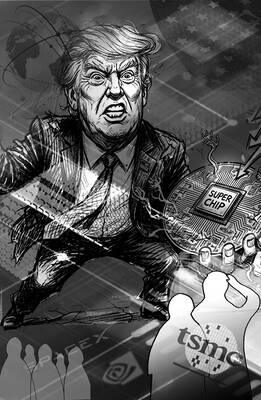
The White House’s decision to take a 9.9 percent stake in Intel Corp is looking like very shrewd business indeed. Since the government bought in at US$20.47 a share last August, the US chipmaker’s surging stock price has delivered the US a US$43 billion return. One of the reasons the investment has so far proved so sound is that the White House has made sure of it. According to The Wall Street Journal, Howard personally pushed deals on Intel’s behalf with some of the most lucrative clients imaginable. They include Nvidia Corp, the company at the heart of the AI


 RSS
RSS