


Thursday last week was International Mother Language Day, which aims to promote awareness of linguistic and cultural diversity. The event is of particular significance to Taiwan, where some communities’ mother tongues are facing decline or are threatened with extinction.
To mark the day, civic groups organized artistic and cultural activities aimed at raising interest in, and awareness of, mother languages. Some shops also played their part, for example by offering special discounts.
The Greater Kaohsiung City Government made posters and held a drama contest to encourage city residents to talk to each other in their mother tongues, and Democratic Progressive Party (DPP) Chairman Su Tseng-chang (蘇貞昌) said that to respect mother languages was to respect different communities’ cultures.
What these groups and enlightened individuals who care about Taiwan’s mother tongues have in common is that they stress that the most important place for a mother tongue to be handed down is in the home. It is very valuable for parents to speak to their children in their own languages, so that the next generation has greater exposure to and knowledge of it. That is how mother languages can be preserved, not just in Taiwan, but throughout the world.
UNESCO chose Feb. 21 to celebrate International Mother Language Day each year and its purpose is to show the world the importance of preserving linguistic assets. It serves not only to promote the dissemination of mother tongues and cherish plurality in languages and culture, as a way to prevent the disappearance of most of the world’s languages, but also to encourage new thinking and promote mutual understanding through exchanges of ideas and opinions.
It is important for the nation to cherish its mother tongues, because in 2001, UNESCO listed Taiwan as a place where some mother languages are on the verge of extinction.
According to internationally accepted standards, the nation’s dozen or so Aboriginal languages are all threatened. Apart from these, two other important mother tongues — Hoklo (commonly known as Taiwanese) and Hakka are also in decline and approaching a critical state whereby they may finally disappear.
Former vice premier Yeh Chu-lan (葉菊蘭), who was born in a Hakka village, once aptly described the crisis faced by mother tongues in Taiwan, saying that Aboriginal languages were already in intensive care, Hakka was in the emergency department and Hoklo was registering for treatment.
Mother languages in Taiwan are in critical condition, and outsider regimes that have ruled over the nation are the main culprits. The blame lies above all with the Chinese Nationalist Party (KMT) authorities that exercised authoritarian rule over the nation for a long period following the end of World War II.
During this period, the KMT authorities gave sole recognition to the “national language” — Mandarin Chinese — while the spoken and written languages of all other communities were labeled as “dialects” and suppressed. The use of languages other than Mandarin at public events and in the media was severely restricted, and Taiwan’s community languages were completely banned on school campuses.
Notably, the Romanized Hoklo Bible that was in use before the 1895 to 1945 half-century of Japanese rule, was banned, as was religious preaching in Hoklo.
Having killed, imprisoned or otherwise suppressed many of Taiwan’s educated elite following 1947’s 228 Incident, the KMT party-state apparatus made great efforts to repress Taiwan’s native languages and culture.
Such repression went on for a long time and the authorities did not shy from employing thuggish means to eradicate local tongues.
On school campuses, students were made to spy on each other, and those caught using their mother tongues were fined, disciplined and even humiliated by being forced to wear labels known as “dog tags.” Many people have painful memories of such things happening to them.
Similarly, community mother tongues were not accepted by government departments or used for bus and train announcements, and this created many obstacles for people who did not speak or understand Mandarin.
Another reason for the decline of mother languages was the KMT party-state’s control of the nation’s media. This was all the more true when televisions became commonplace in people’s homes. News, drama and variety shows were almost entirely “Mandarinized,” even to the extent of making the characters in traditional Taiwanese hand puppet theater speak the “national language.” As well as undermining mother languages, these policies engendered the view that Mandarin speakers were a cut above other people.
Gradually mother tongues lost their practical function and status in people’s daily lives.
In big cities and northern Taiwan especially, many people thought they were superior just because they spoke good Mandarin. Such attitudes, along with decades of stifling influence of the party-state apparatus, created a generation of parents who thought their children would be better off speaking Mandarin. Children gradually became estranged from their mother tongues, hence the precarious situation in which these languages now find themselves.
Efforts that are now being made to salvage the nation’s mother tongues are a product of Taiwan’s democratization.
During the 1990s, the government of then-president Lee Teng-hui (李登輝) said that discriminating against mother languages had been a mistake.
For the first time under KMT rule, mother languages were heard on school campuses.
After the DPP came to power in 2000, mother-tongue classes were introduced in elementary schools. Then-minister of education Tu Cheng-sheng (杜正勝) stipulated that elementary, high and senior-high schools should make one day a week “mother-language day.”
However, after the KMT returned to power in 2008, it made a sharp U-turn on these policies. Since then, the importance attached to mother-tongue education has been eroded. Reduced funding has led to weakened mother-language teaching.
President Ma Ying-jeou (馬英九) and his government were happy to spend more than NT$200 million (US$6.76 million) on the two-night musical extravaganza Dreamers (夢想家) to mark the centennial of the 1911 Chinese Revolution, yet they have cut funding for mother-language teaching. Consequently, Taiwan’s mother languages, which were still in a precarious situation when Ma took office, are now facing an even more serious crisis.
Taiwan is a society of immigrants. Its culture includes Austronesian, Han Chinese, Japanese and Western elements. A multiplicity of thriving mother languages is the best way to promote understanding, respect, tolerance and appreciation between communities.
In this age of globalization, it is a good thing to study a variety of languages, and learning one’s mother tongue is a good way to start out. Mastery of one’s mother language enhances personal growth, as well as social interaction.
While government authorities are duty-bound to ensure that mother languages can thrive, it is more important for families to play their part. If mother tongues are more often spoken at home, especially with their children, then they will take root in the family. Only then can Taiwanese culture continue to thrive and develop.
Translated by Julian Clegg
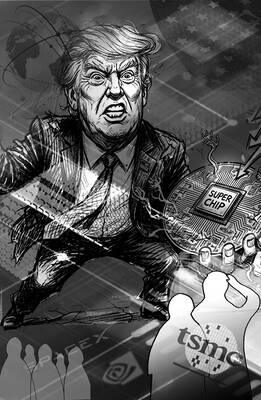
The White House’s decision to take a 9.9 percent stake in Intel Corp is looking like very shrewd business indeed. Since the government bought in at US$20.47 a share last August, the US chipmaker’s surging stock price has delivered the US a US$43 billion return. One of the reasons the investment has so far proved so sound is that the White House has made sure of it. According to The Wall Street Journal, Howard personally pushed deals on Intel’s behalf with some of the most lucrative clients imaginable. They include Nvidia Corp, the company at the heart of the AI
A single photograph can cut through a lot of noise, but it can also be used to misrepresent the truth. At the very least, it can concentrate the mind on something that requires further investigation. On Monday last week, Ma Ying-jeou Foundation CEO Tai Hsia-ling (戴遐齡) and former National Security Council secretary-general King Pu-tsung (金溥聰) held a news conference in which they showed a photograph of former foundation CEO Hsiao Hsu-tsen (蕭旭岑), now Chinese Nationalist Party (KMT) deputy chairman. In the image Hsiao is seated next to Xiamen Taiwan Businessmen Association chairman Han Ying-huan (韓螢煥). The two men were holding
I first met Professor Ray Jiing (井迎瑞) as a film and documentary student at Shih Hsin University’s (SHU) Department of Radio Television and Film in 1988. The following year, he went on to become the director of the Chinese Taipei Film Archive — forerunner of the Taiwan Film and Audiovisual Institute (TFAI). Over his eight-year tenure, Jiing rescued and restored over 200 classic Taiwanese films. In 1997, he established the Graduate Institute of Studies in Documentary and Film Archiving at Tainan National University of the Arts (TNNUA), and I joined the program in his third cohort of students. Beyond a
A recent report concerning a student who is suing his teacher posed the question in its headline: Does failing a student in two subjects constitute bullying? The college student in Chiayi County apparently sought NT$2 million (US$63,603) in state compensation, but a court dismissed the case. The first reaction of many might have been to ask: What has happened to students nowadays? Some say that teachers have lost their authority, while others say students are overindulged. Some even start reminiscing over the days when “whatever the teacher says goes.” However, the real issue might be overlooked if emotional reactions like that are the


 RSS
RSS