


If we want to learn about nuclear power safety here in Taiwan, we might find the answer in a simple plastic bottle.
President Ma Ying-jeou (馬英九) recently said that when it comes to the Fourth Nuclear Power Plant in Gongliao District (貢寮), New Taipei City (新北市), it is important to listen to people’s opinions, conduct thorough research, communicate, make careful decisions and carry out plans effectively. However, considering that the plant’s construction site does not even have a restroom, it is not likely that nuclear safety will ever become a reality in Taiwan.
More than two decades ago when I was interviewing people about the first three nuclear power plants, which had only been up and running for a few years, I discovered that the plants were plagued by the reactors randomly tripping.
Analysis of these incidents showed that, apart from the inevitable problems caused by natural events like earthquakes and typhoons, their biggest cause were things like malfunctioning circuit board control cards and overheating in the reactor units. Further analysis of these causes showed that many of the situations that were put down to “unknown causes” were actually due to “uric acid.”
What do circuit boards at a nuclear power plant have to do with uric acid? First I thought those problems were caused by mice, but later an engineer secretly told me that it was because there was no restroom at the plants’ construction sites, so workers would go to the toilet wherever they could — often against the walls. Their urine then turned into uric acid which seeped into and corroded the circuit boards. The result was irregular signals or lost control of the signals.
When a nuclear power plant trips, operations stop for several days. According to Taiwan Power Co (Taipower), the company loses NT$100 million (US$3.4 million) each day when a plant is down.
Forty years ago, sanitary and lifestyle habits were different, and lack of toilet facilities was in line with the times.
Here, I am reminded of a joke about a punctuation mark: There was once a house owner who became very frustrated because people were urinating on his wall so he put up a notice on the wall reading: “Pedestrians and others may not urinate here” (行人等不得在此小便). Little did he expect that the number of people urinating there would keep on increasing, because someone had added a comma to the original sentence, which changed the notice to: “Pedestrians who cannot hold on may urinate here” (行人等不得,在此小便).
I remembered this anecdote after the recent discussions about safety and the quality of construction at the Fourth Nuclear Power Plant.
I asked a person who had worked on the construction of the plant if there were toilets there. He gave me a wry smile and then sent me a photo, with a note that said the photo was taken at a section of the wall of one of the plant’s containment vessels.
I realized the picture was that of a plastic bottle cemented into the wall.
Things have indeed progressed since the time of the first three power plants: Workers now urinate into plastic bottles and throw them into the containment vessels while they are being filled with cement.
I am sure we could apply to the UN for World Heritage status for this plant. Apart from the plastic bottles and their contents, there is much other rubbish cemented into the wall and, regardless of whether we apply for World Heritage status or any other cultural status, we really should make sure that a record is kept of this.
The problems with the containment vessels at the plant do not stop there.
Broken rebars about 3cm thick have been found in the ninth shear wall. According to Atomic Energy Council (AEC, 原能會) records they have discovered 47 broken rebars in the shear wall of the containment vessels between the reactor and the fuel pool. This means there is a possibility that the shear wall is not structurally sound, and the number of broken rebars is likely to be higher than the AEC’s findings.
According to structural engineering standards, the shear wall should be knocked down and rebuilt.
However, construction of the plant is going ahead, and nothing has been torn down and rebuilt. Even worse, the AEC only issued a small fine of NT$300,000 to Taipower, without demanding any safety inspections or verifications.
Nuclear safety can be discussed anywhere in the world — but not in Taiwan, because nuclear safety does not exist here.
After almost 40 years of nuclear power, there has been no nuclear disaster. Statistically speaking, that is highly improbable. Ma does not necessarily have to listen humbly to the opinions of nuclear power opponents, nor does he have to spend money on bringing in foreign teams for certification purposes.
However, he has to take notice of the message about nuclear safety contained in that plastic bottle.
Jay Fang is the chairman of the Green Consumers’ Foundation.
Translated by Drew Cameron
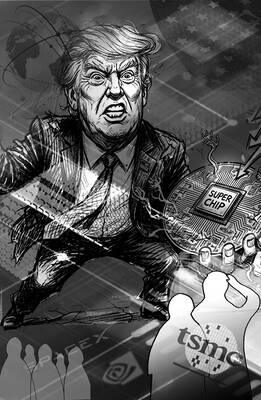
The White House’s decision to take a 9.9 percent stake in Intel Corp is looking like very shrewd business indeed. Since the government bought in at US$20.47 a share last August, the US chipmaker’s surging stock price has delivered the US a US$43 billion return. One of the reasons the investment has so far proved so sound is that the White House has made sure of it. According to The Wall Street Journal, Howard personally pushed deals on Intel’s behalf with some of the most lucrative clients imaginable. They include Nvidia Corp, the company at the heart of the AI
A single photograph can cut through a lot of noise, but it can also be used to misrepresent the truth. At the very least, it can concentrate the mind on something that requires further investigation. On Monday last week, Ma Ying-jeou Foundation CEO Tai Hsia-ling (戴遐齡) and former National Security Council secretary-general King Pu-tsung (金溥聰) held a news conference in which they showed a photograph of former foundation CEO Hsiao Hsu-tsen (蕭旭岑), now Chinese Nationalist Party (KMT) deputy chairman. In the image Hsiao is seated next to Xiamen Taiwan Businessmen Association chairman Han Ying-huan (韓螢煥). The two men were holding
I first met Professor Ray Jiing (井迎瑞) as a film and documentary student at Shih Hsin University’s (SHU) Department of Radio Television and Film in 1988. The following year, he went on to become the director of the Chinese Taipei Film Archive — forerunner of the Taiwan Film and Audiovisual Institute (TFAI). Over his eight-year tenure, Jiing rescued and restored over 200 classic Taiwanese films. In 1997, he established the Graduate Institute of Studies in Documentary and Film Archiving at Tainan National University of the Arts (TNNUA), and I joined the program in his third cohort of students. Beyond a
A recent report concerning a student who is suing his teacher posed the question in its headline: Does failing a student in two subjects constitute bullying? The college student in Chiayi County apparently sought NT$2 million (US$63,603) in state compensation, but a court dismissed the case. The first reaction of many might have been to ask: What has happened to students nowadays? Some say that teachers have lost their authority, while others say students are overindulged. Some even start reminiscing over the days when “whatever the teacher says goes.” However, the real issue might be overlooked if emotional reactions like that are the


 RSS
RSS