


A glance at history suggests it is easier for a Chinese woman to orbit Earth than to land a spot on the highest rung of Chinese politics.
In June, a 33-year-old air force major marked a major feminist milestone by becoming the first Chinese woman to travel in space. With a once-a-decade leadership transition set to start on Nov. 8, many are now waiting to see if another ambitious Chinese female, State Councilor Liu Yandong (劉延東), can win one of the nine spots at the apex of Chinese power.
Liu is a smiley 67-year-old with a degree in chemical engineering and a penchant for pearls and red lipstick. Her portfolios include education, sports and cultural affairs. Experts say she is well-connected and state media paints her as a diligent civil servant with a human touch.
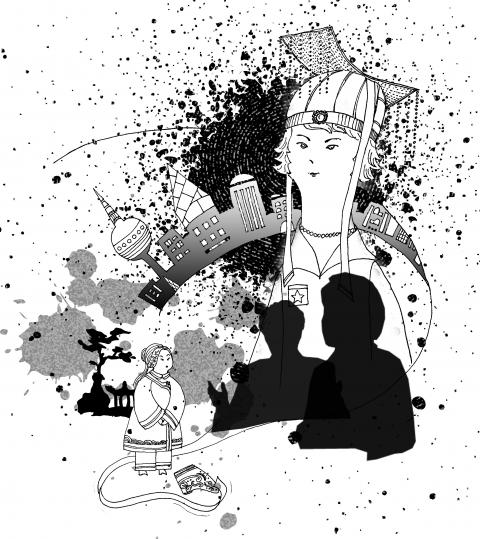
In May, she donned scrubs and stroked the forehead of a hospitalized teacher who lost her legs pushing two students away from an oncoming bus.
“You are so young, so beautiful,” state media quoted Liu as telling the teacher, Zhang Lili. “From now on, you can call me big sister.”
Leadership transitions only happen once a decade in China. This year, Liu is the only female with an outside chance of landing a position at the top, and if she does, she will have made history. However, rocketing into space seems simple compared to busting into the boys’ club of Chinese politics.
“It’s relatively easy to have a Chinese female astronaut because that’s only about winning glory for China and not about actually divvying up political power,” said Feng Yuan (馮媛), a Beijing-based women’s rights advocate.
There are quotas meant to boost participation of women in the political process, but they are not strictly enforced.
Since the founding of Communist China in 1949, no woman has ever served on the Politburo Standing Committee, the topmost leadership clique where major policy is set. Only two women have served as provincial party secretaries, powerful positions seen as stepping stones to national leadership posts.
Chinese former vice premier Wu Yi (吳儀 ) — known as the “Iron Lady” for her tough negotiating skills and ranked by Forbes as the second most powerful woman in the world in 2007 — failed to advance past the politburo, the group of about 25 from which standing committee members are recruited.
Willy Lam (林和立), a historian at Chinese University of Hong Kong, says the climb to power typically begins with a local leadership post that gets parlayed into jobs overseeing increasingly large constituencies until, ideally, one is running a province or a big city.
Those are the people who end up running China from the leafy, high-walled Zhongnanhai leadership compound in central Beijing.
However, to get those positions can be hard for a woman, for sometimes maddening reasons.
“To become a mayor of a big city or a governor of a province you have to be sort of one of the boys, you have to drink a lot and maybe womanize a bit and also be reasonably corrupt,” Lam said. “There’s no lack of corrupt women in China, but this to-be-one-of-the-boys phenomenon, I think, is holding some promising female cadres back.”
Feng, the Beijing rights advocate, has run training workshops on women’s rights around China. She says aspiring female politicians complain to her about the “drinking culture” in Chinese politics, but many say sexual politics also holds them back.
It is common for powerful Chinese men to have mistresses, which can make it difficult for women to curry favor or even cooperate with their male superiors without inviting suspicion.
One female deputy director of an agency told Feng that if she went to the office of her male boss to discuss work, he would typically stand at the door to talk to her. If they had to be in his office, he insisted on leaving the door open.
“This was to prevent rumors,” Feng said. “If you have to be that careful in day-to-day work, imagine how hard it would be to actually promote a female. People would talk, they would wonder about just how close the relationship was.”
Though China’s communists have done much to improve women’s lives by increasing their access to education, health care and jobs once reserved for men, they have failed to meaningfully increase women’s political participation.
Since the 1970s the number of women serving in China’s parliament has actually fallen, and less than a quarter of the Chinese Communist Party’s (CCP) members are women. Also, women typically get shunted into positions considered “women’s work,” such as family planning or public relations.
In 2009, female cadres accounted for just 11 percent of leadership positions at the ministerial or provincial level, 13.7 percent at the local and departmental level, and 16.6 percent in county-level offices. That was only slightly better than figures for 2000, which were 8 percent, 10.8 and 15.1 percent.
In the early days of Chinese Communist rule, the wives of Mao Zedong (毛澤東), Lin Biao (林彪) and Zhou Enlai (周恩來) were all given positions on the politburo, but their tenures did little to pave the way for other women.
Mao’s wife, Jiang Qing (江青), led a series of purges that, after Mao’s death in 1976, resulted in her being sentenced to death for counterrevolutionary crimes. Though some see Jiang as a cautionary tale against the ruthlessness of power-hungry females, she claimed she was only following orders.
“I was Chairman Mao’s dog. I bit whomever he asked me to bite,” Jiang told the court.
Pre-communist history offers similarly scant inspiration for aspiring female politicians. Annals are rife with scheming concubines who helped unseat emperors by distracting them with carnal pleasures, a perception that Hong Kong University history professor Zhou Xun says still lingers.
“Historically, women were quite often seen as trouble, as linked to the downfall of dynasties,” Zhou said.
The last woman to rule China, the Empress Dowager Cixi (慈禧太后), who died in 1908, is remembered as a leader who resisted reform and left China vulnerable to Japanese and western powers.
Today, the CCP’s intolerance for grassroots campaigning has left little room for the growth of a feminist movement that could bring women into the streets to demand equal pay for equal work or more female political participation.
One of the few independent Web forums dedicated to women’s issues, Feminst.cn, has been repeatedly shut down by authorities.
Liu is seen as a long shot for the standing committee, but there are a few other women competing for posts on the politburo, including corruption watchdog Ma Wen (馬文) and Fujian Party Secretary Sun Chunlan (孫春蘭) — only the second woman since 1949 to head a province as party secretary.
Cheng Li (李成), an expert in Chinese politics at the Brookings Institute, says one or two of them are likely to make it — a bleak horizon for women’s empowerment.
However, he says he expects more women to push their way into government in the coming 10 to15 years as younger women come of age with more education and social freedom than their mothers.
Feng says she has noticed more women trying to run as independent candidates at local government level, suggesting an awakening of political consciousness.
“We ought to be even more bold in our questioning and not just ask why there are no women on the standing committee but we ought to ask why there are no women competing for the post of Communist Party secretary or for prime minister,” Feng said.
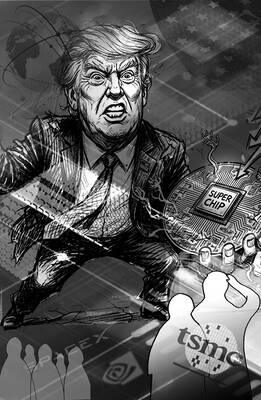
The White House’s decision to take a 9.9 percent stake in Intel Corp is looking like very shrewd business indeed. Since the government bought in at US$20.47 a share last August, the US chipmaker’s surging stock price has delivered the US a US$43 billion return. One of the reasons the investment has so far proved so sound is that the White House has made sure of it. According to The Wall Street Journal, Howard personally pushed deals on Intel’s behalf with some of the most lucrative clients imaginable. They include Nvidia Corp, the company at the heart of the AI
A single photograph can cut through a lot of noise, but it can also be used to misrepresent the truth. At the very least, it can concentrate the mind on something that requires further investigation. On Monday last week, Ma Ying-jeou Foundation CEO Tai Hsia-ling (戴遐齡) and former National Security Council secretary-general King Pu-tsung (金溥聰) held a news conference in which they showed a photograph of former foundation CEO Hsiao Hsu-tsen (蕭旭岑), now Chinese Nationalist Party (KMT) deputy chairman. In the image Hsiao is seated next to Xiamen Taiwan Businessmen Association chairman Han Ying-huan (韓螢煥). The two men were holding
I first met Professor Ray Jiing (井迎瑞) as a film and documentary student at Shih Hsin University’s (SHU) Department of Radio Television and Film in 1988. The following year, he went on to become the director of the Chinese Taipei Film Archive — forerunner of the Taiwan Film and Audiovisual Institute (TFAI). Over his eight-year tenure, Jiing rescued and restored over 200 classic Taiwanese films. In 1997, he established the Graduate Institute of Studies in Documentary and Film Archiving at Tainan National University of the Arts (TNNUA), and I joined the program in his third cohort of students. Beyond a
A recent report concerning a student who is suing his teacher posed the question in its headline: Does failing a student in two subjects constitute bullying? The college student in Chiayi County apparently sought NT$2 million (US$63,603) in state compensation, but a court dismissed the case. The first reaction of many might have been to ask: What has happened to students nowadays? Some say that teachers have lost their authority, while others say students are overindulged. Some even start reminiscing over the days when “whatever the teacher says goes.” However, the real issue might be overlooked if emotional reactions like that are the


 RSS
RSS