


Farmer Le Dung and his fellow villagers stockpiled rocks and petrol bombs to battle police trying to take over their land for a luxury property development near Vietnam’s capital city.
However, their most powerful weapon turned out to be the equipment they had set up with the help of Internet activists to record and broadcast the confrontation, which was ignored by the state-controlled media.
Within hours of the fight on a clear April morning, video of several thousand policemen firing tear gas and beating farmers in the Van Giang District just east of Hanoi had gone viral.
The unlikely alliance between farmers and urban Internet activists illustrates a rapidly evolving challenge to the Vietnamese Communist Party’s authority as Vietnamese grow bolder in their protests over issues ranging from land rights to corruption and China’s expanding regional influence.
The government has responded with a crackdown on bloggers that has earned it the title of “Enemy of the Internet” from media freedom group Reporters Without Borders, which says only China and Iran jail more journalists.
Censors in the one-party state routinely block Facebook and other social networking sites, although a nimble Web activist community often finds ways around them, illustrating the enormous challenge facing the government in a country where a third of the 88 million population is online.
“At first, we didn’t understand how it could help us, but now we see the value. Our struggle was published to the world,” said Le Dung, who fought in Vietnam’s 1979 war against China, as he sat under a framed picture of former Vietnamese communist leader Ho Chi Minh. “If we hadn’t used the Internet the authorities may have killed us; now they know they have to be careful.”
The Van Giang incident and other land disputes covered by bloggers have triggered an unusually heated national debate over how the government should reform Vietnam’s land laws before the expiry of farmers’ 20-year public land leases next year. Rapid economic growth has put pressure on farmers as industrial estates, houses and roads have expanded, leading to a rash of violent land conflicts. Farmers complain the compensation offers for their land are far too low from companies that often have ties to influential politicians.
Fish farmer Doan Van Vuon was catapulted to hero status early this year after he organized armed resistance to local authorities trying to take over his land near Hai Phong city, a case that was covered by official media as well as bloggers.
Bloggers are linking land with other causes they say have a common theme — a government that is beholden to powerful economic interests and unresponsive to popular demands.
“The blogging movement is growing stronger,” said Nguyen Van Dai, a lawyer and rights activist who was jailed for four years for using the Internet to call for democracy and who remains under a loose form of house arrest in Hanoi.
“The government can’t keep secrets like it could before,” Nguyen added.
One influential activist, who goes by the pseudonym Boris and works at a state-owned firm, helped educate the farmers at Van Giang about their rights and taught them how to send pictures and videos through cellphones. Although about 1,000 families there have so far failed to stop the 500-hectare Ecopark project, Boris said wide publicity from the incident had prevented other land developers going ahead with similar plans.
Boris, who boasts he could bring 1,000 people onto Hanoi’s streets at a day’s notice, said he had also played a key role in organizing regular protests against China’s territorial goals in the South China Sea — a claim backed by other bloggers. The government allowed anti-China protests to go ahead last year, but soon clamped down on them after it became clear they could be a lightning rod for broader discontent.
Some activists exhibit a boldness that is startling, considering the stiff jail terms that have been handed down to others for “anti-government propaganda.”
Alfonso Le, a 42-year-old blogger who writes the Homeland Arise blog, spoke to media at a tiny Hanoi cafe within earshot of a green-uniformed police officer across the room.
“Now that social networks are more popular, it’s not so easy for the police to arrest people,” said Le, using his Facebook nickname. “If the police make trouble, I just send a status message on Facebook and a lot of people will come.”
His activism has come at a price. He said he has been arrested three times and divorced his wife after she gave information to the police.
Another blogger, who asked not to be identified, also occupies the world of tolerated blogging. She believes she is safe as long as her writing stays within certain “red lines.” In her blog, a protest march might be described as a “parade” or a “walk.”
Still, she is sometimes followed by police and was arrested at an anti-China protest this month and kept for a day at a rehabilitation camp for “drug users and prostitutes.”
“They [the authorities] are scared to death after what has happened in Burma [Myanmar] and the Arab Spring,” she said.
Former military officer Le Thanh Tung became the latest online activist to be punished this month, receiving a five-year sentence after a trial that lasted an hour, according to Reporters Without Borders. That came less than a week after blogger Dinh Dang Dinh was handed a six-year sentence.
The trial of three other -prominent bloggers was postponed this month after the mother of one of them committed suicide by setting herself on fire.
Washington has voiced concern to Vietnam over a proposed new decree that would require Internet users to register with their real names, enabling the government to track its online critics more easily.
However, Carl Thayer, a Vietnam expert at the Australian Defence Force Academy, said the government’s attempts to control the Internet were probably futile given the Web’s deep penetration and bloggers’ talent for sidestepping technological barriers.
Vietnam has among the world’s fastest-growing rates of Internet use, according to market research firm Cimigo.
Internet penetration in Hanoi and the southern commercial capital Ho Chi Minh City has risen above 50 percent.
“It is a battle I don’t think the Vietnamese government is going to win,” Thayer said.
The thorny problem of land rights, which goes to the heart of the Vietnames Communist Party’s legitimacy in its traditional power base of more than 10 million farmers, is where the bloggers have had the biggest impact.
In the wake of the Van Giang and Hai Phong violence, some lawmakers and academics have called for private land ownership to help protect farmers — an unthinkable proposal until recently in a country where the state’s ownership of all land is enshrined in the constitution.
Nguyen Duc Kien, the vice chairman of the Vietnamese National Assembly’s economic committee, told reporters the country’s Land Law would be revised and that farmers would be allowed to remain on their land after next year. Interpreted literally, the current law allows the state to take back farms without any compensation at the end of the lease period.
“Land is an issue that is a potential cause of tension in society,” he said.
Nguyen’s and other comments from officials have convinced blogger activists that the leases will be extended, although that in itself will not resolve the problem of land grabs by private developers backed by the state.
“The bloggers were a big part of that,” blogger Le said. “We told a different side of the story. We showed that the ruling party’s words don’t match its actions.”
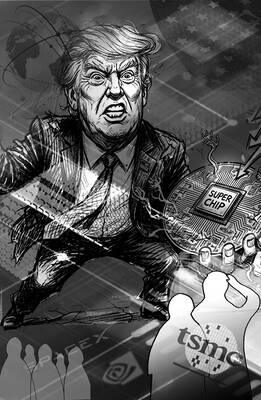
The White House’s decision to take a 9.9 percent stake in Intel Corp is looking like very shrewd business indeed. Since the government bought in at US$20.47 a share last August, the US chipmaker’s surging stock price has delivered the US a US$43 billion return. One of the reasons the investment has so far proved so sound is that the White House has made sure of it. According to The Wall Street Journal, Howard personally pushed deals on Intel’s behalf with some of the most lucrative clients imaginable. They include Nvidia Corp, the company at the heart of the AI
A single photograph can cut through a lot of noise, but it can also be used to misrepresent the truth. At the very least, it can concentrate the mind on something that requires further investigation. On Monday last week, Ma Ying-jeou Foundation CEO Tai Hsia-ling (戴遐齡) and former National Security Council secretary-general King Pu-tsung (金溥聰) held a news conference in which they showed a photograph of former foundation CEO Hsiao Hsu-tsen (蕭旭岑), now Chinese Nationalist Party (KMT) deputy chairman. In the image Hsiao is seated next to Xiamen Taiwan Businessmen Association chairman Han Ying-huan (韓螢煥). The two men were holding
I first met Professor Ray Jiing (井迎瑞) as a film and documentary student at Shih Hsin University’s (SHU) Department of Radio Television and Film in 1988. The following year, he went on to become the director of the Chinese Taipei Film Archive — forerunner of the Taiwan Film and Audiovisual Institute (TFAI). Over his eight-year tenure, Jiing rescued and restored over 200 classic Taiwanese films. In 1997, he established the Graduate Institute of Studies in Documentary and Film Archiving at Tainan National University of the Arts (TNNUA), and I joined the program in his third cohort of students. Beyond a
A recent report concerning a student who is suing his teacher posed the question in its headline: Does failing a student in two subjects constitute bullying? The college student in Chiayi County apparently sought NT$2 million (US$63,603) in state compensation, but a court dismissed the case. The first reaction of many might have been to ask: What has happened to students nowadays? Some say that teachers have lost their authority, while others say students are overindulged. Some even start reminiscing over the days when “whatever the teacher says goes.” However, the real issue might be overlooked if emotional reactions like that are the


 RSS
RSS