


Over the past 30 years China’s economic, social and political rise has astounded the world.
China’s economic growth has enabled hundreds of millions of people to rise out of poverty and has engendered the largest increase in living standards for the largest number of people in world history. These are without doubt good things.
China’s economic growth has also led the country to seek a larger role in the global political system and to invest heavily in a military commensurate with that role. While these are not, in and of themselves, negative developments, they do pose challenges for other countries.
No country is more attuned to or sensitive to these challenges than Taiwan. As Taiwan continues to carefully navigate its relationship with China, no friendly country is more crucial to Taiwan than the US and no relationship in the region is a more important bellwether of Washington’s commitment to its friends, allies and ideals than its relationship with Taiwan.
Fortunately for Taiwan and its people the country has many friends in Washington.
Taiwan’s democracy, vibrant civil society, free economic system and openness make it both easy to like and a model for other countries undergoing political, economic and social transformation — not only in Asia, but throughout the world.
Despite this strong basis of friendship and mutual understanding and the shared values of democracy, free enterprise and liberalism, the US-Taiwan relationship is facing some serious headwinds. Over the past 30 years Taiwan has received less and less attention in the US.
In many ways this is a result of Taiwan’s own success in developing a robust democracy.
Issues such as human rights abuses, political repression and even assassination that once got great attention in the US are no longer significant problems in Taiwan.
Furthermore, Taiwan’s own government authorities, media and non-governmental organizations are now empowered to address those issues and do so with great energy and dedication.
China’s dramatic changes over the past 30 years and the evolution in US-China relations have also led to less attention being paid to Taiwan by Americans.
While the American Institute in Taiwan continues to do nearly everything that is normally done by a US embassy and programs such as the Fullbright Fellowship and the Luce Fellowship continue to send young Americans to Taiwan, the overwhelming shift of attention to China has led to a marginalization of Taiwan. Neither the New York Times nor the Washington Post maintains a bureau in Taiwan. They cover Taiwan (only sporadically) from Hong Kong, Shanghai or Beijing.
More worrying, and likely with longer term consequences for Taiwan’s security, is the decline in interest on the part of young Americans — the next generation of US government officials, professors, policymakers and others — in studying in Taiwan.
Through the 1950s, 1960s, 1970 and 1980s and even the early 1990s many — perhaps most — young Americans interested in Chinese language and Chinese-speaking regions spent some significant period of time in Taiwan.
Whether as English teachers, military officers, diplomats, graduate students or researchers, a large proportion of the US’ Asia specialists — and the overwhelming majority of China specialists — spent time in Taiwan.
For many of course it was a Taiwan very different from the Taiwan we know today.
Recently I spoke with my college professor of East Asian history. He studied Mandarin at National Taiwan University in the early 1970s and has returned to Taiwan every few years since then. He remembered a Taiwan where US graduate students had to enter a special locked room to read literature and China news items that were off limits to most people in Taiwan. At the same time, he experienced a Taiwan that was largely pro-US and that respected religious freedom and free enterprise.
Over the course of years, Taiwan changed, evolved and democratized. Taiwan became a leading force for democracy in Asia and an example of peaceful democratic transformation for other countries. In watching Taiwan change and evolve, US Asia specialists like my former professor developed an appreciation for what Taiwan has accomplished in building the first democracy in the Chinese-speaking world and establishing a vibrant civil society and a system that respects political, religious and economic freedom. For them Taiwan has provided a valuable and living counter to Beijing’s claims that Chinese-based cultures are ill suited to democracy, religious freedom or a free press.
My history professor’s experience of Taiwan is not unusual; it is typical among China and Asia specialists of his generation. So too is an enduring respect for Taiwan, an appreciation for what Taiwan has accomplished and an inclination to keep Taiwan and Taiwan’s concerns in mind when forming US policy toward Asia.
Unfortunately for US-Taiwan relations and Taiwan, the generation of Americans with meaningful Taiwan experience is fast passing from the scene. Since the 1990s US students interested in Mandarin and regional affairs have chosen overwhelmingly to study in China.
Study in China is certainly important in developing the next generation of US Asia experts. Unlike Americans before the 1980s, US students today are fortunate now to be able to spend time in China as teachers, language students, researchers and so forth. And about 15,000 US students each year choose to take advantage of this openness and do study in China.
According to the most recent US State Department figures available, the number of Americans studying in China grew 30 percent annually from 2001 to 2007.
Not only are US students focusing their attention on China, but China itself has been very aggressive and innovative in attracting foreign students and US authorities have also been proactive in promoting exchange programs.
In November 2009, US President Barack Obama announced the “100,000 Strong” initiative, designed to increase dramatically the number of US students studying in China. According to the State Department’s Web site: “The Chinese government strongly supports the initiative and has already committed 10,000 ‘Bridge Scholarships’ for American students to study in China. This initiative seeks to prepare the next generation of American experts on China who will be charged with managing the growing political, economic and cultural ties between the United States and China.”
This is not simply an issue of concern to academics or people who value international education. It is having and will continue to have real ramifications for Taiwan and US-Taiwan relations.
The overwhelming focus on China and consequent lack of interest in studying in Taiwan means that the next generation of US Asia experts will lack meaningful exposure to Taiwan and first-hand knowledge of Taiwan’s pluralist democracy, vibrant civil society and religious freedoms.
Perhaps more worrisome for Taiwan, they will also lack first-hand knowledge of Taiwan’s international concerns and regional security issues. Considering that the US is Taiwan’s primary security guarantor, this reduced attention could have dire consequences in the not-too-distant future.
In some ways it is happening already. A few years back a friend of mine served at the US Department of Defense. He would often take part in inter-agency roundtable meetings on cross-strait issues. These are meetings that bring together country managers from the different US government agencies — the State Department, Treasury Department, CIA, Department of Defense and so forth. Generally about 10 or 12 people would take part in each meeting. When my friend started his job and first started taking part in the meetings there were usually three or four people that would remind the group to keep the US-Taiwan relationship in mind and to take into account Taiwan’s interests and concerns.
By the time my friend’s assignment ended three years later he said that there was only one person left who showed concern for Taiwan’s interests and US-Taiwan relations — that was my friend himself. The rest of the officers had retired and been replaced by younger staffers that were more inclined to focus on US-China relations and to view Taiwan as little more than a troublesome impediment to better relations with Beijing.
The worrisome trend is that more US officials will overlook Taiwan and Taiwan’s concerns and will increasingly view Taiwan and cross-strait issues through Beijing’s lens. This is the view that they will have been exposed to over and over during their time living, working and studying in China. It is a view of Taiwan that downplays Taiwan’s thriving democratic system, closely fought elections and free press. It is a view that denies the Taiwanese complex feelings on their national identity. And it is a view that flatly dismisses the reasons for Taiwan’s deep wariness toward unification with the People’s Republic of China and its one-party state.
Certainly, there is no reason to discourage Americans from studying in China, but Taiwanese and US policymakers, as well as others concerned with US-Taiwan relations, need to ensure that Taiwan is not left by the wayside. Proactive policies to encourage the next generation of policymakers in the US and elsewhere to know Taiwan are crucial.
Taiwan and Taiwan’s friends in the US need to think beyond traditional language scholarships to develop innovative new programs introducing Taiwan to future policymakers and thought leaders.
The privately funded Robert Bosch Foundation Fellowship Program has successfully introduced generations of US public policy leaders to modern Germany, while the Mike Mansfield Fellowships to Japan have, since 1994, trained many of the US government’s leading Japan hands.
Similarly creative and innovative programs are desperately needed in the US-Taiwan relationship to ensure that knowledge of Taiwan and support for Taiwan remains as fulsome in the US going forward as it has been thus far.
Richard Pearson is managing director of the Cross Pacific Center and writes frequently on US foreign policy and US-Asia relations issues.
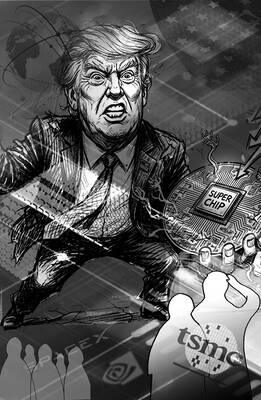
The White House’s decision to take a 9.9 percent stake in Intel Corp is looking like very shrewd business indeed. Since the government bought in at US$20.47 a share last August, the US chipmaker’s surging stock price has delivered the US a US$43 billion return. One of the reasons the investment has so far proved so sound is that the White House has made sure of it. According to The Wall Street Journal, Howard personally pushed deals on Intel’s behalf with some of the most lucrative clients imaginable. They include Nvidia Corp, the company at the heart of the AI
The Ministry of the Interior, working with the navy and coast guard, is organizing Taiwan’s first joint exercise simulating escort tankers carrying liquefied natural gas (LNG) and oil through a Chinese blockade. The drills simulate fuel transport along three maritime corridors leading toward Japan, the Philippines and the US. Deputy Minister of the Interior Sawyer Mars (馬士元) said that a blockade of the Taiwan Strait would amount to “almost a 100 percent blockade of the regional energy supply.” Minister of National Defense Wellington Koo said planning to counter a blockade is standard practice in Taipei. While the exercise is limited in
A single photograph can cut through a lot of noise, but it can also be used to misrepresent the truth. At the very least, it can concentrate the mind on something that requires further investigation. On Monday last week, Ma Ying-jeou Foundation CEO Tai Hsia-ling (戴遐齡) and former National Security Council secretary-general King Pu-tsung (金溥聰) held a news conference in which they showed a photograph of former foundation CEO Hsiao Hsu-tsen (蕭旭岑), now Chinese Nationalist Party (KMT) deputy chairman. In the image Hsiao is seated next to Xiamen Taiwan Businessmen Association chairman Han Ying-huan (韓螢煥). The two men were holding
I first met Professor Ray Jiing (井迎瑞) as a film and documentary student at Shih Hsin University’s (SHU) Department of Radio Television and Film in 1988. The following year, he went on to become the director of the Chinese Taipei Film Archive — forerunner of the Taiwan Film and Audiovisual Institute (TFAI). Over his eight-year tenure, Jiing rescued and restored over 200 classic Taiwanese films. In 1997, he established the Graduate Institute of Studies in Documentary and Film Archiving at Tainan National University of the Arts (TNNUA), and I joined the program in his third cohort of students. Beyond a


 RSS
RSS