


The Olympic Games this year glimmer on London’s horizon, but the Games are more than a smiley-faced sportstopia. The cost of hosting the Olympics has skyrocketed while private funding has evaporated, leaving the British government holding the fiscal bag. Meanwhile, security officials have the green light to militarize the public sphere. The Games have become the pure-grade expression of celebration capitalism, the feelgood complement to Naomi Klein’s “disaster capitalism.”
Host cities routinely underestimate the costs and overstate the benefits of the Games. London is no exception. The city’s bid proclaimed: “Every sector of the economy will benefit from the staging of the Olympic Games.” Originally slated to cost about £2.4 billion (US$3.81 billion), Olympic costs had jumped to £9.3 billion by 2007. The UK’s National Audit Office noted that public sector funding has almost tripled, while private-sector contributions dwindled to less than 2 percent. Recently, the House of Commons’ public accounts committee revealed costs were “heading for about £11 billion.” Meanwhile, Olympics critic Julian Cheyne of Games Monitor calculates costs at £13 billion. A Sky Sports investigation included public-transport upgrade costs, catapulting the five-ring price tag to £24 billion.
The public-pays-private-bails theme crystalized in the construction of the Olympic village. Originally envisaged as a £1 billion centerpiece of London 2012’s urban regeneration plan, the village was to be financed by Australian developer Lend Lease. (The deal reeked of cronyism — David Higgins, the chief executive of the Olympic Delivery Authority until February last year, previously headed Lend Lease.) However, the 2008 economic collapse and credit crunch led private capital to abandon the project, leaving it to the British government. In spring 2009, Olympics honchos admitted the village would be “fully nationalized” — that is, paid for by taxpayers.
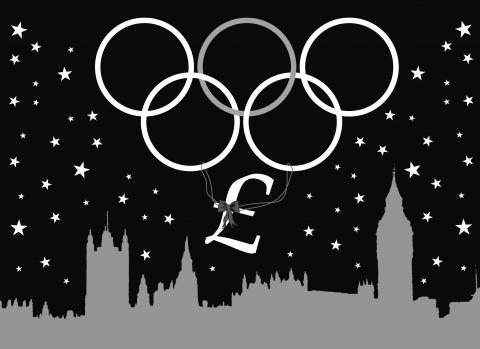
Olympics history is marked by the production of metropolitan jungles teeming with white elephants. London organizers were anxious not to add to the herd, so in August last year they sold the village at a taxpayer loss of £275 million to the Qatari ruling family’s property firm. Quizzically, British Secretary of State for Culture, Olympics, Media and Sport Jeremy Hunt championed the transaction as a “fantastic deal that will give taxpayers a great return and shows how we are securing a legacy from London’s Games.” Such surreptitious subsidies are standard practice with Olympic-induced urban development. Host governments have the incentive to backstop projects to avoid embarrassment on the global stage, while private firms punt responsibility when the going gets tough.
Meanwhile, security officials are exploiting the Olympics as a once-in-a-generation opportunity to multiply and militarize their weapons stocks, laminating another layer on to the surveillance state. The Games justify a security architecture to prevent terrorism, but that architecture can double to suppress or intimidate acts of political dissent. The Olympic Charter actually prohibits political activism, stating, “no kind of demonstration or political, religious or racial propaganda is permitted in any Olympic sites, venues or other areas.” What “other areas” means is open to broad interpretation. So despite Olympics human-rights rhetoric, the charter dictates — if indirectly — that local authorities squelch political activism. On cue, London police recently vowed to scour social media to sniff out any organized protests or disruptions.
The Olympics will militarize London, with surface-to-air missiles at the ready, a Royal Navy battleship moored offshore and soldiers on patrol. After initially estimating 10,000 security guards would suffice, the London organizing committee determined more than double that number would be required. The UK Ministry of Defence is filling the gap with about 13,500 military personnel, 4,000 more than are currently based in Afghanistan. Not placated, the US declared it would send its own security to London, including 500 FBI agents.
The Olympics afford an opportunity to test-drive high-tech equipment in an urban setting. Lightweight aerial drones will hover above while “combined firearms response teams” — elite police units replete with snipers — roam below. Thus London 2012 will tender a legacy not touted in bid materials: a repression-ready security state. The military-grade technologies secured during the Olympics-induced state of exception become normalized for workaday policing in the wake of the Games. And this repressive urbanism is expensive: £1 billion and counting.
In The Shock Doctrine: The Rise of Disaster Capitalism, Naomi Klein explains how capitalists unabashedly capitalize on catastrophe. Disasters create collective states of shock that soften us up to the point where we hand over what we would otherwise ardently defend. In the wake of disaster, while the general population reels in chaos, corporations and their government collaborators ransack the public sphere and slosh thick dollops of neoliberal policy on to the public’s plate.
The 2012 London Olympics are shaping up like a gold-medal playbook for “celebration capitalism” — disaster capitalism’s affable cousin. Both occur in states of exception that allow plucky politicos and their corporate pals to push policies they would not dream of during normal times. However, while disaster capitalism eviscerates the state, celebration capitalism manipulates state actors as partners, pushing economics rooted in so-called public-private partnerships. All too often these public-private partnerships are lopsided: The public pays and the private profits. In a bait and switch that is swaddled in bonhomie, the public takes the risks and private groups scoop up the rewards.
The Olympics promise to conjure athletic dexterity and scintillating competition. However, like it or not, other games are in the works — Olympics bigwigs are uncorking celebration capitalism.
Jules Boykoff is an associate professor of political science at Pacific University in Oregon.
Copyright: Guardian News & Media 2012
Two sets of economic data released last week by the Directorate-General of Budget, Accounting and Statistics (DGBAS) have drawn mixed reactions from the public: One on the nation’s economic performance in the first quarter of the year and the other on Taiwan’s household wealth distribution in 2021. GDP growth for the first quarter was faster than expected, at 6.51 percent year-on-year, an acceleration from the previous quarter’s 4.93 percent and higher than the agency’s February estimate of 5.92 percent. It was also the highest growth since the second quarter of 2021, when the economy expanded 8.07 percent, DGBAS data showed. The growth
In the intricate ballet of geopolitics, names signify more than mere identification: They embody history, culture and sovereignty. The recent decision by China to refer to Arunachal Pradesh as “Tsang Nan” or South Tibet, and to rename Tibet as “Xizang,” is a strategic move that extends beyond cartography into the realm of diplomatic signaling. This op-ed explores the implications of these actions and India’s potential response. Names are potent symbols in international relations, encapsulating the essence of a nation’s stance on territorial disputes. China’s choice to rename regions within Indian territory is not merely a linguistic exercise, but a symbolic assertion
More than seven months into the armed conflict in Gaza, the International Court of Justice ordered Israel to take “immediate and effective measures” to protect Palestinians in Gaza from the risk of genocide following a case brought by South Africa regarding Israel’s breaches of the 1948 Genocide Convention. The international community, including Amnesty International, called for an immediate ceasefire by all parties to prevent further loss of civilian lives and to ensure access to life-saving aid. Several protests have been organized around the world, including at the University of California Los Angeles (UCLA) and many other universities in the US.
Every day since Oct. 7 last year, the world has watched an unprecedented wave of violence rain down on Israel and the occupied Palestinian Territories — more than 200 days of constant suffering and death in Gaza with just a seven-day pause. Many of us in the American expatriate community in Taiwan have been watching this tragedy unfold in horror. We know we are implicated with every US-made “dumb” bomb dropped on a civilian target and by the diplomatic cover our government gives to the Israeli government, which has only gotten more extreme with such impunity. Meantime, multicultural coalitions of US


 RSS
RSS