


Every so often someone asks me: “What is your favorite country other than your own?”
I have always had the same answer: Taiwan.
“Taiwan? Why Taiwan?” everyone asks.
Very simple: Because Taiwan is an island in a typhoon-laden sea with no natural resources to live off of — it even has to import sand and gravel from China for construction — yet it has the fourth-largest financial reserves in the world. Because rather than digging in the ground and mining whatever comes up, Taiwan has mined its 23 million people, their talent, energy and intelligence — men and women.
I always tell my friends in Taiwan: “You are the luckiest people in the world. How did you get so lucky? You have no oil, no iron ore, no forests, no diamonds, no gold, just a few small deposits of coal and natural gas — and because of that you developed the habits and culture of honing your people’s skills, which turns out to be the most valuable and only truly renewable resource in the world today. How did you get so lucky?”
That, at least, was my gut instinct. However, now we have proof.
A team from the Organisation for Economic Cooperation and Development (OECD) has just come out with a fascinating little study mapping the correlation between performance on the Program for International Student Assessment (PISA) exam — which every two years tests math, science and reading comprehension skills of 15-year-olds in 65 countries — and the total earnings on natural resources as a percentage of GDP for each participating country. In short, how well do your high school kids do on math compared with how much oil you pump or how many diamonds you dig?
The results indicated that there was a “a significant negative relationship between the money countries extract from national resources and the knowledge and skills of their high school population,” said Andreas Schleicher, who oversees the PISA exams for the OECD. “This is a global pattern that holds across 65 countries that took part in the latest PISA assessment.”
Oil and the PISA do not mix. (See the data map at www.oecd.org/dataoecd/43/9/49881940.pdf)
As the Bible says, Schleicher added: “Moses arduously led the Jews for 40 years through the desert — just to bring them to the only country in the Middle East that had no oil. But Moses may have gotten it right, after all. Today, Israel has one of the most innovative economies and its population enjoys a standard of living most of the oil-rich countries in the region are not able to offer.”
So hold the oil and pass the books.
According to Schleicher, in the latest PISA results, students in Singapore, Finland, South Korea, Hong Kong and Japan stand out as having high PISA scores and few natural resources, while Qatar and Kazakhstan stand out as having the highest oil rents and the lowest PISA scores. (Saudi Arabia, Kuwait, Oman, Algeria, Bahrain, Iran and Syria stood out the same way in a similar 2007 Trends in International Mathematics and Science Study test, while, interestingly, students from Lebanon, Jordan and Turkey — also Middle East states with few natural resources — scored better.)
Also lagging in recent PISA scores were students in many of the resource-rich countries of Latin America, such as Brazil, Mexico and Argentina. Africa was not tested.
Canada, Australia and Norway — countries that also have high levels of natural resources — still score well on PISA, in large part, Schleicher said, because all three countries have established deliberate policies of saving and investing these resource rents and not just consuming them.
Add it all up and the numbers say that if you really want to know how a country is going to do in the 21st century, do not count its oil reserves or gold mines, count its highly effective teachers, involved parents and committed students.
“Today’s learning outcomes at school are a powerful predictor for the wealth and social outcomes that countries will reap in the long run,” Schleicher said.
Economists have long known about “Dutch disease,” which happens when a country becomes so dependent on exporting natural resources that its currency soars in value and, as a result, its domestic manufacturing gets crushed as cheap imports flood in and exports become too expensive.
What the PISA team is revealing is a related disease: Societies that get addicted to their natural resources seem to develop parents and young people who lose some of the instincts, habits and incentives for doing homework and honing skills.
By contrast, “in countries with little in the way of natural resources — Finland, Singapore or Japan — education has strong outcomes and a high status, at least in part because the public at large has understood that the country must live by its knowledge and skills and that these depend on the quality of education,” Schleicher said.
“Every parent and child in these countries knows that skills will decide the life chances of the child and nothing else is going to rescue them, so they build a whole culture and education system around it,” he said.
Or as my Indian-American friend K.R. Sridhar, the founder of the Silicon Valley fuel-cell company Bloom Energy, likes to say: “When you don’t have resources, you become resourceful.”
That is why the foreign countries with the most companies listed on the NASDAQ are Israel, China/Hong Kong, Taiwan, India, South Korea and Singapore — none of which can live off natural resources.
However, there is an important message for the industrialized world in this study, too. In these difficult economic times, it is tempting to buttress our own standards of living today by incurring even greater financial liabilities for the future.
To be sure, there is a role for stimulus in a prolonged recession, but “the only sustainable way is to grow our way out by giving more people the knowledge and skills to compete, collaborate and connect in a way that drives our countries forward,” Schleicher said.
“Knowledge and skills have become the global currency of 21st century economies, but there is no central bank that prints this currency. Everyone has to decide on their own how much they will print,” Schleicher added.
Sure, it is great to have oil, gas and diamonds; they can buy jobs. However, they will weaken your society in the long run unless they are used to build schools and a culture of lifelong learning.
“The thing that will keep you moving forward,” Schleicher said, is always “what you bring to the table yourself.”
Thomas Friedman is a columnist for the New York Times and a Pulitzer Prize-winning author. This piece first appeared in the New York Times.
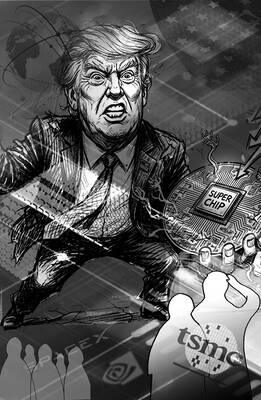
The White House’s decision to take a 9.9 percent stake in Intel Corp is looking like very shrewd business indeed. Since the government bought in at US$20.47 a share last August, the US chipmaker’s surging stock price has delivered the US a US$43 billion return. One of the reasons the investment has so far proved so sound is that the White House has made sure of it. According to The Wall Street Journal, Howard personally pushed deals on Intel’s behalf with some of the most lucrative clients imaginable. They include Nvidia Corp, the company at the heart of the AI
In a Taiwanese university classroom, a lecturer asks in English: “Can anyone give me an example from Taiwan?” Students look down. No one answers. After class, one student writes on the course platform in Mandarin: “I understood the concept, but I didn’t know how to answer in English.” That moment highlights a key issue in Taiwan’s English-medium instruction (EMI) reform: It is not just about more English-taught courses, but whether students can learn, participate and belong. EMI expansion is part of the Bilingual 2030 policy and the Ministry of Education’s BEST Program, aiming to improve English ability, support EMI teaching
The Ministry of the Interior, working with the navy and coast guard, is organizing Taiwan’s first joint exercise simulating escort tankers carrying liquefied natural gas (LNG) and oil through a Chinese blockade. The drills simulate fuel transport along three maritime corridors leading toward Japan, the Philippines and the US. Deputy Minister of the Interior Sawyer Mars (馬士元) said that a blockade of the Taiwan Strait would amount to “almost a 100 percent blockade of the regional energy supply.” Minister of National Defense Wellington Koo said planning to counter a blockade is standard practice in Taipei. While the exercise is limited in
A single photograph can cut through a lot of noise, but it can also be used to misrepresent the truth. At the very least, it can concentrate the mind on something that requires further investigation. On Monday last week, Ma Ying-jeou Foundation CEO Tai Hsia-ling (戴遐齡) and former National Security Council secretary-general King Pu-tsung (金溥聰) held a news conference in which they showed a photograph of former foundation CEO Hsiao Hsu-tsen (蕭旭岑), now Chinese Nationalist Party (KMT) deputy chairman. In the image Hsiao is seated next to Xiamen Taiwan Businessmen Association chairman Han Ying-huan (韓螢煥). The two men were holding


 RSS
RSS