


Taiwanese have been shocked by media reports about a sex party held in a train carriage. Because the people who booked the carriage got together through the Internet and an underage girl allegedly played the “female lead” at the party, children’s welfare groups are once again calling for stricter controls to be imposed on the Internet. Some are even calling for a Taiwanese version of China’s “Great Firewall” to block overseas Web sites that carry undesirable content.
These ideas about Internet control are not in themselves impractical, and, at least from a purely theoretical point of view, such as may be held by people who do not use the Internet very much, there is nothing wrong with them — except of course that they would make Taiwan a laughing stock. One thing people might ask is: Why not also impose controls on mobile phones, since they are also sometimes used as instruments of crime?
The online business environment in Taiwan is pretty bad, the main reason being that the power to make policies and speak out about Internet issues is mostly in the hands of people who do not use the Internet very much. I have attended conferences organized by government departments to discuss Internet-related issues, and people who run online businesses are always in a minority. Instead, most of the people invited are academics. The problem is that the new issues that keep cropping up are not a focus for academic research in Taiwan.
The government’s definition of who is an Internet businessperson is also very broad. It would be very odd if the government invited LCD makers to a conference about memory chips, but it often does much the same thing in relation to the Internet. Internet businesses can roughly be divided into advertising, electronic commerce, online gaming, Web media, sundry online services, mobile phone Web services and so on. How can people who do not even understand these basic categories possibly make the right kinds of policy decisions?
However, the one thing that government and elected officials can always be relied on to do is to invite the most conservative civic groups to attend conferences on how to regulate the Internet.
There is no point in talking about how Taiwan’s electronics industry can be restructured to put software and cloud--computing services at the forefront if we do not have a robust Internet business sector. It also follows that there is no point talking about a robust Internet business sector if, every time a news story makes waves, a lot of moralistic people who have little or nothing to do with Internet business are given carte blanche to bash the hell out of Web services.
Although other countries have measures in place to regulate the Internet, few put amateurs in charge of professionals as happens in Taiwan.
Crude measures taken to regulate the Internet have stifled online business in Taiwan. The outcome is that Taiwanese use US-based Facebook as their favorite social Web site and Canada-based Plurk for microblogging. To watch videos they go to Chinese sites like PPS, Youku (優酷) and Tudou (土豆), and they post their views on Hong Kong discussion forums. Even Taiwan’s biggest Internet media portal — Yahoo — is foreign owned.
However, regulations have done nothing to stop Taiwanese users from downloading pirated music and movies, so the moralists now want the government to cut off access to overseas Web sites that provide such things. There are quite a few countries around the world that have done just that. A quick online search reveals which countries those are, and I don’t think Taiwan really wants to be listed among them.
On the one hand, the government is eager to get Taiwan listed as one of the world’s most competitive economies, but on the other, it displays a certain disdain for those factors that contribute most to competitiveness.
As far as the train sex party is concerned, there are plenty of ways of dealing with such abuses. The government could easily handle the case through the normal channels, without special new laws and regulations.
Even countries that strictly control online content do not have special regulations that get in the way of smartphone applications, but in Taiwan, people have not been able to buy apps from Google’s Android Market for nearly a year now. This negative signal makes a joke of the government’s much-vaunted plan to set up an app business zone. No sooner had some consumers lodged complaints than the Taipei City Government blocked app sales, with the result that the app development business has been put on hold across the nation. Evidently, the right hand does not know what the left hand is doing.
People in the know are very worried about the impact the cloud networking trend pioneered by Apple and Google is having on Taiwan’s electronics industry. It is a bit like when foreign steamships forced Tokugawa Japan to end its self-imposed isolation. Now, as then, there are plenty of traditionalists who would like to take the country back to the Middle Ages. Is that really the way Taiwan wants to go?
Shyu Ting-yao is chief executive of the Association of Digital Culture Taiwan.
Translated by Julian Clegg
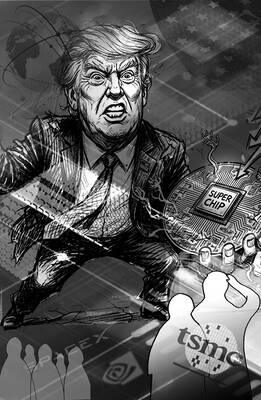
The White House’s decision to take a 9.9 percent stake in Intel Corp is looking like very shrewd business indeed. Since the government bought in at US$20.47 a share last August, the US chipmaker’s surging stock price has delivered the US a US$43 billion return. One of the reasons the investment has so far proved so sound is that the White House has made sure of it. According to The Wall Street Journal, Howard personally pushed deals on Intel’s behalf with some of the most lucrative clients imaginable. They include Nvidia Corp, the company at the heart of the AI
The Ministry of the Interior, working with the navy and coast guard, is organizing Taiwan’s first joint exercise simulating escort tankers carrying liquefied natural gas (LNG) and oil through a Chinese blockade. The drills simulate fuel transport along three maritime corridors leading toward Japan, the Philippines and the US. Deputy Minister of the Interior Sawyer Mars (馬士元) said that a blockade of the Taiwan Strait would amount to “almost a 100 percent blockade of the regional energy supply.” Minister of National Defense Wellington Koo said planning to counter a blockade is standard practice in Taipei. While the exercise is limited in
A single photograph can cut through a lot of noise, but it can also be used to misrepresent the truth. At the very least, it can concentrate the mind on something that requires further investigation. On Monday last week, Ma Ying-jeou Foundation CEO Tai Hsia-ling (戴遐齡) and former National Security Council secretary-general King Pu-tsung (金溥聰) held a news conference in which they showed a photograph of former foundation CEO Hsiao Hsu-tsen (蕭旭岑), now Chinese Nationalist Party (KMT) deputy chairman. In the image Hsiao is seated next to Xiamen Taiwan Businessmen Association chairman Han Ying-huan (韓螢煥). The two men were holding
In a Taiwanese university classroom, a lecturer asks in English: “Can anyone give me an example from Taiwan?” Students look down. No one answers. After class, one student writes on the course platform in Mandarin: “I understood the concept, but I didn’t know how to answer in English.” That moment highlights a key issue in Taiwan’s English-medium instruction (EMI) reform: It is not just about more English-taught courses, but whether students can learn, participate and belong. EMI expansion is part of the Bilingual 2030 policy and the Ministry of Education’s BEST Program, aiming to improve English ability, support EMI teaching


 RSS
RSS