


The US is Taiwan’s principal source of advanced military technology, but it is becoming increasingly clear that the US government is reluctant to share with its ally systems that have offensive potential. While such limits reflect the spirit of the US’ Taiwan Relations Act, they also undermine Taiwan’s ability to present an increasingly powerful China with a credible military deterrent.
Over the years, Taiwan’s failure to acquire certain weapons, such as the F-16C/Ds it has been requesting since 2006, or diesel-electric submarines, has often been blamed on pressure from Beijing and its so-called “red lines,” which if crossed would presumably endanger US-China military relations.
However, pressure from Beijing alone cannot account for recent decisions on arms sales. Moves by Washington to sell Taiwan the Patriot air defense missile system, for example, sparked early threats by Beijing of dire consequences to bilateral relations, but nothing happened when PAC-3 (an upgraded version of the Patriot) fire units and missiles were finally released to Taiwan.
While Chinese pressure should not be discounted altogether, something else appears to be governing Washington’s decisions on arms sales to Taiwan: ensuring that Taipei does not acquire or develop offensive weapons. Defense analysts who have closely followed, or been involved in, arms sales over the years are convinced that the F-16C/D program first ran into trouble when Taiwan embarked on a full-scale program to develop and mass-produce the Hsiung Feng-IIE (HF-2E) surface-to-surface cruise missile.
Efforts to extend the missile’s range, from about 650km at present, may also have resulted in moves by Washington to discourage Taiwan from developing the Taiwan Small Launch Vehicle, which, while intended as a satellite launch platform, could also have been spun off for military purposes, especially given the participation of the Chungshan Institute of Science and Technology — Taiwan’s main military research body and maker of the HF-2E — in the program.
Recent allegations that the US Navy has instructed top US defense firms not to take part in a possible domestic submarine program for Taiwan would also fall under this category, given the offensive nature of submarines equipped with ballistic or cruise missiles. The US$5.85 billion arms package in September last year, which focused predominantly on upgrades for Taiwan’s F-16A/Bs, did include “offensive” weapons, such as a variety of joint direct attack munitions bomb guidance kits, but that inherent offensive capability is offset because no Taiwanese aircraft could bomb China and survive, given the extent of China’s air defense batteries. Another platform with offensive attributes, the AH-64D Apache Longbow helicopter, is limited by the fact that the helicopters cannot cross the Taiwan Strait to attack China, making them exclusively defensive.
It is now rumored that the US$800 million long-range early warning radar (EWR) system that is being built on Leshan (樂山) in Hsinchu County could also be the victim of Washington’s reluctance to provide Taiwan with capabilities that would encourage the latter to develop offensive military technology. As I wrote in an article in the current issue of the UK-based Jane’s Defence Weekly, word in defense circles has it that US technicians would likely “software-disable” the radar system so that it cannot track satellites, a function the EWR would ordinarily be capable of.
The initial reaction to such news would be to assume that Beijing, fearing for its fledging constellation of surveillance satellites, had applied pressure on Washington to withhold such functionality, perhaps by once again threatening the suspension of military-to-military ties. While such a “red line” is not implausible, the answer to another question could provide an equally valid explanation for the embargo on such technology, one that furthermore dovetails with the “no offensive capabilities” theory.
Why, some defense analysts asked me following the publication of my article, would the US not want Taiwan to be able to track Chinese satellites, especially since such information could be shared with US forces in the Asia-Pacific theater?
The answer, fears of tech transfer and bureaucratic inertia aside, could very well be that giving Taiwan such capabilities might encourage it to develop anti-satellite weapons (ASAT), such as missiles capable of shooting down an orbiter, or lasers or radio-wave equipment that could disable one. In other words, “offensive” weapons. Here again, a missile with enough range to shoot down a satellite — a feat that the Chinese military accomplished in 2007 when it used what was reportedly a modified Dong Feng 21 ballistic missile to shoot down the Feng Yun 1C weather satellite, at an altitude of 865km — could also enable scientists to develop longer-range surface-to-surface missiles.
Alongside this reluctance to equip Taiwan with satellite-tracking capabilities are fears that this would spark an arms race in space, which could then put US orbiters at risk. The same fears apply to other types of offensive weapons, which according to Washington’s calculations would increase the risk of a military conflagration in Asia and likely force the US to intervene.
Unfortunately for Washington, the policy of denying offensive technology to Taiwan occurs amid a growing sense that the US is “abandoning” it, a development that has forced Taipei to explore the possibility of adopting a more aggressive defense posture. (These efforts, such as the mass production of the HF-2E and development of the HF-3 “carrier killer,” have taken place mostly behind the scenes as President Ma Ying-jeou (馬英九) endeavors to lower tensions in the Taiwan Strait.) Unless the US reaffirms its security guarantees to Taiwan, Taipei will have no choice but to act contrary to Washington’s wishes and resort to the development or acquisition of offensive capabilities.
To all intents and purposes the policy of US President Barack Obama’s administration has been to withhold security guarantees from Taiwan while sustaining a virtual embargo on its acquisition of offensive technology, but this leaves Taipei dangerously little room to maneuver and risks undermining its confidence as it negotiates with China.
J. Michael Cole is deputy news editor at the Taipei Times.
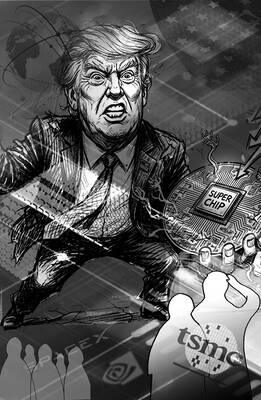
The White House’s decision to take a 9.9 percent stake in Intel Corp is looking like very shrewd business indeed. Since the government bought in at US$20.47 a share last August, the US chipmaker’s surging stock price has delivered the US a US$43 billion return. One of the reasons the investment has so far proved so sound is that the White House has made sure of it. According to The Wall Street Journal, Howard personally pushed deals on Intel’s behalf with some of the most lucrative clients imaginable. They include Nvidia Corp, the company at the heart of the AI
In a Taiwanese university classroom, a lecturer asks in English: “Can anyone give me an example from Taiwan?” Students look down. No one answers. After class, one student writes on the course platform in Mandarin: “I understood the concept, but I didn’t know how to answer in English.” That moment highlights a key issue in Taiwan’s English-medium instruction (EMI) reform: It is not just about more English-taught courses, but whether students can learn, participate and belong. EMI expansion is part of the Bilingual 2030 policy and the Ministry of Education’s BEST Program, aiming to improve English ability, support EMI teaching
A single photograph can cut through a lot of noise, but it can also be used to misrepresent the truth. At the very least, it can concentrate the mind on something that requires further investigation. On Monday last week, Ma Ying-jeou Foundation CEO Tai Hsia-ling (戴遐齡) and former National Security Council secretary-general King Pu-tsung (金溥聰) held a news conference in which they showed a photograph of former foundation CEO Hsiao Hsu-tsen (蕭旭岑), now Chinese Nationalist Party (KMT) deputy chairman. In the image Hsiao is seated next to Xiamen Taiwan Businessmen Association chairman Han Ying-huan (韓螢煥). The two men were holding
The Ministry of the Interior, working with the navy and coast guard, is organizing Taiwan’s first joint exercise simulating escort tankers carrying liquefied natural gas (LNG) and oil through a Chinese blockade. The drills simulate fuel transport along three maritime corridors leading toward Japan, the Philippines and the US. Deputy Minister of the Interior Sawyer Mars (馬士元) said that a blockade of the Taiwan Strait would amount to “almost a 100 percent blockade of the regional energy supply.” Minister of National Defense Wellington Koo said planning to counter a blockade is standard practice in Taipei. While the exercise is limited in


 RSS
RSS