


I’ve heard it several times. You probably have, too. Because of the economy, or simply to forge a new opportunity, so-and-so is heading off to China to share or capitalize on their expertise. As I recently overheard a middle-aged man in a coffee shop say, during a time-out from his Mandarin lesson: “I’m going to China to make a difference.”
Westerners have been going to China to make a difference for centuries, though they often discover the difference made is in them.
Nowhere is this better illustrated than in Jonathan Spence’s To Change China: Western Advisors in China. A series of vignettes that read like a sequence of tragicomedies, the Yale historian’s book chronicles one ambitious and morally superior Westerner after another (always a man) who gallops off to the Middle Kingdom convinced he will be the one to succeed — in educating the Chinese, in converting the Chinese, in advising the Chinese — where so many others before him failed. In the end, the usually intellectually gifted and well-meaning individual finds himself being used for his know-how before being icily discarded, and sometimes despised. Many of Spence’s cautionary tales come from the 19th and 20th centuries. Things have improved substantially since then, but there are modern-day accounts that eerily echo the professor’s work.
Tim Clissold’s Mr China is one such narrative. In the 1990s, the Briton Clissold raised US$400 million to buy shares in about 20 Chinese companies while providing the technical knowledge to make production more efficient and the bottom-line more profitable. On the surface, it seemed a grand idea: a win-win situation. However, in China, win-win can prove a difficult business.
Instead of a spirit of cooperation, what Clissold discovered was widespread graft and a systematic lack of business ethics. A factory land-deed was transferred without his knowledge; a local manager siphoned off funds to establish an identical plant across town; another manager drained the joint bank account and headed for the hills. The bank manager who allowed for the total-sum withdrawal headed for the hills with him. The Englishman discovered that attempting to remove corrupt factory managers resulted in strikes and riots. Investigations on behalf of China’s anti-corruption bureau were possible, but necessitated bribes.
What the aspiring Mr China realized, well down the road to financial ruin and failing health, was that the China of his imagination and the China of reality were poles apart. It’s something every China expat learns, either with a sense of wonder or horror; their preconceptions had been shockingly wrong.
China has always represented different things to different people. It is a vast and vague entity onto which one is free to project one’s own fears and desires. To the pious, it has represented a sea of prospective converts since the proselytizing Portuguese turned up in Macau in the 16th century.
In the 17th and 18th centuries, Europe’s obsession with chinoiserie aided in creating a romanticized version of the Oriental nation. In the 20th century, the Chinese Nationalist Party (KMT) was China’s savior and the West’s ally, until the West realized it was brutal, dysfunctional and corrupt. With its rapid involvement in the Korean War, the Chinese Communist Party became the West’s enemy, but since its capitalistic shift, Western perceptions and projections have flourished once more.
At the supposed cusp of what some are predicting as the post-America era, China impressions are changing yet again. For many, the Middle Kingdom is morphing from the world’s gritty factory floor into a dazzling economic beacon: an efficient, command-economy juggernaut steadily eroding Western influence by defeating it at its own game. The US is on the way down; China on the way up. However, to believe the world will belong to one or the other is to subscribe to simplistic dualism. To believe China is great because its economy is great is merely simplistic.
China does not meet the definition of a developed nation, at least not according to the UN, which lists it in 91st spot on its Human Development Index. Concerning GDP per capita, or so says the IMF, China is in 94th place. About 60 percent of Chinese exports come from foreign companies; for high-tech exports, that’s 85 percent. China has astonishing pollution problems, a culture of corruption and an antiquated education system. It also has a millennia-long tradition of authoritarianism.
Indeed, the humanist wonders whether those so ready to applaud China’s economy are also keen to clap for its oppressed society. Reporters Without Borders ranks China 168th out of 175 countries in terms of freedom of the press. The only nations to rank lower are Burma, Cuba, Eritrea, Iran, Laos, North Korea and Turkmenistan. According to Reuters, China jails more journalists than any other country. The only thing you can know to be true in a Chinese newspaper is the date.
The Reporters Without Borders Web site is banned in China. So are the Web sites for the Norwegian Broadcasting Corp and Radio Canada International. Also prohibited are Facebook, Twitter and YouTube. For reasons concerning national security, China recently outlawed six new songs by Lady Gaga and one by the Backstreet Boys. Authoritarianism makes for strength, sinophiles might say. Ignorance is strength, says George Orwell’s Ministry of Truth. And it is no show of strength when an alleged superpower feels threatened by dance tracks.
In these vexing economic times, China might seem — to those who continue to engage in projection — the land of answers. However, for those who’ve stopped projecting and are carefully observing, it is the land of questions — at least for those permitted to ask them.
Troy Parfitt is the author of Why China Will Never Rule the World.
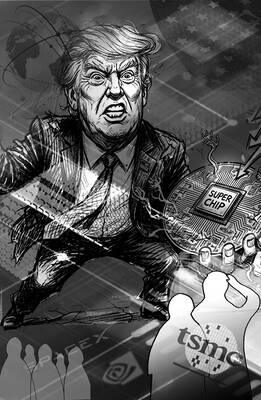
The White House’s decision to take a 9.9 percent stake in Intel Corp is looking like very shrewd business indeed. Since the government bought in at US$20.47 a share last August, the US chipmaker’s surging stock price has delivered the US a US$43 billion return. One of the reasons the investment has so far proved so sound is that the White House has made sure of it. According to The Wall Street Journal, Howard personally pushed deals on Intel’s behalf with some of the most lucrative clients imaginable. They include Nvidia Corp, the company at the heart of the AI
In a Taiwanese university classroom, a lecturer asks in English: “Can anyone give me an example from Taiwan?” Students look down. No one answers. After class, one student writes on the course platform in Mandarin: “I understood the concept, but I didn’t know how to answer in English.” That moment highlights a key issue in Taiwan’s English-medium instruction (EMI) reform: It is not just about more English-taught courses, but whether students can learn, participate and belong. EMI expansion is part of the Bilingual 2030 policy and the Ministry of Education’s BEST Program, aiming to improve English ability, support EMI teaching
The Ministry of the Interior, working with the navy and coast guard, is organizing Taiwan’s first joint exercise simulating escort tankers carrying liquefied natural gas (LNG) and oil through a Chinese blockade. The drills simulate fuel transport along three maritime corridors leading toward Japan, the Philippines and the US. Deputy Minister of the Interior Sawyer Mars (馬士元) said that a blockade of the Taiwan Strait would amount to “almost a 100 percent blockade of the regional energy supply.” Minister of National Defense Wellington Koo said planning to counter a blockade is standard practice in Taipei. While the exercise is limited in
A single photograph can cut through a lot of noise, but it can also be used to misrepresent the truth. At the very least, it can concentrate the mind on something that requires further investigation. On Monday last week, Ma Ying-jeou Foundation CEO Tai Hsia-ling (戴遐齡) and former National Security Council secretary-general King Pu-tsung (金溥聰) held a news conference in which they showed a photograph of former foundation CEO Hsiao Hsu-tsen (蕭旭岑), now Chinese Nationalist Party (KMT) deputy chairman. In the image Hsiao is seated next to Xiamen Taiwan Businessmen Association chairman Han Ying-huan (韓螢煥). The two men were holding


 RSS
RSS