


Liberals don’t like Asians. Asians are basically conservative: They don’t like big and intrusive government and despise high taxes and welfare. Asians espouse strong family values. They are not egalitarian.
When Asians are asked what they don’t like about the US, their top answer is affirmative action and quotas in college and university admission that grievously discriminate against Asians — core tenets of the liberal Democratic Party’s agenda.
US President Barack Obama is an uber-liberal, the most liberal US president ever. Hence the above view of Asians held by liberals applies to him even more. He is an enthusiastic advocate of expanding government, higher taxes and racial quotas.
Obama’s views of Asians are reflected in his administration’s Asia policy. Asia is neglected, which is of particular note given its fast growing economic, military and cultural importance. Obama prefers Europe. He spends most of his time dealing with Middle East issues.
Obama especially dislikes Taiwan. Following are the reasons and the evidence.
First, the reasons:
Obama has shown a level of disdain for his predecessor like no other president. Former US president George W. Bush liked Taiwan. In 2001, Bush said that he would “do whatever it took” to defend Taiwan. Although Bush experienced some serious differences with Taiwan when he was president, Democrats remember him for his defense of the Taiwan line.
Obama’s nemesis during the presidential campaign was Senator John McCain, who said unequivocally (in an article in Foreign Affairs) that he would, if elected president, employ US forces to defend Taiwan.
Of course, the “authoritarian, right-wing” Chinese Nationalist Party (KMT) rules Taiwan. That is the party of Chiang Kai-shek (蔣介石), which Democrats some decades ago demonized after Republicans assailed them for losing China (as it turns out, neither charge has stood the test of time, though Democrats hang on to the mantra and have no doubt cited it to Obama).
There is a history of Republicans liking and supporting Taiwan more than Democrats. Republicans have a greater affinity for Asia, which is conservative, than Democrats. They have considered Taiwan as a bastion of capitalism, democracy and freedom.
Second, the evidence:
Obama was barely in office when his administration proposed talks between top military brass from Taiwan and China. This denied a long-standing tenet of US policy and a promise to Taiwan not to mediate in cross-strait relations or pressure Taiwan to negotiate. Observers took this as a hint that the president favored unification not on Taiwan’s terms.
In 2009, when Obama made his first trip to China, he issued a formal written statement. In it he cited the Three Communiques as the basis of US-China-Taiwan policy. The communiques reflect US efforts to engineer better relations with China (at Taiwan’s expense). The president did not cite the Taiwan Relations Act (which is law, has a higher legal status than the communiques and protects Taiwan).
Similarly, Obama did not broach two topics that top US officials pro forma bring up during talks with Chinese leaders: democracy and human rights. Doing so would have put Taiwan in a good light.
Since Obama became president, no Cabinet or sub-Cabinet official has visited Taiwan and Taiwan has not featured in a speech by any senior administration official dealing with Asia policy, or so says US Representative Ileana Ros-Lehtinen, the new Republican chairperson of the House of Representatives’ Committee on Foreign Affairs. Ros-Lehtinen says Taiwan is an “afterthought” in the Obama administration, while citing a “new spirit of appeasement in the air.”
Obama’s top appointments mirror the view that China is important and deserves respect. The US debt to China is huge and growing. The new US Ambassador to China Gary Locke is Chinese, but has few, if any, Taiwan connections. His forte is economic issues; he has little experience in strategic matters (which might favor Taiwan).
The US-Taiwan Free Trade Agreement that has been proposed for some time is now a dead issue. Obama, responding to Republican pressure, has given conditional support to FTAs with three countries; but Taiwan is not among them.
Obama has cut US military spending by US$400 billon and has proposed further cuts of about the same amount. Meanwhile he is spending more on US involvement in the Middle East, which means US forces in the Far East will be cut and the US may no longer be able to protect Taiwan.
If the US forsakes its vows to protect Taiwan, it has no place to go. No other country and no international organization will help defend Taiwan. Obama may yet oversee the end of Taiwan as we know it.
John Copper is the Stanley J. Buckman professor of International Studies at Rhodes College in Memphis, Tennessee.
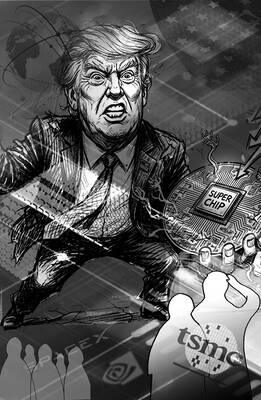
The White House’s decision to take a 9.9 percent stake in Intel Corp is looking like very shrewd business indeed. Since the government bought in at US$20.47 a share last August, the US chipmaker’s surging stock price has delivered the US a US$43 billion return. One of the reasons the investment has so far proved so sound is that the White House has made sure of it. According to The Wall Street Journal, Howard personally pushed deals on Intel’s behalf with some of the most lucrative clients imaginable. They include Nvidia Corp, the company at the heart of the AI
A single photograph can cut through a lot of noise, but it can also be used to misrepresent the truth. At the very least, it can concentrate the mind on something that requires further investigation. On Monday last week, Ma Ying-jeou Foundation CEO Tai Hsia-ling (戴遐齡) and former National Security Council secretary-general King Pu-tsung (金溥聰) held a news conference in which they showed a photograph of former foundation CEO Hsiao Hsu-tsen (蕭旭岑), now Chinese Nationalist Party (KMT) deputy chairman. In the image Hsiao is seated next to Xiamen Taiwan Businessmen Association chairman Han Ying-huan (韓螢煥). The two men were holding
I first met Professor Ray Jiing (井迎瑞) as a film and documentary student at Shih Hsin University’s (SHU) Department of Radio Television and Film in 1988. The following year, he went on to become the director of the Chinese Taipei Film Archive — forerunner of the Taiwan Film and Audiovisual Institute (TFAI). Over his eight-year tenure, Jiing rescued and restored over 200 classic Taiwanese films. In 1997, he established the Graduate Institute of Studies in Documentary and Film Archiving at Tainan National University of the Arts (TNNUA), and I joined the program in his third cohort of students. Beyond a
A recent report concerning a student who is suing his teacher posed the question in its headline: Does failing a student in two subjects constitute bullying? The college student in Chiayi County apparently sought NT$2 million (US$63,603) in state compensation, but a court dismissed the case. The first reaction of many might have been to ask: What has happened to students nowadays? Some say that teachers have lost their authority, while others say students are overindulged. Some even start reminiscing over the days when “whatever the teacher says goes.” However, the real issue might be overlooked if emotional reactions like that are the


 RSS
RSS