


Last week’s United Air Defense Fire missile exercise — the largest since President Ma Ying-jeou (馬英九) took office in May 2008 — sparked consternation in many circles after six of the 19 missiles fired either misfired or encountered technical problems.
Although a hit ratio below 70 percent is considered less than optimal, what several media outlets omitted — fixated as they were on the failures — was the fact that some missiles, including the indigenous Tien Kung II “Sky Bow,” the only potential “game changer” on display last week, performed quite well.
Given the timing of the exercise and the fact that reporters were allowed on the Chung-shan Institute of Science and Technology’s (CSIST) off-limit Jiupeng missile testing base for the first time since 2002, the Ministry of National Defense was likely seeking to send a signal of strength to China. The failures and the subsequent media focus on the shortcomings indicate that that effort may have backfired and highlighted weakness rather than strength.
Ma, who attended the exercise, said after its conclusion that he was not satisfied with the outcome and called on the armed services to determine what went wrong and redouble their efforts.
While there is little to disagree with in Ma’s remarks, there is no small irony in the fact that his discontent targeted an exercise that fielded equipment that belongs in a museum rather than in the field facing a military giant. To use but one example, Dwight Eisenhower was still US president when the Hawk surface-to-air missile — four of which were fired last week — was first fielded by the US military. Although it went through a number of upgrades to keep it from becoming altogether obsolete, it was phased out of service by the US military in 2002.
Over the years, Taiwan’s military has been like the Red Queen’s race in Alice in Wonderland, running just to stay in place. Just as the first signs of China’s military modernization were beginning to emerge, former president Chen Shui-bian’s (陳水扁) administration turned to the US to ensure it could maintain its edge in the Taiwan Strait. Shenanigans by the Chinese Nationalist Party (KMT) in the legislature, however, brought those efforts to an abrupt end, resulting in several lost years and seriously undermining the ability of the military to defend the nation. In contrast, China’s military, backed by a decade of double-digit growth in its defense expenditure, modernized in leaps and bounds.
Aside from the material deficiencies resulting from decisions made by the KMT, which when Chen was in office put its political interests ahead of those of the nation, morale in the ranks suffered as men and women, who every day put their lives on the line defending the nation, saw that their political masters were incapable of providing them with the tools they needed to do their job properly.
With Ma in office and his party having firm control over both the executive and legislative bodies, one might have expected the situation to be reversed, with a new emphasis on defense and enhanced opportunities to acquire the arms needed to keep the gap between Chinese and Taiwanese defense capabilities as narrow as possible. However, rather than do this, the Ma administration has cut the military budget, de-prioritized live-fire exercises and made natural catastrophes, rather than the People’s Liberation Army, the main enemy.
The lackluster performance on Tuesday last week can only be rationalized as the product of years of neglect and plummeting morale.
Instead of berating officers who worked for months to make the exercise possible and the scientists at CSIST who have developed impressive technologies, Ma should perhaps ask himself why the nation’s armed forces are in such a state and what role he and his party have played in allowing this to happen.
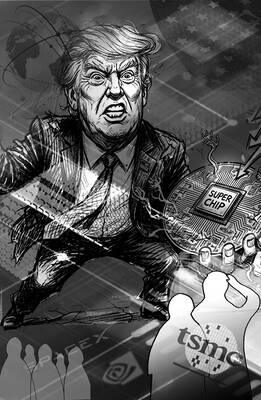
The White House’s decision to take a 9.9 percent stake in Intel Corp is looking like very shrewd business indeed. Since the government bought in at US$20.47 a share last August, the US chipmaker’s surging stock price has delivered the US a US$43 billion return. One of the reasons the investment has so far proved so sound is that the White House has made sure of it. According to The Wall Street Journal, Howard personally pushed deals on Intel’s behalf with some of the most lucrative clients imaginable. They include Nvidia Corp, the company at the heart of the AI
The Ministry of the Interior, working with the navy and coast guard, is organizing Taiwan’s first joint exercise simulating escort tankers carrying liquefied natural gas (LNG) and oil through a Chinese blockade. The drills simulate fuel transport along three maritime corridors leading toward Japan, the Philippines and the US. Deputy Minister of the Interior Sawyer Mars (馬士元) said that a blockade of the Taiwan Strait would amount to “almost a 100 percent blockade of the regional energy supply.” Minister of National Defense Wellington Koo said planning to counter a blockade is standard practice in Taipei. While the exercise is limited in
A single photograph can cut through a lot of noise, but it can also be used to misrepresent the truth. At the very least, it can concentrate the mind on something that requires further investigation. On Monday last week, Ma Ying-jeou Foundation CEO Tai Hsia-ling (戴遐齡) and former National Security Council secretary-general King Pu-tsung (金溥聰) held a news conference in which they showed a photograph of former foundation CEO Hsiao Hsu-tsen (蕭旭岑), now Chinese Nationalist Party (KMT) deputy chairman. In the image Hsiao is seated next to Xiamen Taiwan Businessmen Association chairman Han Ying-huan (韓螢煥). The two men were holding
I first met Professor Ray Jiing (井迎瑞) as a film and documentary student at Shih Hsin University’s (SHU) Department of Radio Television and Film in 1988. The following year, he went on to become the director of the Chinese Taipei Film Archive — forerunner of the Taiwan Film and Audiovisual Institute (TFAI). Over his eight-year tenure, Jiing rescued and restored over 200 classic Taiwanese films. In 1997, he established the Graduate Institute of Studies in Documentary and Film Archiving at Tainan National University of the Arts (TNNUA), and I joined the program in his third cohort of students. Beyond a


 RSS
RSS