


Ever since President Ma Ying-jeou’s (馬英九) administration came to power, it has stumbled around in the dark and achieved precious little. Its sluggish and apathetic response to Typhoon Morakot in August last year, was without doubt its worst hour, causing public outrage and costing it a premier. It also caused Ma’s popularity ratings to plummet to a low from which they have never really recovered. What is troubling is that a year on from the disaster, victims are still facing considerable challenges.
We have now arrived at the first anniversary of the carnage caused by Morakot, and the anger and frustration felt by Aborigines has reached critical mass. They have sent a succession of groups up to Taipei to stage protests against the government, and are even planning to take their case to the UN, accusing the government of contravening the UN Declaration on the Rights of Indigenous Peoples and the Indigenous Peoples Basic Act (原住民族基本法) by forcefully expropriating land. Furthermore, the inadequate post-disaster reconstruction efforts suggest that the government still has little idea about the enormity of the challenges faced by the local residents because it is orchestrating the destruction of Aborigines’ way of life.
This is the greatest tragedy of the whole affair.
It is true that many of the disaster areas have been listed as no-go zones unsuitable for human habitation and the original residents have been relocated to safer sites. In principle, this is the correct response. However, the total lack of participation by the residents raises concerns about the way the government has handled the safety surveys, the relocations and the reconstruction program.
The government has clearly failed to take the various tribes’ cultures and way of life into consideration. Aborigines have not had any input in the reconstruction committees at any level, and the recommendations they have come up with have been ignored. The lack of respect for their specific needs and poor communication has led to compulsory relocation and forced land expropriations. This is the main reason for the discontent.
The government’s reconstruction efforts have concentrated on the temporary relocation of disaster victims while permanent housing is built, with administrative efficiency, number crunching, moving people into permanent housing, repairing communication routes, boosting the local tourism industry and commissioning construction projects had been discredited as solutions even before the disaster happened. This illustrates a complete lack of comprehensive planning for the long-term needs of Aborigines.
What is happening is Aborigines are being asked to move away from the land they have lived on for centuries and that has sustained their economy, their culture and their survival for many generations, to safer areas. While this housing does give them a roof over their heads, it also isolates them from their way of life. This isolation will inevitably bring about changes that will see their economy wither and their cultural heritage fade away. The government, when making reconstruction preparations, overlooked these issues, failing to recognize that forcing these people from the homes and land they had lived on for many generations was not a simple matter of relocation, it was actually tearing up their cultural and economic roots.
The disaster victims have been let down by the government on several levels, mainly the speed of the reconstruction efforts, the quality of the housing and the arrangements of the places they have been relocated to. The relief efforts would have been better handled by civic groups.
The victims of Morakot can still legitimately ask the government the question: “Where are we to call home?” One wonders how the government would respond.
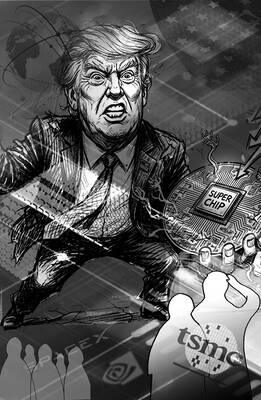
The White House’s decision to take a 9.9 percent stake in Intel Corp is looking like very shrewd business indeed. Since the government bought in at US$20.47 a share last August, the US chipmaker’s surging stock price has delivered the US a US$43 billion return. One of the reasons the investment has so far proved so sound is that the White House has made sure of it. According to The Wall Street Journal, Howard personally pushed deals on Intel’s behalf with some of the most lucrative clients imaginable. They include Nvidia Corp, the company at the heart of the AI
A single photograph can cut through a lot of noise, but it can also be used to misrepresent the truth. At the very least, it can concentrate the mind on something that requires further investigation. On Monday last week, Ma Ying-jeou Foundation CEO Tai Hsia-ling (戴遐齡) and former National Security Council secretary-general King Pu-tsung (金溥聰) held a news conference in which they showed a photograph of former foundation CEO Hsiao Hsu-tsen (蕭旭岑), now Chinese Nationalist Party (KMT) deputy chairman. In the image Hsiao is seated next to Xiamen Taiwan Businessmen Association chairman Han Ying-huan (韓螢煥). The two men were holding
I first met Professor Ray Jiing (井迎瑞) as a film and documentary student at Shih Hsin University’s (SHU) Department of Radio Television and Film in 1988. The following year, he went on to become the director of the Chinese Taipei Film Archive — forerunner of the Taiwan Film and Audiovisual Institute (TFAI). Over his eight-year tenure, Jiing rescued and restored over 200 classic Taiwanese films. In 1997, he established the Graduate Institute of Studies in Documentary and Film Archiving at Tainan National University of the Arts (TNNUA), and I joined the program in his third cohort of students. Beyond a

President William Lai Ching-te’s (賴清德) May 20 second-anniversary address was not just a routine policy review; it was damage control. US President Donald Trump’s remarks — that he did not want to see anyone move toward independence and that the delivery of a major Taiwan arms package could depend on the progress of US-China relations — unsettled Taiwan’s public and created an opening for opposition parties to question whether Taiwan was being treated as a bargaining chip in Washington’s dealings with Beijing. Lai’s speech was designed to close that opening. The address covered the expected ground: sovereignty, cross-strait relations, defense spending,


 RSS
RSS