


Looking over the past 20 years of economic development, we can see that Taiwan has been moving in a clearly defined direction, one which has found considerable consensus at home. This has been to play to our strengths, to consolidate international resources, to expand onto the global market, to do what we do best even better and to strengthen the Taiwanese economy. Taiwan doesn’t have a huge amount of resources or a large market in which to sell our goods, so we have had to look beyond our borders and rely on global resources and markets for sustainable economic growth.
Since the late 1980s, China and other East Asian countries have gradually overtaken the Four Asian Tigers as the production powerhouses for goods for the US market, and Taiwan has consequently had to cast around for a new role. The government has offered a string of models for how to proceed, such as trying to establish Taiwan as an Asia-Pacific regional operations center, a global logistics management center, or an Asia-Pacific economic and trade hub.
Basically, the thinking goes that Taiwan has to find a place for itself internationally and exploit its geographical advantages within the Asia-Pacific economic network to ensure its sustainable economic development.
The fact that China has obstructed Taiwan from participating in East Asian economic agreements has caused us to miss the boat: Our reputation for competitiveness has suffered and our market is perceived as being too narrow. As a result, foreign investment has shied away from us. From 2000 to 2007, the net international investment attracted by Taiwan was minus US$107.4 billion. The repercussions of this extend beyond a large net capital outflow: It is accompanied by a considerable drain of talent, skills and spending power which has led, to our sustained and continuous detriment, to an institutional corrosion of Taiwan’s international competitiveness.
According to a survey I conducted mong 1,019 Taiwanese and foreign businesses, between 23 percent and 37 percent of respondents said they would increase their levels of investment in Taiwan if it were to join some sort of East Asian economic integration body, compared with between 29 percent and 42 percent who said they would do so if Taiwan were to sign an economic agreement with China. In addition, all types of business were unanimous in their recommendation that China would be the preferred option for Taiwan to sign such an agreement with, followed by the US, the EU, Southeast Asia and Japan. In other words, Taiwan is more likely to achieve its goal of engaging with global markets if it aligns itself more closely to China. These two concepts, of engaging globally and with China, are considered to be mutually beneficial and not, as some would claim, mutually opposed.
Taiwan has got to come out fighting and be more pro-active in promoting global economic integration, while pushing unilateral and domestically agreed upon deregulation. This is the only way we can avoid getting caught in a geopolitical quagmire and circumvent the political obstructions that China is laying before us. Taiwan really must take a lead role in globalization and make use of the global market and global resources to give free rein to our strengths, rather than wait for other countries to sign free-trade agreements with us before we start deregulating. Both the Taiwanese government and the wider society have to shake off the victim mentality we have fostered in the past, as well as the preoccupation with having been isolated internationally. We need to fix our eyes on the future and embrace the new century.
Of course we can, and should, make use of China’s market and productive resources to enhance our competitive advantage in the global economy and promote economic development, but we also need to take a strategic line. By this I mean we need to combine our political leverage with both China and the US and sign economic agreements with both, enabling us to maintain our economic independence and mitigate China’s attempts to put obstacles in our way. We will then be able to establish economic agreements with our major trading partners and optimize Taiwan’s regional economic interests.
There is nothing terribly new about the recommendations outlined above: They constitute little more than a return to the generally subscribed-to path Taiwan had been taking before. It remains, however, the best foundation for Taiwan’s sustainable development.
Tung Chen-yuan is a professor at National Chengchi University’s Graduate Institute of Development Studies.
TRANSLATED BY PAUL COOPER
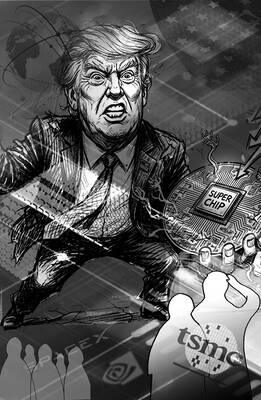
The White House’s decision to take a 9.9 percent stake in Intel Corp is looking like very shrewd business indeed. Since the government bought in at US$20.47 a share last August, the US chipmaker’s surging stock price has delivered the US a US$43 billion return. One of the reasons the investment has so far proved so sound is that the White House has made sure of it. According to The Wall Street Journal, Howard personally pushed deals on Intel’s behalf with some of the most lucrative clients imaginable. They include Nvidia Corp, the company at the heart of the AI
A single photograph can cut through a lot of noise, but it can also be used to misrepresent the truth. At the very least, it can concentrate the mind on something that requires further investigation. On Monday last week, Ma Ying-jeou Foundation CEO Tai Hsia-ling (戴遐齡) and former National Security Council secretary-general King Pu-tsung (金溥聰) held a news conference in which they showed a photograph of former foundation CEO Hsiao Hsu-tsen (蕭旭岑), now Chinese Nationalist Party (KMT) deputy chairman. In the image Hsiao is seated next to Xiamen Taiwan Businessmen Association chairman Han Ying-huan (韓螢煥). The two men were holding
I first met Professor Ray Jiing (井迎瑞) as a film and documentary student at Shih Hsin University’s (SHU) Department of Radio Television and Film in 1988. The following year, he went on to become the director of the Chinese Taipei Film Archive — forerunner of the Taiwan Film and Audiovisual Institute (TFAI). Over his eight-year tenure, Jiing rescued and restored over 200 classic Taiwanese films. In 1997, he established the Graduate Institute of Studies in Documentary and Film Archiving at Tainan National University of the Arts (TNNUA), and I joined the program in his third cohort of students. Beyond a
President William Lai Ching-te’s (賴清德) May 20 second-anniversary address was not just a routine policy review; it was damage control. US President Donald Trump’s remarks — that he did not want to see anyone move toward independence and that the delivery of a major Taiwan arms package could depend on the progress of US-China relations — unsettled Taiwan’s public and created an opening for opposition parties to question whether Taiwan was being treated as a bargaining chip in Washington’s dealings with Beijing. Lai’s speech was designed to close that opening. The address covered the expected ground: sovereignty, cross-strait relations, defense spending,


 RSS
RSS