


Public concerns about housing affordability have recently prompted the government to step up its efforts to curb rising property prices. However, the government must know what caused this problem and what it can do about it.
On Thursday, real-estate broker Evertrust Rehouse sounded a warning about the price-income ratio for residential housing, saying that ordinary workers would have to spend 13.38 years of their income to buy a house in one of Taipei’s upscale districts.
Deterred by higher prices in the city’s fashionable Xinyi (信義) and Da-an (大安) districts, more home buyers shifted their focus to suburban Wenshan District (文山) last year. Still, the average worker would still have to spend about nine years of their salary to purchase a home in the suburbs and nearly 7.8 years’ wages to own one in Taipei County, the broker said.
Economists have said that five years’ wages is considered reasonable for most salaried workers, but the swelling prices of luxury residences have fueled an overall rise in property prices in the Taipei area, making it increasingly unrealistic for people to realize their dreams of owning a home in five years.
Meanwhile, a survey conducted by the real-estate transaction information portal Giga House showed that a house in Taipei City cost an average of NT$434,400 (US$13,600) per ping (3.3m²) last year, up 4.27 percent from the previous year, while the average price was about NT$199,400 per ping in Taipei County, up 3.55 percent from 2008.
Worse, the survey also found that aged apartment buildings in Taipei City are often even more expensive than office buildings, mainly owing to the spill-over effects of luxury residences and partly because of the city’s zoning deregulation.
Worst of all are Taipei City’s record land auctions. On Feb. 25, the National Property Administration (NPA) auctioned off a 121.3 ping plot of land on Jianguo S Road in Taipei at NT$6.02 million per ping. It represented the second-highest price per ping for land in the city’s history, after the NPA sold a 116.16 ping piece of land on Renai Road at NT$6.79 million per ping on Jan. 28.
As the record-high public land sales are causing concerns about growing speculative investment in the property market, the government has decided to suspend state-owned land auctions in Taipei, although this move is likely to boost prices for private lots because of the simple rule of supply and demand. For instance, all eyes are now on the scheduled auction of a 1,715 ping plot of land on Tianmu E Road owned by the charity group Evangelize China Fellowship on March 17. The owner has set the floor price at NT$4.97 billion, or NT$2.9 million per ping, but property experts are speculating that the selling price may break the city’s record once again.
Clearly, housing affordability is an issue in Taipei, but not nationally. According to Giga House, price adjustments were rather limited in places elsewhere in Taiwan last year, with the average price per ping rising only 0.34 percent to NT$86,300 in Kaohsiung City and County, and dropping 0.68 percent to NT$119,800 in Taichung City and County.
Therefore, halting public land sales is not enough to contain the rising property prices in the city, as the key issue is too much liquidity in the market, which will require the government adopt effective monetary policies sooner than later. But the bottom line is that the government needs to rethink the nation’s regional development plans and help create more jobs in places outside Taipei. By doing so, people will not have to find a job and a place to live in Taipei.
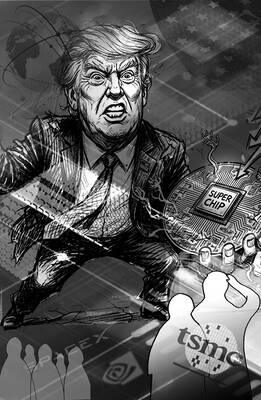
The White House’s decision to take a 9.9 percent stake in Intel Corp is looking like very shrewd business indeed. Since the government bought in at US$20.47 a share last August, the US chipmaker’s surging stock price has delivered the US a US$43 billion return. One of the reasons the investment has so far proved so sound is that the White House has made sure of it. According to The Wall Street Journal, Howard personally pushed deals on Intel’s behalf with some of the most lucrative clients imaginable. They include Nvidia Corp, the company at the heart of the AI
A single photograph can cut through a lot of noise, but it can also be used to misrepresent the truth. At the very least, it can concentrate the mind on something that requires further investigation. On Monday last week, Ma Ying-jeou Foundation CEO Tai Hsia-ling (戴遐齡) and former National Security Council secretary-general King Pu-tsung (金溥聰) held a news conference in which they showed a photograph of former foundation CEO Hsiao Hsu-tsen (蕭旭岑), now Chinese Nationalist Party (KMT) deputy chairman. In the image Hsiao is seated next to Xiamen Taiwan Businessmen Association chairman Han Ying-huan (韓螢煥). The two men were holding
I first met Professor Ray Jiing (井迎瑞) as a film and documentary student at Shih Hsin University’s (SHU) Department of Radio Television and Film in 1988. The following year, he went on to become the director of the Chinese Taipei Film Archive — forerunner of the Taiwan Film and Audiovisual Institute (TFAI). Over his eight-year tenure, Jiing rescued and restored over 200 classic Taiwanese films. In 1997, he established the Graduate Institute of Studies in Documentary and Film Archiving at Tainan National University of the Arts (TNNUA), and I joined the program in his third cohort of students. Beyond a

President William Lai Ching-te’s (賴清德) May 20 second-anniversary address was not just a routine policy review; it was damage control. US President Donald Trump’s remarks — that he did not want to see anyone move toward independence and that the delivery of a major Taiwan arms package could depend on the progress of US-China relations — unsettled Taiwan’s public and created an opening for opposition parties to question whether Taiwan was being treated as a bargaining chip in Washington’s dealings with Beijing. Lai’s speech was designed to close that opening. The address covered the expected ground: sovereignty, cross-strait relations, defense spending,


 RSS
RSS