


Amid complaints by Plurkers and concerns by the Ministry of Foreign Affairs (MOFA) following a tip-off from Democratic Progressive Party Legislator Kuan Bi-ling (管碧玲), CNN on Sunday corrected its Web site after initially quoting the US National Ocean and Atmospheric Administration’s Pacific Tsunami Warning Center as calling Taiwan “Chinese Taipei” in its tsunami watch report.
Despite its initial inertia and lack of awareness, the ministry deserves praise for swiftly responding to Kuan’s alert and requesting that CNN make the correction on its Web site.
If it hadn’t been for the complaints made by Taiwanese netizens and the government, the potential repercussions for Taiwan could have been dire. Wittingly or not, influential news networks like CNN can undermine the nation’s image through inadequate references.
As of yesterday, references to Taiwan as “Chinese Taipei,” however, remained on the tsunami bulletin post on the center’s Web site. Kuan said the “Chinese Taipei” reference by the center, which falls under the jurisdiction of the US Department of Commerce, was a “serious matter,” as the US government until then had never referred to Taiwan as “Chinese Taipei” in its official documents.
The controversy is not over and the ministry still has work to do. It, along with related national security agencies, should contact the Department of Commerce, the National Ocean and Atmospheric Administration and the Pacific Tsunami Warning Center and determine where things went wrong. It should also ensure that the process, as well as its findings, are shared with the public.
While some may be quick to dismiss the matter as trivial and not worth further pursuit, we should be aware that silence and passivity are exactly what Beijing is counting on in its pursuit of unification.
Beijing’s efforts to marginalize Taiwan and diminish its international space are well known. It has resorted to many means — openly and clandestinely — to shape the global discourse on Taiwan, and this has often been accomplished through the use of language.
Although a lie repeated 1,000 times still doesn’t make it the truth, it could eventually manage to deceive the international community into believing that Taiwan is indeed part of China’s territory, of which the “Chinese Taipei” appellation is but one among many iterations.
If Taiwanese and their government do not speak out whenever Taiwan’s sovereign status is put into question or its name corrupted, it will only be a matter of time before the name Taiwan — or the nation’s official title, the Republic of China — is permanently removed from world maps.
Since taking office in May 2008, President Ma Ying-jeou (馬英九) has engaged in a so-called diplomatic “truce” with Beijing, saying the country should concentrate more on cementing ties with allies than seeking to make new ones. While there may be wisdom in this, under no circumstances should this entail agreeing to this nation being referred to by a demeaning — and geographically incorrect — name such as “Chinese Taipei.”
Taiwanese cannot afford to be silent, especially when the greatest threat to Taiwan’s identity and survival as an independent nation comes from a giant whose voice echoes at every corner of the planet.
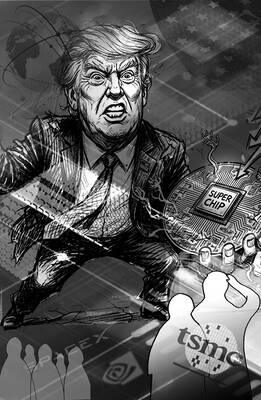
The White House’s decision to take a 9.9 percent stake in Intel Corp is looking like very shrewd business indeed. Since the government bought in at US$20.47 a share last August, the US chipmaker’s surging stock price has delivered the US a US$43 billion return. One of the reasons the investment has so far proved so sound is that the White House has made sure of it. According to The Wall Street Journal, Howard personally pushed deals on Intel’s behalf with some of the most lucrative clients imaginable. They include Nvidia Corp, the company at the heart of the AI
In a Taiwanese university classroom, a lecturer asks in English: “Can anyone give me an example from Taiwan?” Students look down. No one answers. After class, one student writes on the course platform in Mandarin: “I understood the concept, but I didn’t know how to answer in English.” That moment highlights a key issue in Taiwan’s English-medium instruction (EMI) reform: It is not just about more English-taught courses, but whether students can learn, participate and belong. EMI expansion is part of the Bilingual 2030 policy and the Ministry of Education’s BEST Program, aiming to improve English ability, support EMI teaching
The Ministry of the Interior, working with the navy and coast guard, is organizing Taiwan’s first joint exercise simulating escort tankers carrying liquefied natural gas (LNG) and oil through a Chinese blockade. The drills simulate fuel transport along three maritime corridors leading toward Japan, the Philippines and the US. Deputy Minister of the Interior Sawyer Mars (馬士元) said that a blockade of the Taiwan Strait would amount to “almost a 100 percent blockade of the regional energy supply.” Minister of National Defense Wellington Koo said planning to counter a blockade is standard practice in Taipei. While the exercise is limited in
A single photograph can cut through a lot of noise, but it can also be used to misrepresent the truth. At the very least, it can concentrate the mind on something that requires further investigation. On Monday last week, Ma Ying-jeou Foundation CEO Tai Hsia-ling (戴遐齡) and former National Security Council secretary-general King Pu-tsung (金溥聰) held a news conference in which they showed a photograph of former foundation CEO Hsiao Hsu-tsen (蕭旭岑), now Chinese Nationalist Party (KMT) deputy chairman. In the image Hsiao is seated next to Xiamen Taiwan Businessmen Association chairman Han Ying-huan (韓螢煥). The two men were holding


 RSS
RSS