


Taiwan can improve in 2010
As it is time for New Year’s resolutions, I want to propose two ideas that could help Taiwan become a more responsible society and gain more respect in the international community. These suggestions can easily be put into effect by the government and have the added advantage that there is no need for China’s approval.
Specifically, Taiwan should stop wasting resources and abolish the death penalty.
Like many foreigners living in Taiwan, I am impressed by the degree to which Taiwanese have gotten used to separating their garbage, rivaling even German standards. At the same time, however, tonnes and tonnes of precious natural resources are wasted every day in the form of plastic bags, plastic cups and throwaway chopsticks.
There simply is no reason for every piece of fruit or bread to be put into separate plastic bags. It is also appalling to see coffee shops handing out plastic cups to customers who drink inside the restaurant. Not only do bags and cups often end up being discarded on the street or in parks (aided by the inexplicable fact that public waste bins are few and far between), this also fosters a throwaway mentality that effectively prevents a sense of responsibility for the environment.
The government could easily change this by making customers pay a compulsory fee of, say, NT$2 for every plastic bag handed out to them, and not just for those stores currently required to charge fees. Also, customers should tell shopkeepers to act more responsibly. Such improvements on the environmental front would also lead to positive press coverage internationally.
Knowing the Western media from the inside, I can further assure Taiwanese that there is no single decision that would generate such an international wave of goodwill for Taiwan as the abolition of the death penalty.
It has been widely argued, including in the Taipei Times, that executions do not prevent crime. More than three years ago, Taiwan’s government wisely decided to put a moratorium on capital punishment. Now the Chinese Nationalist Party (KMT) should use its control of both the government and the legislature to finally get rid of it altogether. By this simple act, Taiwan would make it unmistakably clear to the world that, unlike China, it is a country in which human rights are respected and the government does not need to threaten to kill its own citizens. Media worldwide will gladly report this story.
More often than not, New Year’s resolutions are quickly forgotten. However, Taiwanese should not allow these two to fade away. They will not make Chinese missiles go away, they will not guarantee a seat in any international organization or bring back lost jobs, but they would make Taiwan an even better country.
Klaus Bardenhagen
Taipei
Thumbs down for ‘Taiwan Up’
I’d just like to say that the slogan “Taiwan Up,” in massive illuminated letters on Taipei 101 on New Year’s Eve, was total rubbish, and “up” there for all the world to see.
Which bright spark came up with that? And which (city government) dimwits didn’t point out that it doesn’t actually make much sense in English? Maybe “Up Taiwan” was really what they meant (as in “Up yours”), otherwise why not go to the trouble to come up with a slogan that makes sense in English?
To be serious, while not an exact translation of the Chinese, “Viva Taiwan” would have been better (universally understood and also expressing the hope that things go well/get better), or even just “Go Taiwan!”
Things like this and the English mistakes in the Duty Free shops in Terminal 2 at Taoyuan Airport (which I saw when I was back in Taiwan last month) and in other materials meant to promote Taiwan are well meaning, but badly conceived and shoddily carried out (and easily avoided, simply by asking a reasonably competent native English speaker/translator to check them) and do Taiwan’s international image no favors at all.
It is worth noting that the examples I mention would not happen in Hong Kong.
Kevin Lax
Shanghai

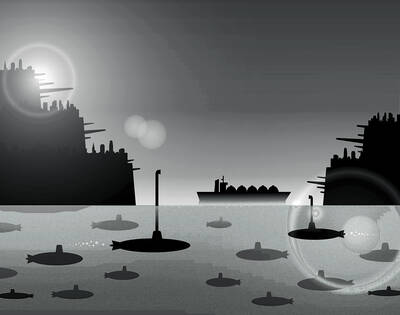
In the event of a war with China, Taiwan has some surprisingly tough defenses that could make it as difficult to tackle as a porcupine: A shoreline dotted with swamps, rocks and concrete barriers; conscription for all adult men; highways and airports that are built to double as hardened combat facilities. This porcupine has a soft underbelly, though, and the war in Iran is exposing it: energy. About 39,000 ships dock at Taiwan’s ports each year, more than the 30,000 that transit the Strait of Hormuz. About one-fifth of their inbound tonnage is coal, oil, refined fuels and liquefied natural gas (LNG),
On Monday, the day before Chinese Nationalist Party (KMT) Chairwoman Cheng Li-wun (鄭麗文) departed on her visit to China, the party released a promotional video titled “Only with peace can we ‘lie flat’” to highlight its desire to have peace across the Taiwan Strait. However, its use of the expression “lie flat” (tang ping, 躺平) drew sarcastic comments, with critics saying it sounded as if the party was “bowing down” to the Chinese Communist Party (CCP). Amid the controversy over the opposition parties blocking proposed defense budgets, Cheng departed for China after receiving an invitation from the CCP, with a meeting with
Chinese Nationalist Party (KMT) Chairwoman Cheng Li-wun (鄭麗文) is leading a delegation to China through Sunday. She is expected to meet with Chinese President Xi Jinping (習近平) in Beijing tomorrow. That date coincides with the anniversary of the signing of the Taiwan Relations Act (TRA), which marked a cornerstone of Taiwan-US relations. Staging their meeting on this date makes it clear that the Chinese Communist Party (CCP) intends to challenge the US and demonstrate its “authority” over Taiwan. Since the US severed official diplomatic relations with Taiwan in 1979, it has relied on the TRA as a legal basis for all
To counter the CCP’s escalating threats, Taiwan must build a national consensus and demonstrate the capability and the will to fight. The Chinese Communist Party (CCP) often leans on a seductive mantra to soften its threats, such as “Chinese do not kill Chinese.” The slogan is designed to frame territorial conquest (annexation) as a domestic family matter. A look at the historical ledger reveals a different truth. For the CCP, being labeled “family” has never been a guarantee of safety; it has been the primary prerequisite for state-sanctioned slaughter. From the forced starvation of 150,000 civilians at the Siege of Changchun


 RSS
RSS