


The Copenhagen climate summit had people focused on a range of issues, at least for thetime being. Global warming, energy conservation and the reduction of carbon emissions are being debated throughout the world. Public debates such as this, however, are often nothing more than opportunities for people to demonstrate how concerned they are and then to come out with some frivolous critiques or recommendations. The fact is that the vast majority of people don’t comprehend the ecological issues involved, or if they do, it is at best a rather superficial understanding.
Many countries in the world follow a farmer’s almanac. People in Taiwan use this to tell them not only which days they should carry out certain actions, but also dates important for agriculture, such as the correct time to plant and harvest crops. The ancient Chinese philosopher Mencius wrote: “If the agricultural seasons are followed, there will be more than enough food to go around.”
There is a lot of ecological wisdom in this.
In his “Governing the Nation: a Weekly Journal” on Dec. 12th, President Ma Ying-jeou (馬英九) warned if we do not do more to save energy and cut carbon emissions, we will have to rewrite the farmer’s almanac. This is a definite possibility. Rewriting the calendar is, however, a “mission impossible” for ecologists.
Different organisms require different “effective thermal summation” to complete their development or flower properly. People count their lifespans in years and it is difficult to see the impact of climate change on the human population in a few short years. Many insects, on the other hand, measure their lifespans in days, and their growth and development is significantly impacted by changes in temperature. Warming may well result in an earlier appearance of agricultural pests and dengue-fever-bearing mosquitoes. We could also see an exponential increase in their numbers.
During an economic recession it is natural for us to try to conserve energy and reduce waste. Waste is still all too common, however, and one of the biggest offenders in Taiwan is the government. Laws may be effective in combating corruption, but they do little to stop waste. The major universities also play their part, with their penchant for holding seminars. These seminars are black holes for the public purse. All the money goes into PR and entertainment, and all they achieve is to come up with the same tired conclusions.
In 1998, the German artist Thomas Jacobi held an exhibition at the German Cultural Center in Taipei. In this exhibition was a painting entitled Landscape of Wealth: the Passion and the Fortune, a reflection on the situation in Taiwan. The painting depicted a Taiwanese farmer, wearing a straw hat, ostensibly looking at a chart of stock prices, but actually looking at a parched paddy field. What a shame that more people don’t seem to be concerned about superficiality and waste.
So many ecological problems today are a direct result of the global population explosion and the subsequent exploitation and waste of natural resources. Fishermen in poverty stricken areas around the world make a living by dynamite fishing, using explosives to kill or stun fish. Fishing companies in affluent countries use advanced fishing equipment and mass fishing techniques, chasing vast commercial profits. The developing and developed countries at the climate summit were vying with each other, closing ranks along the lines of who created the problems and who has what vested interest.
The ecological issue at stake has many aspects to it. In addition to the scientific element, there are political, economic, educational and legal considerations. Very few of the politicians engaged in this process have an ecological background and they are unlikely to know the right answers to the problems. This makes the prospect of a future ecological catastrophe likely.
Our current ecological knowledge does not equip us adequately for the problems we face in this regard, and I believe just saying we need to save energy and reduce carbon emissions is not enough. We need to change people’s attitude toward ecology and call for everyone to be more frugal.
Chi Hsin is a professor in the laboratory of theoretical and applied ecology at National Chung Hsing University’s Department of Entomology.
TRANSLATED BY PAUL COOPER
A gap appears to be emerging between Washington’s foreign policy elites and the broader American public on how the United States should respond to China’s rise. From my vantage working at a think tank in Washington, DC, and through regular travel around the United States, I increasingly experience two distinct discussions. This divergence — between America’s elite hawkishness and public caution — may become one of the least appreciated and most consequential external factors influencing Taiwan’s security environment in the years ahead. Within the American policy community, the dominant view of China has grown unmistakably tough. Many members of Congress, as
The Hong Kong government on Monday gazetted sweeping amendments to the implementation rules of Article 43 of its National Security Law. There was no legislative debate, no public consultation and no transition period. By the time the ink dried on the gazette, the new powers were already in force. This move effectively bypassed Hong Kong’s Legislative Council. The rules were enacted by the Hong Kong chief executive, in conjunction with the Committee for Safeguarding National Security — a body shielded from judicial review and accountable only to Beijing. What is presented as “procedural refinement” is, in substance, a shift away from
The shifting geopolitical tectonic plates of this year have placed Beijing in a profound strategic dilemma. As Chinese President Xi Jinping (習近平) prepares for a high-stakes summit with US President Donald Trump, the traditional power dynamics of the China-Japan-US triangle have been destabilized by the diplomatic success of Japanese Prime Minister Sanae Takaichi in Washington. For the Chinese leadership, the anxiety is two-fold: There is a visceral fear of being encircled by a hardened security alliance, and a secondary risk of being left in a vulnerable position by a transactional deal between Washington and Tokyo that might inadvertently empower Japan
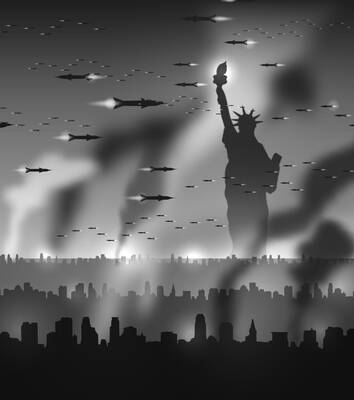
After declaring Iran’s military “gone,” US President Donald Trump appealed to the UK, France, Japan and South Korea — as well as China, Iran’s strategic partner — to send minesweepers and naval forces to reopen the Strait of Hormuz. When allies balked, the request turned into a warning: NATO would face “a very bad” future if it refused. The prevailing wisdom is that Trump faces a credibility problem: having spent years insulting allies, he finds they would not rally when he needs them. That is true, but superficial, as though a structural collapse could be caused by wounded feelings. Something


 RSS
RSS