


The economics award is usually the last of the Nobel Prizes to be announced. Correctly so, for it was also the last to be created — and strictly speaking is not even a real Nobel Prize.
The five original awards, first given out in 1901 for literature, peace, medicine/physiology, physics and chemistry, were intended by Alfred Nobel to recognize contributions that enhanced the quality of human life, through scientific advance, literary creativity or efforts at bringing about peace.
The economics prize is not a prize of the Nobel Foundation; rather, it was created in 1968 by the Central Bank of Sweden as a “prize in economic sciences in memory of Alfred Nobel.” However, it now has the same procedure of selection by the Royal Swedish Academy of Sciences and the same cash award presented at a similar ceremony as the Nobel Prizes.
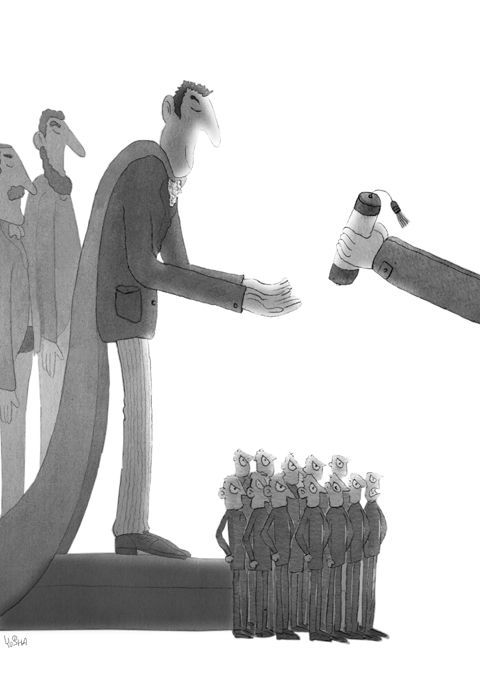
There have been recurrent doubts about whether it conforms to the basic goals of the prizes as envisaged by the founder. Is economics a science, on the same lines as physics or chemistry? Does it unambiguously contribute to human well-being, like peace or literature? In any case, should economics be privileged over other branches of learning?
Peter Nobel, great-grandnephew of the founder and human rights activist, famously argued that Alfred Nobel would not have approved of such a prize, which he termed as “a PR coup by economists to improve their reputation ... most often awarded to stock-market speculators.”
Certainly the reputation of economists has needed building up, not only in the wake of the global financial crisis, but even before that. As much of mainstream economics became obsessed with navel-gazing esoteric models or theories designed to justify market liberalism, the public became relatively more alienated from the activities of economists.
In such a context, the Nobel Prize has been a useful tool not only to proclaim the conceptual advances supposedly made by “the dismal science” but also to encourage certain types of economic analysis and research. So its power extends beyond public recognition, altering the very production of economic knowledge.
The early prizes generally honored economists whose work was already widely recognized. But even in the first decade, the list of exceptions was probably more impressive than that of the recipients, as great economists like Michal Kalecki, Joan Robinson, Richard Kahn, Nicholas Kaldor and Piero Sraffa were overlooked in favor of lesser contributors. In the subsequent period, the award has occasionally gone to economists of relatively minor and sometimes absolutely questionable achievement, whom others in the profession quickly had to look up when the announcement was made.
The political effect of the prize in the profession has been undeniable. There has been overwhelming domination of neoclassical economics to the exclusion of alternative streams of thought, with only a few nods in the direction of broader and more socially embracing approaches. This has encouraged more conservative approaches in research and teaching.
Monetarist and free market approaches have been disproportionately rewarded, often at crucial times. For example, the 1974 award to Friedrich von Hayek led to a resurgence of interest in the Austrian school and made his book The Road to Serfdom a bestseller. Two years later the prize went to Milton Friedman, making his extreme form of monetarism academically respectable and even leading to a conservative policy revolution. Economic history in the turgid and restricting form of retrospective econometrics was promoted by the 1993 award to Robert Fogel and Douglass North, while rational expectations theory was given a big boost by honoring Robert Lucas in 1995.
The geographical distribution of the award both creates and reflects power hierarchies in the discipline. The economics prize has been awarded 40 times to 62 recipients, 42 of whom have been from the US, while more than 50 were working in the US at the time of the award. The University of Chicago has 11 laureates, leading to the joke about “the Stockholm-Chicago Express.” This does not reflect the actual state of economic knowledge so much as the biases and blindness of the jury.
Only two persons from developing countries have received it (Arthur Lewis and Amartya Sen) and both worked in the US and England. Only three economists with an interest in the economics of developing countries — which is the economic reality for around three-quarters of the world’s population — have received the award.
In recent years, the prize has been focused on financial market behavior. In 1997, the award went to two economists — Robert Merton and Myron Scholes — who were supposed to have discovered a method of valuing derivatives that could reduce or eliminate risk in financial investment. When the hedge fund that they ran (Long Term Capital Management) went bust within the year and had to be rescued by the US Federal Reserve, there was some embarrassment. Perhaps to right this wrong, a few years later the prize was given to economists George Akerlof and Joseph Stiglitz, who had pointed to the imperfect functioning of financial markets. The award last year to Paul Krugman may also have indicated some bowing to changing times.
So far, no woman has got the economics Nobel. Apart from obvious exclusions such as Joan Robinson, this also reflects power hierarchies within the subject, because women economists, even in the US and the UK, tend to be concentrated in the lower reaches of the academics profession as researchers and lecturers rather than professors.
These imbalances will not be rectified easily. But the Nobel Prize in economics may now be as much in need of wider legitimacy as the economics profession itself. It will be interesting to see if this is reflected in the current year’s award.
Jayati Ghosh is professor of economics at the Jawaharlal Nehru University in India.
Two sets of economic data released last week by the Directorate-General of Budget, Accounting and Statistics (DGBAS) have drawn mixed reactions from the public: One on the nation’s economic performance in the first quarter of the year and the other on Taiwan’s household wealth distribution in 2021. GDP growth for the first quarter was faster than expected, at 6.51 percent year-on-year, an acceleration from the previous quarter’s 4.93 percent and higher than the agency’s February estimate of 5.92 percent. It was also the highest growth since the second quarter of 2021, when the economy expanded 8.07 percent, DGBAS data showed. The growth
In the intricate ballet of geopolitics, names signify more than mere identification: They embody history, culture and sovereignty. The recent decision by China to refer to Arunachal Pradesh as “Tsang Nan” or South Tibet, and to rename Tibet as “Xizang,” is a strategic move that extends beyond cartography into the realm of diplomatic signaling. This op-ed explores the implications of these actions and India’s potential response. Names are potent symbols in international relations, encapsulating the essence of a nation’s stance on territorial disputes. China’s choice to rename regions within Indian territory is not merely a linguistic exercise, but a symbolic assertion
At the same time as more than 30 military aircraft were detected near Taiwan — one of the highest daily incursions this year — with some flying as close as 37 nautical miles (69kms) from the northern city of Keelung, China announced a limited and selected relaxation of restrictions on Taiwanese agricultural exports and tourism, upon receiving a Chinese Nationalist Party (KMT) delegation led by KMT legislative caucus whip Fu Kun-chi (傅崑萁). This demonstrates the two-faced gimmick of China’s “united front” strategy. Despite the strongest earthquake to hit the nation in 25 years striking Hualien on April 3, which caused
In the 2022 book Danger Zone: The Coming Conflict with China, academics Hal Brands and Michael Beckley warned, against conventional wisdom, that it was not a rising China that the US and its allies had to fear, but a declining China. This is because “peaking powers” — nations at the peak of their relative power and staring over the precipice of decline — are particularly dangerous, as they might believe they only have a narrow window of opportunity to grab what they can before decline sets in, they said. The tailwinds that propelled China’s spectacular economic rise over the past


 RSS
RSS