


I have a theory that we each have a vague kinship with an exotic animal. Perhaps you have an inexplicable affinity for leopard print. Or your shower curtain is covered in butterflies, similar to the one tattooed on your ankle. Or you were a Rubenesque, somersaulting toddler and your family nicknamed you Panda.
For me it is the giraffe. My career as a long-necked mammal began at a supermarket checkout circa 1987, when a woman actually said it: “Aw. You look just like a little giraffe!”
I looked up to my mother for help, but her face was hidden behind a tabloid announcing Princess Diana’s marital woes. I was left to fend for myself.
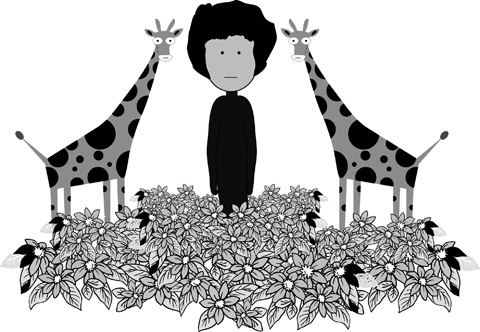
I must have looked stricken, because the woman said: “Don’t worry honey, it’s a compliment.” (“Don’t worry” is code for “You should really worry a lot about this.”)
She was a puffin of a woman, smiling warmly down at me. Stick drawings were an accurate representation of my body that year, so I’m sure that my limbs shooting out of a jumper below a mop of brown hair did indeed resemble a baby giraffe.
Up to that point, I was aware of height only insofar as I bruised my knees on my best friend Jeni’s bike handlebars, and that I shopped in the juniors section. I wasn’t concerned until adults started regularly shrieking, “My, look how tall you are!” Rather than looking at my never-ending fingers and saying, “Oh, a piano player,” they opted for a comparison with an African safari creature.
The woman was still looking at me expectantly. I grabbed my mother’s thigh, looked down and quietly said: “Thanks.”
Puffin woman would prove to be firmly in line with the rest of society. In my elementary school zoo play, I was the giraffe. In sixth grade, when my science class voted on who would do reports on which animals, I got the giraffe.
A decade later, as a 188cm first-year undergraduate at Harvard, the annual water polo team initiation ritual took place at a jungle-themed party. While the other girls wore little black dresses (the panther), faux snakeskin trousers (the python) or tight red sweaters over green minis (the parrot), I wore tapioca yellow Capri pants, ears and chocolate body paint spots.
Tall folk are incapable of talking about their height without discussing their family. Height is a trait that comes with a long shadow. There’s always a history. It’s an inheritance.
Mine begins in 1952, when my grandmother bought a baby book in which to note the developments of my mother’s childhood and began plotting my mother’s height on the growth chart provided. The result is comical: My mother’s height stubbornly refuses to stay within half a page of the chart’s clearly defined “average zone.” By age four, my grandmother’s ballpoint indentations have turned into a panic. The page is filled with erased pencil dots attempting to plot the future. The future said 188cm.
In 1962, my grandmother read in a newspaper about a new estrogen treatment that brought on early puberty, closing the growth plates around the age of 11, thereby skipping the furious years of growth at 12 and 13. Up to that point, my mother’s tall childhood had been textbook: “Amazon Arline!” she was called. “Daddy Long Legs.” Ten thousand queries of “How’s the weather up there?”
One of her legs was already permanently shorter than the other from her hip-drop stance, where she spread her legs into an upside-down V and shifted one hip downward so the socket dropped, shaving off around 10cm. With slouching, she could reduce herself by nearly 17cm.
The photo albums are consistent with the baby book: a coltish girl with never-ending legs under an afro of auburn curls. Arline pouting in a slouch on family vacation. Arline pouting in a slump at home. Arline pouting in a pile at the beach. It takes the suspense out of turning the page.
Which is all to say that my mother arrived at the office of the endocrinologist in a mild state of ecstasy. For the next year and a half, she took an orange pill morning and night. A bevy of male doctors tracked her for signs of puberty. She had a few migraines, presumably from the hormones, and went into express puberty, gaining 13kg in a year, as dutifully documented in the baby book’s accompanying weight chart. Her growth curve, previously a gentle sinusoidal arch, suddenly flatlined. And then treatment ended abruptly. She was 182cm, thrilled to have dodged the 183cm bullet.
Of course, she was still tall, towering 17cm over the 166cm Jacqueline Onassis, then considered statuesque. She puts it shortly: “My height was my biggest problem, it defined who I was, and it was defined negatively.”
She grew into an adult who “dreams of being 1.65m.” She wore beige and navy, and never donned a hue that you might see in, say, a rainbow — nor heels, ever. (The goal is to be shorter, not pretty.) If she could become the wallpaper, she would.
Which is how I came to visit the endocrinologist annually from the age of three. She wanted me to have the option, because for her it had been “among the best things I’ve ever done.” For a decade I went as a matter of course. I thought everyone had an endocrinologist, like a dentist for your growth. Just bone scans instead of tooth X-rays.
The skeleton details of why I was there were revealed to me when I was 11. Which is how I found myself facing Dr Kauger, my mother, and the question: “So what height would you like to be?”
I had six months to decide, because the pills had to be started before puberty. I peered over Dr Kauger’s shoulder, tracing my curve to its end: 190cm. Way above all the other growth curves. My mother sent me to the waiting room so she could talk with Dr Kauger. I thought things over.
I was having a hard time framing my height positively. The week before I’d attended a social, a dance-cum-hangout where 11-year-olds gossiped in the basement of my school alongside pool tables and a long mahogany bar that served root beer and ginger ale. I arrived early and lingered in a corner for a while in my signature stance, the hip drop. Nothing is more unattractive than the hip drop. The room lacked chairs (no one can work a chair like a tall girl), so I hovered awkwardly, towering above the cliques, unable to hear the girls and drawing zero interest from the boys.
When my hips started to ache, I awkwardly strolled my 170cm self around the room, passing Katie and Justin, a year older, at a pool table. My brain has blocked out the precise phrasing of what they said, but the gist was: “No one likes you, you look like a giraffe, and no boy will ever date you.”
The problem with tall teasing is that, unlike most teasing, it’s 100 percent accurate. I really did look like a giraffe. And no boy on the premises would even consider dating me. So obviously they were right.
At least my mother was on my side. She had smartly overloaded my schedule with activities where height was an asset — tennis, dance, swimming.
In Dr Kauger’s waiting room, I watched adorable chemo-stunted boys and girls play below walls muralled with giraffes. Children’s illustrators often employ giraffes as a neutral mascot of difference.
“Because of its height, the giraffe has long been a symbol of people who just don’t fit in,” writes Lynn Sherr, the tall American news anchor who was so intrigued by her own lifelong association with giraffes that she took time off to write a book about them, Tall Blondes. “They may be too tall or too eccentric, or simply too different from everyone else, like exclamation points on the landscape.”
An exclamation point. That is exactly what I felt like.
I was the sort of child who read the op-ed page, so I thought that perhaps there might be a book to help me make my decision. That afternoon I went to the library. The card catalogue said, “Tall: see Giraffe.” No mention of “estrogen” or “height-reduction treatment.”
From Memily, by children’s writer Stephen Cosgrove: “Week after week, Memily grew and she became sadder and sadder. She was shy and embarrassed by her height, and whenever any of the other creatures walked by she would turn her head, knowing that they had to look up just to look her in the eye.”
Memily develops a severe slouching problem. So did I.
But Memily, apparently, was never offered estrogen therapy. So I had to make the decision alone. My thinking had little to do with height and more to do with a general aversion to medication: When in doubt, don’t take chemicals.
At the time, it was simply a decision of passivity. I was frozen. Though I wasn’t happy with my body, I didn’t want to change it. I told myself that the fastest swimmers in the world were six-footers. Long limbs were important. So I decided to not do anything. I figured I’d just wait and see what happened.
What happened is I ended up on the couch of therapist Diane, my gawky 17-year-old limbs sprawled awkwardly. My mother sent me as a precautionary measure, concerned that I wasn’t talking much. But really, I just didn’t want to talk about my life as an exclamation point. I mean, what was there to say? Boys ignored me. My closest resemblance was to Big Bird. There wasn’t enough happening to fill light pleasantries, let alone an hour of analysis.
So we talked about my mom. This is what therapists do: untangle women from their mothers. One day I announced that I didn’t think my familial height was particularly feminine. Diane gamely insinuated that perhaps this was just one perception: mine.
She asked me how I felt about my body. I looked down at myself on the couch, lean and tanned from hours of daily swimming. As bodies go, even then, mine sort of did what it’s supposed to do. Length is a great friend of thighs and tummies — it stretches them, taking the eye away from the bulges. And I could wear pretty much any style — glam, boho, sporty, chic.
Tallness is, objectively speaking, gorgeous. Tallness, by definition, can only be awkward when there are shorter bodies nearby. You see it at basketball games: the tall athlete looks ethereal in her own space, all grace and long angles. And then the much shorter teammate comes into the frame, and suddenly she looks like the Hulk. Or the shorter teammate looks like Humpty Dumpty. Ditto on catwalks when the designer appears. Sitting on the couch alone was great.
“So,” Diane asked, “where’d you get the idea that you weren’t feminine?”
The true challenge of tall life is not that you’re tall. Who cares about that — legs are legs. The challenge is that everyone can see you, all the time. Eyes follow you everywhere you go. You’re public. On display. There is no hiding. Learning to love yourself has nothing to do with the blather you see in women’s magazines about treating your body as a temple — it’s learning to accept the high-wattage spotlight that came packaged with your body, always shining on you. I can tell you what it feels like to resist: like a non-performer pushed on stage, day after day. The giraffe in the room.
Shortly after college, I headed for a journalism job in Cambodia, one of the shortest countries in the world, where men average 160cm, and women below 150cm. If you want to know why I chose Cambodia, I can only say that I had just spent four undergraduate years at Harvard, where students are quite tall, and I’d melded in for the first time. Thus, height wasn’t on my mind when I chose my next step.
I spent much of my time in Phnom Penh attending press conferences where I walked in to find 50 men and 20 cops milling around, the tallest of whom reached my armpit. All stared. I never figured out how to manage this situation.
I was the tallest person anyone had ever seen. Taller than the locals, taller than the expatriates. I assumed that after months of frequenting the same markets with the same saleswomen, they would eventually get over it. Never happened. Every time I entered a market or passed any Cambodian, I ran a 75 percent chance of hearing, “Bpee meters!” (“Two meters!”) followed by a swift sucking in of breath.
I was considered so tall, and therefore exotic, that I didn’t get a gender — I was just an enormous barang (foreigner), a sort of uber-large white mutant.
Tall hazards are never what you expect. One Monday I awoke in Phnom Penh with a bit of stomach pain and soon found myself on a plane to Bangkok General for an emergency appendectomy. The surgery went smoothly and I landed in an extra-long bed on the Foreigner Floor. A nurse handed me my belly-button ring, which had apparently caused 15 minutes of operating room commotion.
The English-speaking doctor, the green-turbaned Dr Singh, explained that my surgery had been successful. Then he informed me that they had found an “unspecified mass” on my pancreas. He wanted to let me rest and then perform another CAT scan the following day, focusing on the pancreas. He also ordered blood work to look for tumor markings. He held up an MRI image of my pancreas and pointed to where it should end. Mine extended 15cm past his finger. He said it could just be inflammation, but that he’d asked the nurses not to mention it.
I knew perfectly well that pancreatic tumors are bad news. The five-year survival rate is 3 percent. But I consoled myself with the free-flowing morphine and the knowledge that I would have an answer soon.
While I pondered the fact that I was potentially dying of pancreatic cancer, Dr Singh took a five-day trip to China. I was put on the Foreigner Diet, which consisted of cream of corn soup breakfast, cream of chicken soup lunch and, one night, cream of cream. Then the CAT-scan machine broke. Despite this, too-young nurses starved me every night in preparation for morning CAT scans that never materialized. I was so bored that I watched Showgirls in Chinese.
When you think you have a terminal illness at 23, this is what you do: first, you want to wave a wand to make your problems go away. You poke at your pancreas, and wonder why you can’t just reach through the skin and fix it. Then you remind yourself that you will never have sex again, and that the rest of your life will be painful, boring and short. It was over.
On day seven, a relaxed-looking Dr Singh appeared.
I was very hungry, having fasted yet again. He was smiling.
“Good news, your CAT scan was fine. You do not have a pancreatic tumor.”
I tried to convey my best “I just spent eight days contemplating my own death” look.
He explained that in the basement the radiologists review the X-rays and scans, and they have little charts glued to the wall telling them how many centimeters each organ should be.
“My dear, as you know, you are very tall. So, I think that maybe they looked and thought your pancreas was very large for a Thai person. You probably had a bit of pancreatitis, too, but you are OK now.”
I glared.
“You do not have a tumor, my dear,” he smiled. “You are just very tall.”
Cambodia was my one respite from giraffes. Southeast Asians don’t really know what they are. But had I known what I know now about giraffes, I would have missed their presence in my life. Giraffes are tall, laid-back creatures of the highest order: polysocial, known for hanging out in any number or gender combination, the cool lunch table. They stand lookout among the zebras and wildebeests and ostriches, and get along with the entire savannah. They are anything but outcasts.
Giraffes come in all the hair colors I have tried — red, black, brown and blonde — and their hooves are the size of dinner plates, their eyes wider than a spread hand. The word comes from the Arabic zarafa, which means to hurry, something at which they are more awkward than the most awkward tall person you’ve ever seen. They move both right legs and then both left legs to prevent tangles. At 4m tall, their ability to get a drink and not black out is studied by NASA scientists. They are nuts for routine. If the daily schedule changes, they turn into Rain Man.
Our interest in giraffes is intriguing, because giraffes are one of those rare creatures that serve no purpose to us. We can’t eat them or make clothes out of them or use them for labor. They’re not even all that entertaining (see: penguins). Basically, we like them because they’re tall.
I saw this during my brief stint as one half of America’s tallest couple, with my 215cm partner, Alan. It was important for me to see someone else’s experience of extreme height. We met at the European Tall Club convention, where I’d gone to report for my book. As I watched people interact with him, what I saw was that people really loved him. Toddlers make a beeline for him; adults want to sit at his table; friends sort of burrow into his side; at parties, the space next to him is always filled. He gets a lot of hugs. From everyone. Men, women, children, the elderly. They could never say why.
I found the answer in a 1969 book on giraffes by C.A.W. Guggisberg: “Humans are awed and deeply stirred by anything that is big. A monumental building, a big ship or a towering mountain all give us a thrill.”
People love tall. I didn’t believe it until I saw it with my own eyes.
In researching The Tall Book, I found that, without fail, children absorb their parents’ feelings about their height. Just as one learns from one’s parents a suitable wedding gift and what appropriate make-up and jewelry looks like, one also finds one’s adult self-ingrained with a sense of what bodies are appropriate. And I sensed that to be tall was not appropriate.
Susie Orbach puts it differently: “If parents are tall and uncomfortable, then children will feel that part of being tall is to be out of sorts, to be peculiar in some way. So they will feel like they are ill-fitting in a profound sense.”
Which is how I ended up at the European Tall Club Convention, on the arm of the one man who negated any sense that I was on display — more than any other man on Earth. When we went for walks, people either stared at him or at my dog. In my journal I wrote, “Ignored again! Fascinating!”
I had never dated anyone shorter than me. I spent my time seeking out the 3 percent of men taller than me, who by definition made me not tall. I was alerted to the error of my ways while interviewing love and relationship expert Betty Dodson. When I told her I only dated up, she exclaimed: “You’re prejudiced! I mean, come on! Develop a sense of humor! It will help. Look in the mirror and say, ‘Goddamn, we’re a weird-looking couple.’ And then shut it off.”
This was among the most life-changing advice I’ve ever received. Because she’s not talking about height. She’s talking about the way in which we all unwittingly corner ourselves by whittling down our options. Perhaps you only date or befriend people who are your ethnicity, or are overly educated, or in a certain field. And suddenly, just like that, 90 percent of your pool disappears.
Height makes a great case study, because height statistics are easily quantifiable. Tall women have half the birth rate of shorter women.
“It’s not related to lower fertility,” says anthropologist Boguslaw Pawlowski, the pre-eminent mating patterns researcher. “It’s the same with short guys. They are not limited by sperm quality or hormone level — they’ve got problems with finding a partner.”
In the population at large, women typically date men who are 8 percent taller. This is a boon for the women below the 50th percentile, who have 99 percent of men to choose from. A 190cm woman is looking at less than 3 percent of the male population. Extrapolate freely to the choices you make in your own life.
I had six months with Alan to let Dodson’s words marinate before the relationship imploded. The truth was that despite getting along famously, we had little in common. No tall joke could save us. And in the two years since, I haven’t kissed anyone taller than me. Don’t get me wrong, they’re still tallish — the 183cm DJ, the 181cm triathlete, the 185cm actor. But my dating pool has expanded by 3,000 percent. I’m happier.
Giraffes have incredible vision, able to identify people or animals a mile away. This is also metaphorically true. To be different is to see more. And I saw that perhaps I should look slightly downward from time to time.
I did, and a whole new world opened up — one a little closer to the ground.
Arianne Cohen is the author of The Tall Book: A Celebration of Life on High.

A failure by the Chinese Communist Party (CCP) to respond to Israel’s brilliant 12-day (June 12-23) bombing and special operations war against Iran, topped by US President Donald Trump’s ordering the June 21 bombing of Iranian deep underground nuclear weapons fuel processing sites, has been noted by some as demonstrating a profound lack of resolve, even “impotence,” by China. However, this would be a dangerous underestimation of CCP ambitions and its broader and more profound military response to the Trump Administration — a challenge that includes an acceleration of its strategies to assist nuclear proxy states, and developing a wide array
Eating at a breakfast shop the other day, I turned to an old man sitting at the table next to mine. “Hey, did you hear that the Legislative Yuan passed a bill to give everyone NT$10,000 [US$340]?” I said, pointing to a newspaper headline. The old man cursed, then said: “Yeah, the Chinese Nationalist Party [KMT] canceled the NT$100 billion subsidy for Taiwan Power Co and announced they would give everyone NT$10,000 instead. “Nice. Now they are saying that if electricity prices go up, we can just use that cash to pay for it,” he said. “I have no time for drivel like
Twenty-four Chinese Nationalist Party (KMT) lawmakers are facing recall votes on Saturday, prompting nearly all KMT officials and lawmakers to rally their supporters over the past weekend, urging them to vote “no” in a bid to retain their seats and preserve the KMT’s majority in the Legislative Yuan. The Democratic Progressive Party (DPP), which had largely kept its distance from the civic recall campaigns, earlier this month instructed its officials and staff to support the recall groups in a final push to protect the nation. The justification for the recalls has increasingly been framed as a “resistance” movement against China and
Chinese Minister of Foreign Affairs Wang Yi (王毅) reportedly told the EU’s top diplomat that China does not want Russia to lose in Ukraine, because the US could shift its focus to countering Beijing. Wang made the comment while meeting with EU High Representative for Foreign Affairs and Security Policy Kaja Kallas on July 2 at the 13th China-EU High-Level Strategic Dialogue in Brussels, the South China Morning Post and CNN reported. Although contrary to China’s claim of neutrality in the Russia-Ukraine conflict, such a frank remark suggests Beijing might prefer a protracted war to keep the US from focusing on


 RSS
RSS