


You say CECA, I say ECFA — let’s call the whole thing off.
I don't know about you, but I've had just about enough of the alphabet-soup jabbering over President Ma Ying-jeou's (馬英九) proposed economic agreement with the Chicoms.
First it was a CECA, or “Comprehensive Economic Cooperation Agreement.” The CECA had aimed to get the two sides to the economic equivalent of “second base,” as our American friends say, further enhancing Taiwan and China’s trade relationship.
In more concrete terms, it would lower tariff and other trade barriers for a range of goods in line with regional trends.
But to many Taiwanese ears, CECA sounds suspiciously like CEPA — the agreement that Hong Kong inked with Beijing a few years after reverting to Chinese control.
In other words, it seemed like Ma was preppin’ us for a no-holds barred, pack-the-edible-underwear and gobble-the-Viagra love hotel tryst with the Chicoms.
Naturally, that’s going too far and too fast for most Taiwanese. Our economy is already in a depraved lip-lock with China’s, so do we really want to become full-fledged “friends with benefits”?
I mean, we’re not that drunk — most of us, anyway.
So, in his predictable, reactive (read: spineless, Jell-O-like) style, Ma beat a hasty retreat. Now, he says, we’re not going to have a CEPA, we’re going to have an ECFA (Economic Cooperation Framework Agreement) instead.
Apparently, Ma thinks that shifting to a harder-to-pronounce acronym will make it go down better politically.
To me, ECFA sounds like a communicable skin disease — something you might pick up in the Combat Zone if you’re not careful.
The Bloomberg news agency said: “President Ma Ying-jeou proposed Feb. 27 that the pact be described as an economic framework and asserted that it would not involve the sensitive issues of unification or independence but rather … be part of Taiwan’s efforts to better position itself in the global economic landscape.”
By “position” ourselves, I guess Ma means applying a generous dollop of KY, grabbing both ankles and gazing toward Guam.
As the Taiwan News writes: “the gravest issue in this flap is the evident inability or, more likely, abject refusal of the Ma government to frankly discuss and thoroughly discuss the nature of an ECFA and CECA and the attendant costs and risks as well as purported benefits with Taiwan’s opposition parties, diverse economic, civic and social ‘stakeholders’ and all citizens.”
A bit wordy, that — but I heartily agree (I think).
Exhibit A: What is to be included in the CECA-cum-ECFA other than generally lower tariffs?
Dunno.
Ma promises, as he did in his campaign, that any such agreement wouldn’t allow Chinese laborers into Taiwan’s job market or result in a flood of cheap agricultural products. But are we supposed to take his word for it?
Even former president Lee Teng-hui (李登輝) pulled himself together long enough to croak to a reporter that an ECFA wouldn’t make Taiwan any better off, and that it would be “silly” to think that it could.
And the China Post generously noted that not everyone thinks this is an economics-only issue: “CECA would result in a downgrade of Taiwan’s sovereignty and pave the way for unification with China, the opposition said.”
But forget the tiresome sovereignty debate. Here’s my question: China, aka Melaministan, has a proven track record as a source of toxic, shoddy products. Even Beijing this week described the food safety situation as “grim.” (Take that, you WHO flunkies!)
So do we really want to make it easier for Chicoms to flood our little island with planeloads of low-grade, poisonous crap?
Moreover, it looks like Ma’s clever name games were too hard for the Chicoms to follow. According to Bloomberg, Chicom big cheese Wen Jiabao (溫家寶) had the following to say as he addressed China’s “parliament” (sneer quotes intended): “‘We will accelerate normalization of cross-straits economic relations and promote the signing of a comprehensive agreement on economic cooperation,’ Wen said in his work report, presented to the National People’s Congress in Beijing today.”
So much for The Economic Pact Formerly Known As CECA. And not only that, now Wen’s talking about a peace agreement.
Hold on to your dentures there, Grandpa Wen. I know “Mr Malleable” Ma is the best thing to happen to China in decades, but still — aren’t we getting just a wee bit ahead of ourselves?
The Chicoms are all in a lather wanting to lock in some kind of political deal while their best bud Ma is still in office. But Ma realizes that scoring too high, too soon on the Wuss Index could see his reelection chances capsize faster than an overcrowded Bangladeshi ferry.
Selling out Taiwan can wait until his second term.
In the meantime, the government needs to go back to the drawing board to come up with intermediate agreements that Taiwanese find more palatable.
An obvious starting point: toilet restaurant cooperation. According to Time magazine’s Web site this week, Taiwan’s own Modern Toilet restaurant chain — you know, the one that dishes up curry chicken and chocolate ice cream in mini-toilet bowls — is all set to open a store in Shenzhen.
Which means now would be the perfect time for an alternate CECA: a “Comprehensive Edible Crap Agreement.” This will provide low-interest loans and other perks to make it easier for Chicom toilet restaurants to invest in Taiwan, and vice versa. A small but important step in freeing up cross-strait trade and investment.
Here are a few other suggestions to get our bureaucrats’ mental wheels turning:
NMPWTA: The “No Melamine, Please — We’re Taiwanese” Agreement, which would ban all Chinese goods. This one’s popular in Sanchong (三重).
FUCKTVA: The “Free, Unlimited Cross-Strait KTV” Agreement, which would provide free entry for Chinese tourists visiting Taiwanese KTVs, and vice versa. Expected to increase total amount of tuneless warbling by 316 percent.
CECBJCMNTFCA: the “Closer Economic Cooperation, But Jesus Christ Man, Not That Frickin’ Close” Agreement. Similar to the CECA, but with smaller tariff cuts and no scary details.
NMAFA, aka TIBET: The “No More Absconding Filipinas” Agreement (also known as “The Indigent Boomerang Effect is Toast”), in which runaway housemaids and carers for Taiwan’s young, infirm and elderly are locked up in a Chinese thought-correction-through-slavery camp near Lhasa instead of being deported to Manila.
SELAGDA: the “Screw the Economy, Let’s All Get Drunk” Agreement. Expected to boost kaoliang sales 43 percent and double Kinmen’s GDP.
The BOOM-CECA-ROCKA-CECA-ROCKA-CECA-BOOM Agreement. Not sure what this one’s about, but it might get us all singing.
Got something to tell Johnny? Go on, get it off your chest. Write to dearjohnny@taipeitimes.com, but be sure to put “Dear Johnny” in the subject line or he’ll mark your bouquets and brickbats as spam.
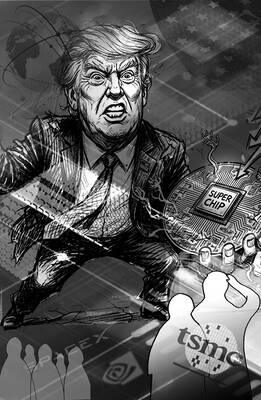
The White House’s decision to take a 9.9 percent stake in Intel Corp is looking like very shrewd business indeed. Since the government bought in at US$20.47 a share last August, the US chipmaker’s surging stock price has delivered the US a US$43 billion return. One of the reasons the investment has so far proved so sound is that the White House has made sure of it. According to The Wall Street Journal, Howard personally pushed deals on Intel’s behalf with some of the most lucrative clients imaginable. They include Nvidia Corp, the company at the heart of the AI
A single photograph can cut through a lot of noise, but it can also be used to misrepresent the truth. At the very least, it can concentrate the mind on something that requires further investigation. On Monday last week, Ma Ying-jeou Foundation CEO Tai Hsia-ling (戴遐齡) and former National Security Council secretary-general King Pu-tsung (金溥聰) held a news conference in which they showed a photograph of former foundation CEO Hsiao Hsu-tsen (蕭旭岑), now Chinese Nationalist Party (KMT) deputy chairman. In the image Hsiao is seated next to Xiamen Taiwan Businessmen Association chairman Han Ying-huan (韓螢煥). The two men were holding
I first met Professor Ray Jiing (井迎瑞) as a film and documentary student at Shih Hsin University’s (SHU) Department of Radio Television and Film in 1988. The following year, he went on to become the director of the Chinese Taipei Film Archive — forerunner of the Taiwan Film and Audiovisual Institute (TFAI). Over his eight-year tenure, Jiing rescued and restored over 200 classic Taiwanese films. In 1997, he established the Graduate Institute of Studies in Documentary and Film Archiving at Tainan National University of the Arts (TNNUA), and I joined the program in his third cohort of students. Beyond a
President William Lai Ching-te’s (賴清德) May 20 second-anniversary address was not just a routine policy review; it was damage control. US President Donald Trump’s remarks — that he did not want to see anyone move toward independence and that the delivery of a major Taiwan arms package could depend on the progress of US-China relations — unsettled Taiwan’s public and created an opening for opposition parties to question whether Taiwan was being treated as a bargaining chip in Washington’s dealings with Beijing. Lai’s speech was designed to close that opening. The address covered the expected ground: sovereignty, cross-strait relations, defense spending,


 RSS
RSS