


In the week of the crash in 1929, Wall Street fell by 23 percent. Last week, it fell by 18 percent, London and Frankfurt by 21 percent and Japan’s Nikkei by 24 percent. Every major financial center’s interbank market is frozen. Trust and confidence have collapsed; the global system is paralyzed on a scale that now surpasses 1929. There is a combination of a worldwide bank run, seizure of credit markets and collapse of asset values that could plunge the globe into a depression. This is history’s joke: the crisis of capitalism long predicted by communists and socialists who are no longer able to take advantage of it.
The scale of what is happening is scarcely credible. Last week, the UK government committed itself to an unparalleled £500 billion (US$875 billion) of extra support for Britain’s paralyzed financial system — up to £50 billion of capital, guarantees for £250 billion of lending between banks and additional injections of cash. This is the biggest, most comprehensive and best-thought-through operation of its kind mounted by any Western government since 1945. It was rewarded for its pains by a further 10 percent fall in stock market prices, a further freezing of the already crisis-stricken interbank markets and, most ominously of all, the beginnings of a run on sterling.
One government can do so much; the British plan was simply swept to one side by what is now a financial pandemic that only a global response can address. G7 finance ministers, at last jointly aware of the gravity of the crisis, attempted to produce such a response in their five-point plan announced at the meeting of the IMF and World Bank in Washington last Friday night.
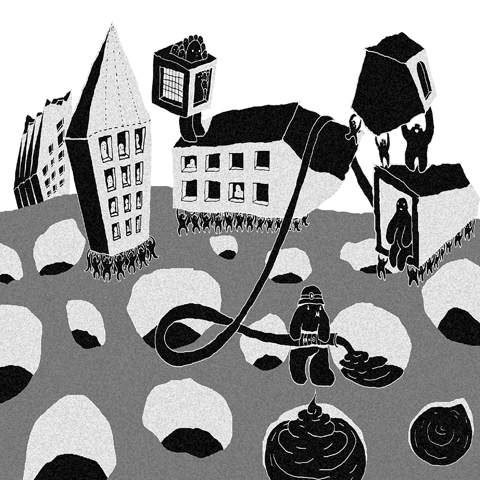
ILLUSTRATION: MOUNTAIN PEOPLE
The proposals are distressingly broad brush and hardly add to the markets’ knowledge. It is no longer news that governments do not intend to let a major bank fail, nor that they will protect depositors, inject capital from taxpayers, free up liquidity and do whatever is necessary to keep the system going. At best, I fear it will temporarily hold the line; at worst, it will be ignored as platitudinous.
The problem is that the markets no longer have any faith that the world financial system they helped create has any future. The model is bust. It is encouraging that both the US citizens and Germans are now moving towards what they considered ideologically unthinkable a fortnight ago — they are preparing to follow the British lead, take big public stakes in banks and offer guarantees to the interbank market.
But while this is a necessary condition for stabilization it is not sufficient. What needs to happen on top is an assault on the dark heart of the global financial system — the US$55 trillion market in credit derivatives and, in particular, credit default swaps, the mechanisms routinely used to insure banks against losses on risky investments. This is a market more than twice the size of the combined GDP of the US, Japan and the EU. Until it is cleaned up and the toxic threat it poses is removed, the pandemic will continue. Even nationalized banks, and the countries standing behind them, could be overwhelmed by the scale of the losses now emerging.
This market in credit derivatives has grown explosively over the last decade largely in response to the US$10 trillion market in securitized assets — the packaging up of income from a huge variety of sources (office rents, port charges, mortgage payments, sport stadiums) and its subsequent sale as a “security” to be traded between banks.
Plainly, these securities are risky, so the markets invented a system of insurance. A buyer of a securitized bond can purchase what is in effect an insurance contract that will protect him or her against default — a credit default swap (CDS). But unlike the comprehensive insurance contract on your car, which you have with one insurance company, these credit default contracts can be freely bought and sold. Complex mathematical models are continually assessing the risk and comparing it to market prices. If the risk falls, the CDSs are cheap; if the risk rises — because, say, a credit rating agency declares the issuing company is less solid — the price rises. Hedge funds speculate in them wildly.
Their purpose was a market solution to make securitization less risky; in fact, they make it more risky, as we are now witnessing. The collapse of Lehman Brothers — the refusal to bail it out has had cataclysmic consequences — means that it can no longer honor US$110 billion of bonds, nor US$440 billion of CDSs it had written. On Friday, the dud contracts were auctioned, with buyers paying a paltry 8 cents for every dollar. Put another way, there is now a US$414 billion hole that somebody holding these contracts has to honor. And if your head is spinning now, add the three bust Icelandic banks. They can no longer honor more than US$50 billion in bonds, nor a mind-boggling US$200 billion in CDSs.
The implications are global. The UK government might have frozen Icelandic assets in the UK to get some compensation for the losses, but we are only part of the story. Austrian, Danish and Finnish banks all hold near valueless Icelandic bonds on which they will have bought CDSs from heaven knows whom — Deutsche Bank? A two-bit hedge fund in Dubai? Lehman Brothers? Kaupthing? Shareholders in Barclays and RBS are rightly concerned; the two banks hold a stunning US$2.4 trillion of CDSs each — more than the UK’s GDP.
We don’t know their exposure to Iceland and Lehman Brothers, but with such enormous credit derivative books it would be amazing if there were none. While every bank tries to pass the toxic parcel on to somebody else, the system has to find the money. So will compensation for the near valueless contracts and thus now uninsured debt ultimately be made — and by whom? And because nobody knows — not the regulators, banks or governments — who owns the swaps and whether they are credit-worthy, nobody can answer the question. Maybe holders of insurance policies will get the cash due to them, but will that weaken somebody else? The result — panic.
This is the ultra-dangerous downward vortex in which the system is locked. It is why share prices are plummeting. As recession deepens, there will be defaults on securitized bonds and the potential collapse of more banks outside the G7 ring-fence. Nobody knows what proportion of the US$55 trillion of credit default contracts that have actually been written will be honored and who might bear losses running into trillions of dollars. Buying new contracts to insure against default has become prohibitively expensive. Securitization, and insuring against risk, has effectively ceased. And because the markets don’t know where the losses will fall, banks cannot borrow from each other except overnight or from their central bank. Credit flows are at a standstill. Property prices are plummeting. A famous economist, Hyman Minsky, foretold that unregulated finance capitalism inevitably ends in a meltdown and slump. The world is facing a Minsky moment.
One element of the necessary response is in the making — giving banks access to unlimited taxpayers’ capital, guaranteeing interbank lending and pumping cash into the system. I suspect that only majority government control of the West’s major banks will now stabilize matters. But that is not enough. The markets no longer believe in the financial market structures they have invented. As a result, the US Fed, the European Central Bank, the Bank of Japan and Bank of England must become not just lenders, but insurers of last resort, providing the insurance contracts that the markets have stopped. Governments must write CDSs themselves.
In future, the global credit derivative markets will need to be organized into regulated, licensed exchanges rather than conducted in a way that made the Wild West look tame. We will need a global authority to supervise the credit derivative markets, write insurance contracts and stand ready to guarantee that contracts are settled. And we will need a global, independent credit rating agency to assess risk objectively. More immediately, there needs to be deep co-ordinated cuts in interest rates; last week’s half percent cut was useful but inadequate.
I don’t know whether politicians and their advisers can move as quickly as they need in so many areas and collaborate across so many countries to restore stability. Most of those who should be leading the world’s recovery are, politically speaking, numbered among the politically walking wounded or dead; either near the end of office like US President George W. Bush, in a fractious coalition like German Chancellor Angela Merkel, or leading a dysfunctional party like the weak Japanese Prime Minister Taro Aso.
Without collaboration and leadership, we face disaster. On Friday, there were terrifying signs that the contagion was spreading to the foreign exchange markets: for example, the Australian dollar dived 20 percent against the yen over the week; the pound fell 3 percent against the dollar. If investors start to think that politicians cannot control the situation and the necessary international action falls short of what is required, then the UK has got neither the GDP nor financial firepower to support the scale of capital flight and financial losses that will hit London.
The pound could fall by at least the 30 percent to 40 percent that currencies fell during the Asian financial crisis. London could become the center of the rout. If so, it will not just be complete nationalization of the banks we will be considering but the reimposition of capital and exchange controls.
For 30 years, greedy, callow, ignorant financiers, supported by no less callow politicians from all the political parties, have proclaimed the wonders of financial innovation and how proud we all should be of London. The price tag for their behavior is an economic calamity. We should never have bought such snake oil. The consolation in these dark times is that we never will again.

The White House’s decision to take a 9.9 percent stake in Intel Corp is looking like very shrewd business indeed. Since the government bought in at US$20.47 a share last August, the US chipmaker’s surging stock price has delivered the US a US$43 billion return. One of the reasons the investment has so far proved so sound is that the White House has made sure of it. According to The Wall Street Journal, Howard personally pushed deals on Intel’s behalf with some of the most lucrative clients imaginable. They include Nvidia Corp, the company at the heart of the AI
The Ministry of the Interior, working with the navy and coast guard, is organizing Taiwan’s first joint exercise simulating escort tankers carrying liquefied natural gas (LNG) and oil through a Chinese blockade. The drills simulate fuel transport along three maritime corridors leading toward Japan, the Philippines and the US. Deputy Minister of the Interior Sawyer Mars (馬士元) said that a blockade of the Taiwan Strait would amount to “almost a 100 percent blockade of the regional energy supply.” Minister of National Defense Wellington Koo said planning to counter a blockade is standard practice in Taipei. While the exercise is limited in
A single photograph can cut through a lot of noise, but it can also be used to misrepresent the truth. At the very least, it can concentrate the mind on something that requires further investigation. On Monday last week, Ma Ying-jeou Foundation CEO Tai Hsia-ling (戴遐齡) and former National Security Council secretary-general King Pu-tsung (金溥聰) held a news conference in which they showed a photograph of former foundation CEO Hsiao Hsu-tsen (蕭旭岑), now Chinese Nationalist Party (KMT) deputy chairman. In the image Hsiao is seated next to Xiamen Taiwan Businessmen Association chairman Han Ying-huan (韓螢煥). The two men were holding
I first met Professor Ray Jiing (井迎瑞) as a film and documentary student at Shih Hsin University’s (SHU) Department of Radio Television and Film in 1988. The following year, he went on to become the director of the Chinese Taipei Film Archive — forerunner of the Taiwan Film and Audiovisual Institute (TFAI). Over his eight-year tenure, Jiing rescued and restored over 200 classic Taiwanese films. In 1997, he established the Graduate Institute of Studies in Documentary and Film Archiving at Tainan National University of the Arts (TNNUA), and I joined the program in his third cohort of students. Beyond a


 RSS
RSS