


US presidential candidates senators Barack Obama and John McCain worked to cool the partisan heat of the financial crisis, with both calling for Congress to regroup and act quickly to prevent a feared financial collapse and foster confidence in the banking system.
McCain and Obama are under pressure to reassure voters that they can prevent an economic meltdown of a kind unseen since Franklin D. Roosevelt was voted into the White House in the depths of the 1930s Great Depression.
McCain, Obama and Senator Joe Biden, the Democratic vice presidential nominee, signaled plans to return to Washington for the vote last night on a revised bailout plan.
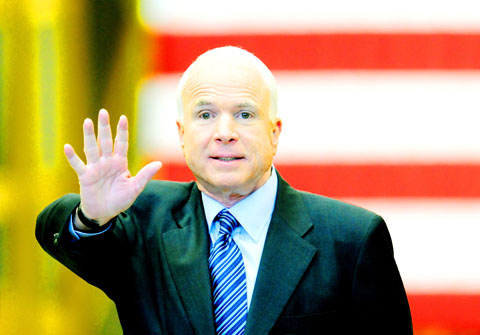
PHOTO: AFP
Republican McCain and Democrat Obama both said on Tuesday that politicians needed to set aside politics to save the financial system. Together, they backed a call to raise the Federal Deposit Insurance Corp (FDIC) guarantee on bank accounts from a limit of US$100,000 to US$250,000 — a proposal later incorporated into the Senate version of the financial rescue plan.
FDIC Chairwoman Sheila Bair took up the proposal on Tuesday afternoon, asking Congress for authority for an unspecified increase in insurance limits. She said most banks remained sound, but contended that increasing the insurance cap would help ease the crisis of confidence.
Obama warned it would be “catastrophic” if a deal were not reached soon and that Congress should build on the bill it rejected on Monday rather than start from scratch.
“Given the progress we have made, I believe we are unlikely to succeed if we start from scratch or reopen negotiations about the core elements of the agreement,” Obama said in a statement. “But in order to pass this plan, we must do more.”
McCain, whose own Republicans were largely responsible for sinking the bill, said that lawmakers had failed to convince voters that the deal was urgent.
Both said the time for blame had passed and action was needed urgently.
Obama told about 12,000 people at a rally at the University of Nevada at Reno that the crisis “affects the financial well-being of every single American. There will be time to punish those who set this fire, but now is the moment for us to come together and put the fire out.”
McCain concurred in an interview on the cable television station MSNBC.
“So we’ve got to act and we’ve got to act — and I’m confident we will — we will pass legislation because we have to do it. And that’s — the important thing now is bipartisanship. Sit down and work together. That’s what I want to do and that’s what I’m committed to do,” McCain said.
McCain said he recommended to Bush on Tuesday morning that the Treasury’s Exchange Stabilization Fund of US$250 billion be used to shore up institutions and that the Treasury exercise its ability to buy up US$1 trillion in mortgages.
“Housing and mortgages are at the root of this crisis,” the Republican senator said later at a small business round-table in Des Moines, Iowa. “I urge Treasury to take action to shore up mortgage values.”
Obama said he, too, had talked with Bush as well as Senate Majority Leader Reid and other leaders on Tuesday about resurrecting the recovery plan. He also sought to reassure the public, saying the plan had been “misunderstood and poorly communicated.”
“This is not a plan to just hand over US$700 billion of your money to a few banks on Wall Street,” Obama told supporters at the Nevada rally.

When a hiker fell from a 55m waterfall in wild New Zealand bush, rescuers were forced to evacuate the badly hurt woman without her dog, which could not be found. After strangers raised thousands of dollars for a search, border collie Molly was flown to safety by a helicopter pilot who was determined to reunite the pet and the owner. A week earlier, an emergency rescue helicopter found the woman with bruises and lacerations after a fall at a rocky spot at the waterfall on the South Island’s West Coast. She was airlifted on March 24, but they were forced to
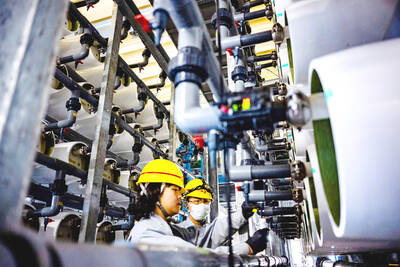
HIGH HOPES: The power source is expected to have a future, as it is not dependent on the weather or light, and could be useful for places with large desalination facilities A Japanese water plant is harnessing the natural process of osmosis to generate renewable energy that could one day become a common power source. The possibility of generating power from osmosis — when water molecules pass from a less salty solution to a more salty one — has long been known. However, actually generating energy from that has proved more complicated, in part due the difficulty of designing the membrane through which the molecules pass. Engineers in Fukuoka, Japan, and their private partners think they might have cracked it, and have opened what is only the world’s second osmotic power plant. It generates

Hundreds of Filipinos and tourists flocked to a sun-bleached field north of Manila yesterday, on Good Friday, to witness one of the country’s most blood-soaked displays of religious fervor, undeterred by rising fuel prices. Scores of bare-chested flagellants with covered faces walked barefoot through the dusty streets of Pampanga Province’s San Fernando as they flogged their backs with bamboo whips in the scorching heat. Agence France-Presse (AFP) journalists said they saw devotees deliberately puncturing their skin with glass shards attached to a small wooden paddle to ensure their bleeding during the ritual, a way to atone for sins and seek miracles from

Chinese dissident artist Gao Zhen (高兟), famous for making provocative satirical sculptures of former Chinese leader Mao Zedong (毛澤東), was tried on Monday over accusations of “defaming national heroes and martyrs,” his wife and a rights group said. Gao, 69, who was detained in 2024 during a visit from the US, faces a maximum three-year prison sentence, said his wife, Zhao Yaliang (趙雅良), and Shane Yi, a researcher at the Chinese Human Rights Defenders group which operates outside the nation. The closed-door, one-day trial took place at Sanhe City People’s Court in Hebei Province neighboring the capital, Beijing, and ended without a


 RSS
RSS