


In the concrete and glass shopping center in the heart of Zhengzhou, thousands of spectators, many wearing red and white “I love China” T-shirts and waving national flags, roar in approval as they gaze up at images of the Olympic torch on a giant TV screen.
The air is thick with pollution, heat and humidity. The security is so tight people are not allowed within a kilometer of the real flame. But among the crowd there is unabashed joy and pride that the Olympic symbol is passing through the capital of Henan, the most populous province in China.
“It’s wonderful, terrific. Everyone is so enthusiastic. I love my country, I love China,” gushes Du Juan, a 30-year-old housewife. “Foreigners don’t understand us. They think we are pitiful. But I think most Chinese people are good.”
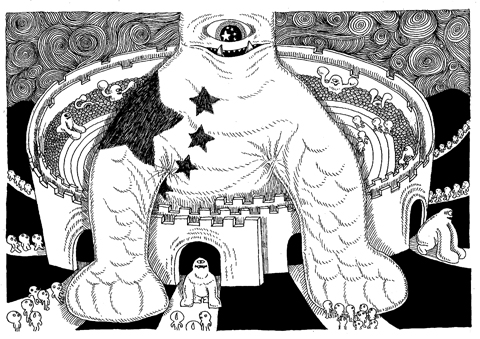
ILLUSTRATION: MOUNTAIN PEOPLE
With less than two weeks until the opening ceremony, the tide of nationalist fervor is rising to fever pitch as the torch enters the final stages of its epic and controversial journey to Beijing.
Given the highlighted unrest in Tibet, the protests in Europe and the Sichuan earthquake that brought a route diversion, the Olympic flame has come to represent one of the most tumultuous years in modern Chinese history. Originally intended to highlight the organizers’ “one world, one dream” message of international harmony, its progress now brings to mind the question of whether the Olympics will bring China closer to the rest of the world or just help exacerbate the differences.
In Henan, the enthusiastic crowds could not be further from the angry street protests generated as the torch reached London, Paris, San Francisco and Seoul. Here, the only worry is of patriotic ardor getting out of hand. At one point, the chanting and mostly young crowd spills through the police ranks and stops the traffic. There are scuffles before order is restored.
“People are just too excited,” an officer said.
Fear of the mob runs deep in China, particularly in Henan, which has a population of 98 million — bigger than that of any European country — and a reputation in other provinces for being untrustworthy.
But anxiety over size and trust is expressed in other nations about China — with its 1.3 billion people and an increasingly nationalist one-party state — with the Olympics bringing such fears to a head. By one recent estimate, China’s economy is on course to overtake the US within 20 years. A report this month by Jane’s Defence Weekly showed military spending had more than doubled in the past five years. That sense of rising strength could well be amplified in the Olympics, where many Chinese expect to come top of the gold medal table for the first time.
But, having overcome unrest, overseas criticism and natural calamity this year, many Chinese are feeling more proud of their country than ever. In this year’s Pew Global Attitudes Survey, China appeared the most positive of 24 countries, with 96 percent in the poll saying they expected the Olympics to be a success.
There is a gulf in perception, however. In the survey, 77 percent believed foreigners had a positive view of China. A Wall Street Journal/NBC news poll last week showed that 54 percent of Americans saw China as a foe and a Financial Times survey this year showed Europeans believing China had surpassed the US as the greatest threat to global stability.
Many concerns focus on China’s nationalist youth. A generation of fenqing (憤青, angry youth) has started furious online campaigns against what are seen as China’s enemies — these include Nicolas Sarkozy, Sharon Stone, Steven Spielberg, the Carrefour supermarket chain, CNN, the BBC and countless other media groups. After the Tibet unrest in March at least 10 foreign journalists received death threats.
A new assertiveness is evident in the country.
“In the future we will get better, we’ll beat you,” said Gao Yang, an insurance clerk and Chelsea supporter in Taiyuan. “We’re getting stronger. Hong Kong has been returned to us. Foreigners are not as powerful as before.”
This emotion is a double-edged sword for the authorities, said Victor Cha, a professor at Georgetown University in Washington, who has published a book about the politics of sports in Asia.
“There is a lot of nationalism now because of these Games. The Chinese leadership knows that sometimes nationalism can be useful, but it can also be dangerous because it can turn against the government at any time,” Cha said.
It is unclear whether the angry youngsters could be the voice of a new generation of chauvinists. But it is not hard to find young people who adore their nation while still wanting greater accountability, transparency and debate.
Chao Shen, a 20-year-old student of international trade, living in Quanzhou, hopes for a nationalist uprising, like the May 4 movement of 1919.
“We need someone who can lead a revolution,” he said.
He feels encouraged by the patriotism.
“We have a chance to improve ourselves,” he said.
Along with the confidence runs insecurity about the relations between government and people. And the authorities are taking no chances.
This contradiction has been apparent from the start of the Olympic torch relay, when Tiananmen Square was closed off to the public. As the flame passed through China, police vetted the huge crowd on much of the route to ensure that only invited guests got to within sight of the Olympic symbol.
Known “troublemakers” — many of them fervent nationalists — have been locked up, put under house arrest or threatened. Hu Jia (胡佳), a human rights campaigner, Liu Jie (劉杰), a petitioner, and Yang Chunping (楊春林), an activist, are in jail after linking criticism of the government with the Olympics. Another “rights defender,” Hou Wenzhou (候文周), was kept without trial for 18 days in Qincheng prison. There was no arrest warrant. She was taken away by five men, covered in a black hood and driven off for days of questioning about her involvement in a planned “human rights torch” designed to link protesters.
“Face means so much for Chinese,” Hou told the Guardian after her release. “I bet no one who works for the government would like to admit openly that the country still has an immature personality and worries so much about being embarrassed, thus vehemently shutting off all kinds of critical voices.”
Olympic organizers announced plans this week for three zones for protesters, but human rights groups said this was an empty gesture given the difficulty of obtaining permission and the risk of retribution afterwards.
This is little encouragement for those seeking diversity in the transformation of Beijing ahead of the Games. The migrants who built the Olympic city have been ordered to return to their homes in the countryside; some foreign-owned bars and live music venues have closed; the formerly ubiquitous pirate DVD stores have been driven deeper underground and the usual summer rock festivals have been called off. Even the city’s most popular gay bar, Destination, is under orders not to allow customers to dance while the Olympics are staged.
“Instead of showcasing Beijing as the great modern cultural city that actually it is, people are going to see something more likely to conform to the negative stereotype now ... You’ve got beer gardens being told ‘No beer in the garden,’” said Tom Pattinson, editor of Time Out Beijing.
Tight security and tougher visa restrictions are not going down well with the visitors. Travel agency Ctrip says hotels are cutting prices by 10 percent to 20 percent to attract guests. This month the Beijing municipal tourism bureau said the occupancy rate of four-star hotels stood at only 44 percent. Critics — mostly foreign residents — joke that the Beijing Games will be the “No Fun Olympics.”
China’s patriots are not amused. The Global Times, a nationalist publication, said this week the country’s passion for the Games was being ridiculed by Western media.
“From this we Chinese can realize just how hard a task it is to be truly understood and accepted by the world,” it said.
The International Olympic Committee insists the tightening of security is normal in the run-up to the Games and some sports professionals stress that the upsurge of expectation needs to be understood in a historical context.
Wang Libin (王立彬), a basketball coach, compares patriotism to economic development, saying both have risen from a base of extremely low confidence. Wang carried the Chinese flag at the Olympic opening ceremony in Los Angeles in 1984. In those days, he says, everyone asked whether he was Japanese or Korean because the sight of a Chinese Olympian was a novelty.
“Ever since then, our desire as a nation has grown bigger and bigger. In 2008, the competition will be psychological. People think the more gold we get, the better,” he said.
At Los Angeles, China won 15 golds; in Athens in 2002, against strong competition, it gained 32 golds. No target has been set for Beijing, but the Internet is buzzing with expectation that China will come top with more than 40 golds.
Wang thinks the gains will go beyond medals.
“The Olympics challenge every country to improve itself in terms of economics and national power. No matter what the final medal table, I believe that after the Olympics there will be fewer people who cross on red or smoke, there will be fewer sandstorms, more green areas and ordinary citizens will have a greater understanding of the need to keep fit, mentally and physically. The impact will last for 50 years,” he said.
Will the political impact endure? Li Datong (李大同), who was ousted as editor of the influential newspaper Freezing Point for his progressive views, says “deluded nationalism” and a “victim mentality” are part of the regime’s legitimacy.
“There is still a view that ‘anti-Chinese forces’ are constantly plotting to overthrow the Chinese government and that all criticism of the government equals criticism of China itself,” he wrote in a recent article for Open Democracy.
But he adds that this belief is too shallow to pose a threat.
“The reason is simple — their ideas are a result of party-led education and one-way inculcation of information. As soon as these people are able to gain access to different sources of information and see different points of view publicly debated, the basis of their ideas collapses,” he said.
The Olympics will put that theory to the test. Despite the visa restrictions for foreign business people and students, at least 20,000 journalists, 10,000 athletes and several hundred thousand officials, sponsors and spectators will arrive in China over the next week or so.
In Zhenghou, there is not much sign of a “victim mentality.” The “angry youth” are looking cheerful amid the great expectations of sporting success and international goodwill.
Zhu Jiankang, 20, who traveled nearly 65km to see the torch on a big screen, waved a national flag and said: “I totally love my country. Our life here is so great. I’m so happy, so happy.”
A few weeks ago in Kaohsiung, tech mogul turned political pundit Robert Tsao (曹興誠) joined Western Washington University professor Chen Shih-fen (陳時奮) for a public forum in support of Taiwan’s recall campaign. Kaohsiung, already the most Taiwanese independence-minded city in Taiwan, was not in need of a recall. So Chen took a different approach: He made the case that unification with China would be too expensive to work. The argument was unusual. Most of the time, we hear that Taiwan should remain free out of respect for democracy and self-determination, but cost? That is not part of the usual script, and
Behind the gloating, the Chinese Nationalist Party (KMT) must be letting out a big sigh of relief. Its powerful party machine saved the day, but it took that much effort just to survive a challenge mounted by a humble group of active citizens, and in areas where the KMT is historically strong. On the other hand, the Democratic Progressive Party (DPP) must now realize how toxic a brand it has become to many voters. The campaigners’ amateurism is what made them feel valid and authentic, but when the DPP belatedly inserted itself into the campaign, it did more harm than good. The
For nearly eight decades, Taiwan has provided a home for, and shielded and nurtured, the Chinese Nationalist Party (KMT). After losing the Chinese Civil War in 1949, the KMT fled to Taiwan, bringing with it hundreds of thousands of soldiers, along with people who would go on to become public servants and educators. The party settled and prospered in Taiwan, and it developed and governed the nation. Taiwan gave the party a second chance. It was Taiwanese who rebuilt order from the ruins of war, through their own sweat and tears. It was Taiwanese who joined forces with democratic activists
Chinese Nationalist Party (KMT) Chairman Eric Chu (朱立倫) held a news conference to celebrate his party’s success in surviving Saturday’s mass recall vote, shortly after the final results were confirmed. While the Democratic Progressive Party (DPP) would have much preferred a different result, it was not a defeat for the DPP in the same sense that it was a victory for the KMT: Only KMT legislators were facing recalls. That alone should have given Chu cause to reflect, acknowledge any fault, or perhaps even consider apologizing to his party and the nation. However, based on his speech, Chu showed


 RSS
RSS