


Facebook is partnering with a Malaysian company to sell credits at retail outlets across Asia for the first time, aiming to make it easier for millions of people to purchase virtual goods and play games on the social networking site while boosting revenue for developers.
Electronic payments company MOL — part of the business empire of tycoon Vincent Tan (陳志遠) — will offer the online currency from Aug. 1 at more than 500,000 outlets including 7-Eleven stores and Internet cafes in five Southeast Asian countries, India, Australia and New Zealand, company spokesman Nor Badron said yesterday.
The move is targeting people who don’t have a credit card, particularly younger Facebook users, and those who don’t want to take the risk of making payments online.
“Asia has a huge gaming community, and it’s typically young people,” Nor said. “The penetration for credit cards is very low ... so the developers are not making money and missing this opportunity.”
Nor said MOL already sells prepaid credits for other online games at its established network of stores, but it will be the first time that consumers can buy credits for Facebook’s applications, including such popular games as Mob Wars and FarmVille, without credit cards.
MOL, which last year bought social networking site Friendster, announced the partnership with Facebook in a press release on Thursday.
“We view this agreement as a major opportunity to broaden the availability of a simple, unified currency that can be used in games and applications across Facebook,” said Vaughan Smith, director of business and corporate development at Facebook, in the press release.
In Southeast Asia, the credits will be sold in Malaysia, Thailand, Singapore, Indonesia and the Philippines.
Meanwhile, Facebook on Thursday acquired a start-up called Nextstop, which provides online guides for finding new places to visit.
The Palo Alto, California, based company has purchased most of Nextstop’s assets, Jonathan Thaw, a Facebook spokesman, said in an e-mailed statement. Thaw called the deal “a small talent acquisition.” Terms weren’t disclosed.
“We’ve admired the engineering team’s efforts for some time now and we’re excited to have them join Facebook,” Thaw said.
Facebook has used acquisitions to bring in new employees and improve its services. Last year it bought FriendFeed, a social networking site, and this year named FriendFeed co-founder Bret Taylor its chief technology officer.

National Taiwan University (NTU) yesterday said it disqualified a person from an entrance examination for using AI smart glasses to cheat, along with two others for making untruthful statements in their curriculum vitae. The three applicants were given null scores, Taiwan’s highest-ranked university said, calling on prospective students to be honest in the admissions process. NTU registrar Lee Hung-sen (李宏森) said that the cheating applicant wore a hat and thick-rimmed glasses to the second written exam for medical school, claiming that they felt cold. Suspicions were aroused when the applicant stared oddly at the test for long stretches while steadily bringing the paper

The Tourism Administration yesterday announced that it would reward repeat international visitors with incentives of up to NT$8,000 to boost inbound tourism. The incentives are available to all international tourists, it said, adding that repeat visitors would be rewarded with NT$5,000 and would receive an additional NT$3,000 if they bring travel companions. The nation received 2,990,657 inbound visitors during the first quarter, marking a 3.8 percent increase from the same period last year, agency data showed. Japanese nationals are among groups visiting Taiwan the most. About 1.48 million Japanese tourists arrived last year, a year-on-year increase of more than 12

66 FIGHTER JETS: The aircraft is likely undergoing preparations for its transfer to Taiwan — a significant step forward in the nation’s modernization program, a lawmaker said The first of Taiwan’s order of F-16V Block 70 aircraft has been sighted in Texas ahead of delivery, Democratic Progressive Party (DPP) Legislator Wang Ting-yu (王定宇) said. Taiwan’s first F-16V Block 70 two-seat aircraft, tail number 6831, was seen flying from Lockheed Martin’s production facility in Greenville, South Carolina, to Naval Air Station Joint Reserve Base Fort Worth in Texas, Wang wrote on Facebook yesterday. The plane is likely undergoing preparations for its transfer to Taiwan, marking a significant step forward in the Republic of China Air Force’s modernization program, Wang said, citing military analysts. The F-16V Block 70 is a new-build version
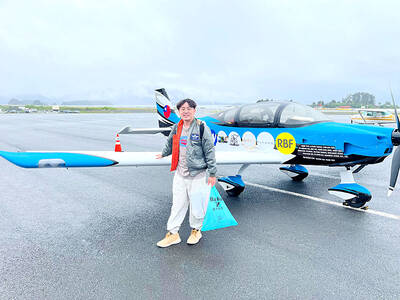
Taiwanese aviator Roger Lin (林睿哲) returned to Taiwan on Saturday after completing a nine-day round-the-world journey in a single-engine aircraft, becoming the first Taiwanese pilot to achieve the feat. Lin departed on June 5 from Los Angeles, California, and continued through Alaska, Japan, Taiwan, the Philippines, Indonesia, Malaysia, Thailand, Nepal, Jordan, Norway, Iceland and Canada before landing at the Taipei International Airport (Songshan) via Los Angeles and Japan. Lin shared numerous photos and videos of his journey on a Facebook page titled “Pilot Roger’s Around the World Flight,” including a video showing his aircraft flying over the Danjiang Bridge and


 RSS
RSS