


The eyes of the world are on BP after the disaster that left oil spewing into the Gulf of Mexico at the rate of about 200 liters a day, but campaigners accuse “Big Oil” of an appalling track record elsewhere in the world, saying it leaves a trail of devastation in its wake.
From Nigeria in Africa to Kazakhstan in Central Asia and Colombia and Ecuador in South America, major oil firms stand accused of a blatant disregard for local communities and the environments in which they operate.
With demand for energy expected to surge as industrialization accelerates in China, India and Brazil, critics say oil companies are taking ever-increasing risks to cash in on yet another bonanza.
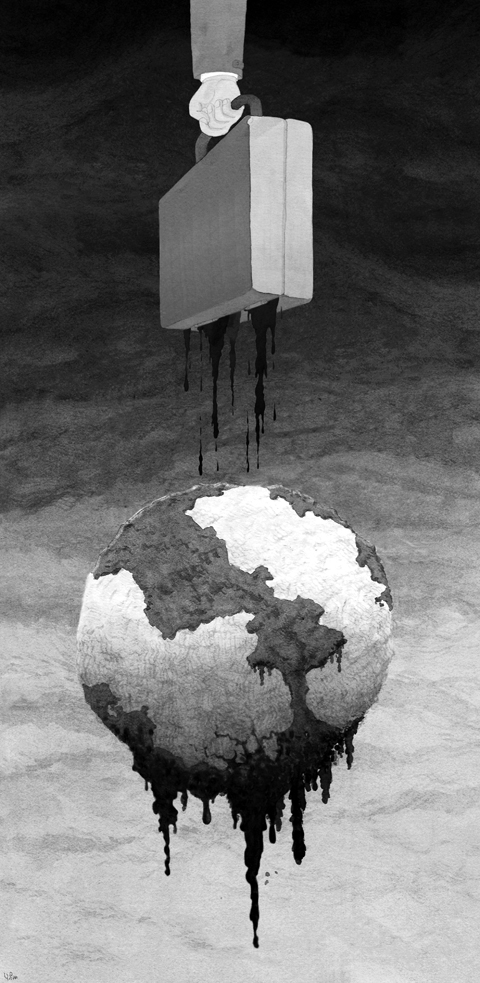
Two other factors ensure the dash for oil continues apace. One is growing concern in the developed world that, at some point in the next 30 years, demand could outstrip supply. That means governments are under pressure to make it easier for firms to look for oil in inhospitable areas, whether in deep water off the US or in the tar sands of Canada.
Second, Western governments want to reduce their dependence on unstable regimes in the Middle East, which partly explains the recent US move to lift restrictions on drilling in Alaska.
All this could change if the world made a determined attempt to invest more heavily in renewable energy sources, but international initiatives take time. In the interim, the oil majors face a barrage of criticism from environmental and human rights campaigners in places thousands of kilometers away from BP’s sunken Deepwater Horizon rig.
Nigeria is a case in point. People who live in the Niger Delta have had to withstand huge oil spills for decades. Farmers allege that spills from Shell pipelines have contaminated their land and fishing ponds, destroying their livelihoods. They want Shell to clean up the mess and compensate them for lost earnings. Shell argues that the ruptures to its supply lines are, in the main, the result of sabotage and any damages claims should be heard in the Nigerian courts.
The Anglo-Dutch oil giant is by far the biggest oil firm operating in the delta — where, in March 2008, it was estimated that at least 2,000 sites required treatment because of oil pollution. Independent oil and environmental experts estimate that between 9 million and 13 million barrels of oil have been spilled in the delta area during the past 50 years — equivalent to an Exxon Valdez disaster every 12 months.
“The result of oil exploration, extraction and spills is that many people in the Niger Delta have to drink, cook with and wash in polluted water. They have to eat contaminated fish — if they are lucky enough to still be able to find fish — and farm on spoiled land,” Kate Allen of Amnesty International said.
“After oil spills, the air reeks of pollutants. Many [people] have been driven into poverty, and because they can’t make Shell accountable for its actions, there is enormous distrust between the group and local people,” she said.
“Shell operates in 100 countries, but about 40 percent of spills are in Nigeria, which is quite incredible,” a spokesman for Greenpeace said. “There is evidence of sloppy management.”
Shell rejects these charges.
The actions of the Nigerian government are a critical part of this story. Oil is estimated to have earned Nigeria more than US$600 billion since the 1960s, and the oil and gas sector represents about 80 percent of government revenues. The government’s reluctance to take a hard line with oil companies is not difficult to understand. The most that local people often ever see of the state are armed soldiers visiting the region to protect oil companies’ assets.
A similar story is unraveling in Colombia, where BP has a presence in the Casanare region. Strikers recently blockaded a plant, 200km from the capital Bogota, for a fortnight, prompting BP officials to say they felt like hostages. The dispute has been rolling on since February over issues including labor, the environment and human rights. Most of these have now been resolved.
Cinep, a non-governmental organization in Colombia that investigates oil firms, said the strike was not marked by the extremes seen in previous BP disputes.
“Disputes involving BP are characterized by a heavy hand and shows of government force,” Cinep representative Fernando Rodriguez said.
He alleges that in a 1995 dispute with BP contractor Servipetrol, the army shot at the civilian population. He claims paramilitaries then persecuted and assassinated community leaders.
BP strongly denies any paramilitary connections.
“BP has no relation whatsoever with illegal armed groups, irrespective of their motives or inclinations,” said Poly Martinez, a media spokesman for the company.
BP did acknowledge it had had to deal with officials in elected positions who had turned out to have paramilitary links.
In Kazakhstan, Friends of the Earth is worried about the environmental, social and health effects caused by the development of the Kashagan oilfield. The consortium behind the project includes companies such as ExxonMobil, Shell and Italy’s ENI. Friends of the Earth said thousands of people have already been relocated in the region because of sulfur emissions and other highly poisonous chemicals, such as mercaptans, which are present at high levels in northern Caspian oil. All the companies deny they have behaved irresponsibly.
In Ecuador, the Amazon Defense Coalition claims Chevron holds the record for the world’s largest oil-related contamination in the populated Amazon rainforest — an even more sensitive ecosystem than the marshes of Louisiana. The allegations are at the root of a class action lawsuit in Ecuador, where the oil giant faces more than US$27 billion in damages for poisoning an area the size of Rhode Island with 70 billion liters of toxic “produced water” — water that emerges from drilling activities. That is more than 474 times the amount of contamination estimated to have been spilled in the Gulf of Mexico, according to claims made by representatives of the plaintiffs.
A bigger campaign is building behind the involvement of the oil majors in Canada’s tar sands. The sands are naturally occurring mixtures of sand or clay, water and a dense form of petroleum called bitumen. They are found in large quantities in Canada and Venezuela. Making liquid fuels from oil sands requires energy for steam injection and refining. This process generates two to four times the amount of greenhouse gases per barrel of final product as conventional oil.
“Every day, the extraction process uses enough natural gas to heat 3.2 million Canadian homes for a day. Tar sands are a significant factor in Canada’s failure to meet its Kyoto protocol targets,” said a spokesman for FairPensions, a shareholder activist group.
It is also claimed that tar sands development affects the health and human rights of people over wide areas. According to FairPensions, about 11 million liters of contaminated water leaks into surrounding rivers and groundwater each day, containing arsenic, mercury and various carcinogens that have been linked to elevated rates of cancer in downstream communities.
Investors have raised the issue at Shell and BP shareholder meetings — some shareholders are worried about the long-term profitability of tar sands, pointing to the very high operating costs.
However, the oil companies are “as likely to curtail their hunt for new sources of energy as turkeys voting for Christmas,” Friends of the Earth said.
It points out that only last week, Cairn Energy won clearance to drill off Greenland this summer. Greenland is viewed as one of the last great frontier areas in the oil and gas business, and the US Geological Survey estimates that the territory could hold 50 billion barrels of oil and gas, but campaigners point out that the region is under “constant threat of ice floes,” while in Canada, lawmakers complain that Cairn has had no history of drilling in the Arctic. The company says it has “prepared for every eventuality.”
“We are going to the ends of the earth to find the next barrel,” Canadian energy economist Peter Tertzakian said.
At what cost?
Environmental pressure group Platform says the drive for “frontier oil” comes out of “a political environment whereby concerns over energy security are routinely top of the agenda.”
To illustrate its point, Platform points out there has been a quickening in the race for rights to territory in the Arctic, with the Russians two years ago symbolically planting a flag under the North Pole during a submarine expedition, but the last frontier is perhaps Antarctica.
Signatories to the Antarctic Treaty officially refrain from any territorial claims on the continent, but some countries, including Britain, Australia and Russia, have made unofficial claims and produce stamps with maps of Antarctica showing territory purportedly belonging to them.
The worldwide dash for the black stuff underscores Tertzakian’s argument that though we may not soon run out of oil, “new supplies will be increasingly dirty, insecure, expensive and indiscreet.”
A gap appears to be emerging between Washington’s foreign policy elites and the broader American public on how the United States should respond to China’s rise. From my vantage working at a think tank in Washington, DC, and through regular travel around the United States, I increasingly experience two distinct discussions. This divergence — between America’s elite hawkishness and public caution — may become one of the least appreciated and most consequential external factors influencing Taiwan’s security environment in the years ahead. Within the American policy community, the dominant view of China has grown unmistakably tough. Many members of Congress, as
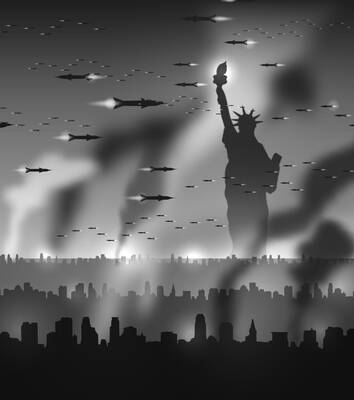
After declaring Iran’s military “gone,” US President Donald Trump appealed to the UK, France, Japan and South Korea — as well as China, Iran’s strategic partner — to send minesweepers and naval forces to reopen the Strait of Hormuz. When allies balked, the request turned into a warning: NATO would face “a very bad” future if it refused. The prevailing wisdom is that Trump faces a credibility problem: having spent years insulting allies, he finds they would not rally when he needs them. That is true, but superficial, as though a structural collapse could be caused by wounded feelings. Something
Former Taipei mayor and Taiwan People’s Party (TPP) founding chairman Ko Wen-je (柯文哲) was sentenced to 17 years in prison on Thursday, making headlines across major media. However, another case linked to the TPP — the indictment of Chinese immigrant Xu Chunying (徐春鶯) for alleged violations of the Anti-Infiltration Act (反滲透法) on Tuesday — has also stirred up heated discussions. Born in Shanghai, Xu became a resident of Taiwan through marriage in 1993. Currently the director of the Taiwan New Immigrant Development Association, she was elected to serve as legislator-at-large for the TPP in 2023, but was later charged with involvement
Out of 64 participating universities in this year’s Stars Program — through which schools directly recommend their top students to universities for admission — only 19 filled their admissions quotas. There were 922 vacancies, down more than 200 from last year; top universities had 37 unfilled places, 40 fewer than last year. The original purpose of the Stars Program was to expand admissions to a wider range of students. However, certain departments at elite universities that failed to meet their admissions quotas are not improving. Vacancies at top universities are linked to students’ program preferences on their applications, but inappropriate admission


 RSS
RSS