


China must lift the incomes of workers to protect stability, the country’s top official paper said yesterday, after the latest in a series of labor disputes briefly closed a supplier for Toyota Motor Corp.
The Toyoda Gosei plant, in the northern port city of Tianjin close to Beijing, was shut down on Tuesday by a strike, but employees went back to work the next day after managers agreed to discuss wage increases, a company spokesman said.
The firm, 43 percent owned by Toyota Motor and a supplier of items such as door components for compact cars, has not fallen behind its production schedule because it canceled a holiday on Wednesday, the spokesman said.
A Toyota Motor spokeswoman also said her company keeps some spare parts in inventory to allow it to cope with unexpected situations at its main auto plants in Tianjin.
A rash of walkouts in recent weeks has paralyzed several factories across China. The unusual display of worker assertiveness is sensitive for the ruling Communist Party, which fears movements that could undermine its legitimacy or grip on power.
The commentary on treatment of migrant workers in the People’s Daily newspaper, which acts as a channel for government thinking, did not mention the strikes.
However, echoing comments by Chinese Premier Wen Jiabao (溫家寶) earlier in the week, its author said the time had come to narrow the gap between the rich and poor, which it added was stifling consumer demand.
The “made-in-China” model is “facing a turning point,” the newspaper said.
It urged improved conditions for the migrant workers whose cheap labor has powered China’s export-led growth.
“What is important is achieving a relatively big improvement in the lives of ordinary people, especially wage laborers and their families,” said Tang Jun, a social policy researcher at the Chinese Academy of Social Sciences, a government think tank.
Also yesterday, a branch of US fast food restaurant KFC signed a collective labor contract in which it agreed to raise minimum wages by 200 yuan (US$29.30) a month, as demanded by a local trade union, the official Xinhua agency said.
The highest profile stoppage has been at a factory in southern Guangdong Province that makes locks for Honda Motor vehicles, where hundreds of employees have returned to work after days of protests, pending an outcome from wage negotiations today.
The sympathetic account of worker grievances in the state media suggests that Beijing wants to avoid outright confrontation with the workers and may welcome some concessions.
This week, Wen also urged better treatment of the nation’s many millions of migrant workers.
He told some of them that “all parts of society should treat young migrant workers as they would treat their own children.”
The strike at Honda Lock was the third to hit a Honda parts supplier in China in the last few weeks. The other two strikes, at suppliers producing transmissions and exhausts, were settled after workers received pay rises.
The People’s Daily said that as China’s supply of young, cheap workers from the countryside tightens, the country must focus on improving skills and shifting to service jobs.
That shift will also require giving workers thicker pay packets to spend on consumption and services, the paper said.
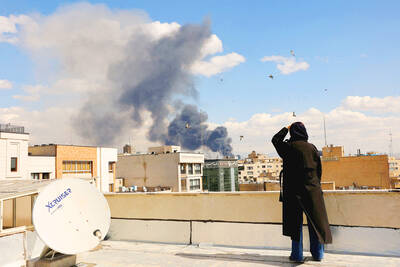
CHAOS: Iranians took to the streets playing celebratory music after reports of Khamenei’s death on Saturday, while mourners also gathered in Tehran yesterday Iranian Supreme Leader Ayatollah Ali Khamenei was killed in a major attack on Iran launched by Israel and the US, throwing the future of the Islamic republic into doubt and raising the risk of regional instability. Iranian state television and the state-run IRNA news agency announced the 86-year-old’s death early yesterday. US President Donald Trump said it gave Iranians their “greatest chance” to “take back” their country. The announcements came after a joint US and Israeli aerial bombardment that targeted Iranian military and governmental sites. Trump said the “heavy and pinpoint bombing” would continue through the week or as long
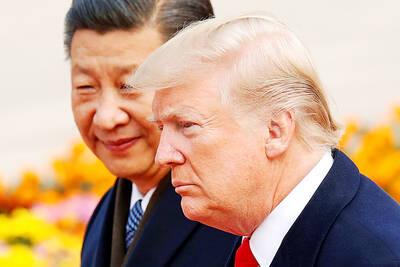
TRUST: The KMT said it respected the US’ timing and considerations, and hoped it would continue to honor its commitments to helping Taiwan bolster its defenses and deterrence US President Donald Trump is delaying a multibillion-dollar arms sale to Taiwan to ensure his visit to Beijing is successful, a New York Times report said. The weapons sales package has stalled in the US Department of State, the report said, citing US officials it did not identify. The White House has told agencies not to push forward ahead of Trump’s meeting with Chinese President Xi Jinping (習近平), it said. The two last month held a phone call to discuss trade and geopolitical flashpoints ahead of the summit. Xi raised the Taiwan issue and urged the US to handle arms sales to

An Emirates flight from Dubai arrived at Taiwan Taoyuan International Airport yesterday afternoon, the first service of the airline since the US and Israel launched strikes against Iran on Saturday. Flight EK366 took off from the United Arab Emirates (UAE) at 3:51am yesterday and landed at 4:02pm before taxiing to the airport’s D6 gate at Terminal 2 at 4:08pm, data from the airport and FlightAware, a global flight tracking site, showed. Of the 501 passengers on the flight, 275 were Taiwanese, including 96 group tour travelers, the data showed. Tourism Administration Deputy Director-General Huang He-ting (黃荷婷) greeted Taiwanese passengers at the airport and

State-run CPC Corp, Taiwan (CPC, 台灣中油) yesterday said that it had confirmed on Saturday night with its liquefied natural gas (LNG) and crude oil suppliers that shipments are proceeding as scheduled and that domestic supplies remain unaffected. The CPC yesterday announced the gasoline and diesel prices will rise by NT$0.2 and NT$0.4 per liter, respectively, starting Monday, citing Middle East tensions and blizzards in the eastern United States. CPC also iterated it has been reducing the proportion of crude oil imports from the Middle East and diversifying its supply sources in the past few years in response to geopolitical risks, expanding


 RSS
RSS