


Sleeker, smarter mobile phones, tablets and netbooks will be stars at this week’s premier Consumer Electronics Show (CES) in Las Vegas, as firms bring out their latest gadgets to court the Internet crowd.
While this year’s CES will be smaller because of the global economic crisis, 110,000 people are registered to attend and the number of first-time exhibitors tops 330 for the first time.
A Google “Nexus One” smartphone based on Android software is likely to ignite CES buzz even though the device is to debut at the Internet giant’s headquarters in California two days before CES starts on Thursday.
CES goers are eager to see whether the Google branded phone lives up to expectations in a scenario reminiscent of the Palm Pre launch at the annual electronics show last year.
“All eyes are on the Nexus One,” said analyst Rob Enderle of Enderle Group in Silicon Valley. “The other thing of course is the tablets. A wave of Android tablets will be hitting at CES, and it looks like Apple’s is coming at the end of the month.”
A tablet computer to be launched at CES by India-based Notion Inc is generating the most interest because of attributes such as paper-like screen graphics for easy reading outdoors and full-color resolution.
By waiting a few more weeks to launch a tablet, Apple will be able to assess how competitors position themselves in the market and adapt its strategy accordingly.
Electronic books, or e-books, will also be rolled out in abundance at CES.
Industry tracker Forrester Research predicts that 6 million e-readers will be sold in the US alone this year, doubling the number bought in the country the prior year.
An eagerly awaited QUE e-reader by Plastic Logic will premier on Thursday in an invitation-only press conference slated prior to the opening of the show floor.
“We are going to be awash in e-books,” Enderle said. “The contrast between tablets and e-books is going to be pronounced.”
Lightweight, bare-bones laptops referred to as netbooks or “ultraportables” will also be a rage at CES as computer makers debut offerings tailored for a market that has boomed during hard times.
Making devices ranging from flat-screen televisions to cars or home thermostats “smart” with computer chips and links to the Internet will gain momentum at CES.
Powerhouses behind huge but ever-thinning televisions that are a hallmark of CES will tout online capabilities along with rich graphics prime for viewing films in high-definition or Blu-ray formats.
“You will see the TV set become more than just a simple TV set and the Blu-ray player more than a Blu-ray player,” Dolby consumer technology marketing director Craig Eggers said. “Last year saw Yahoo widgets on TV sets. More television makers are installing devices to stream YouTube, CinemaNow and other online video on TV.”
Dolby, which is planning CES announcements of its own, is intent on making sure audio richness on devices does justice to eye-popping graphics.
Television screens with improved 3D capabilities will be “big stuff” at CES and there is a rumor that the first US 3D television station will launch during CES, Enderle said.
Microsoft and Yahoo are among Internet titans that will be announcing innovations or alliances at CES.
The Consumer Electronics Association has beefed up the size of a videogame gear zone and an iLounge devoted to software and accessories for Apple iPhones, iPods and Macintosh computers.
Speakers include Microsoft chief executive Steve Ballmer; Nokia head Olli-Pekka Kallasvuo; Ford president Alan Mulally; Intel leader Paul Otellini; Qualcomm boss Paul Jacobs and Hisense (海信) chairman Zhou Houjian (周厚健).
Analysts also expect the automotive zone at CES to hold intriguing innovations, with Internet networking and television being further integrated into cars and trucks.
“The final thing is that 4G is expected to start showing up hard at CES,” Enderle said, referring to the coming iteration of wireless broadband Internet technology. “It is kind of the holy grail of next-generation wireless: more bandwidth, lower price and overall better experience.”
CES routinely includes surprise visits by celebrities as well as a chance for people in the industry to fire policy questions at the head of the US Federal Communications Commission.

PROVOCATIVE: Chinese Deputy Ambassador to the UN Sun Lei accused Japan of sending military vessels to deliberately provoke tensions in the Taiwan Strait China denounced remarks by Japan and the EU about the South China Sea at a UN Security Council meeting on Monday, and accused Tokyo of provocative behavior in the Taiwan Strait and planning military expansion. Ayano Kunimitsu, a Japanese vice foreign minister, told the Council meeting on maritime security that Tokyo was seriously concerned about the situation in the East China and South China seas, and reiterated Japan’s opposition to any attempt to change the “status quo” by force, and obstruction of freedom of navigation and overflight. Stavros Lambrinidis, head of the EU delegation to the UN, also highlighted South China Sea

The final batch of 28 M1A2T Abrams tanks purchased from the US arrived at Taipei Port last night and were transported to the Armor Training Command in Hsinchu County’s Hukou Township (湖口), completing the military’s multi-year procurement of 108 of the tanks. Starting at 12:10am today, reporters observed more than a dozen civilian flatbed trailers departing from Taipei Port, each carrying an M1A2T tank covered with black waterproof tarps. Escorted by military vehicles, the convoy traveled via the West Coast Expressway to the Armor Training Command, with police implementing traffic control. The army operates about 1,000 tanks, including CM-11 Brave Tiger
Taiwan Semiconductor Manufacturing Co (TSMC, 台積電), the world’s largest contract chipmaker, said it expects its 2-nanometer (2nm) chip capacity to grow at a compound annual rate of 70 percent from this year to 2028. The projection comes as five fabs begin volume production of 2-nanometer chips this year — two in Hsinchu and three in Kaohsiung — TSMC senior vice president and deputy cochief operating officer Cliff Hou (侯永清) said at the company’s annual technology symposium in Silicon Valley, California, last week. Output in the first year of 2-nanometer production, which began in the fourth quarter of last year, is expected to
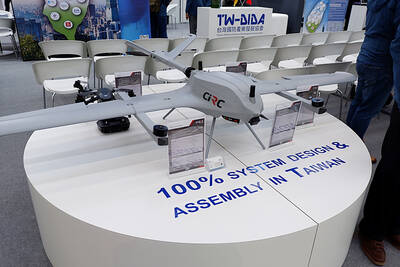
Taiwan’s drone exports surged past US$100 million in the first quarter, exceeding last year’s full-year total, with the Czech Republic emerging as the largest buyer, the Ministry of Economic Affairs said. Exports of complete drones reached US$115.85 million in the period, about 1.2 times the total recorded for all of last year, the ministry said in a report. Exports to the Czech Republic accounted for about US$100 million, far outpacing other markets. Poland, last year’s top destination, recorded about US$11.75 million in the first quarter. Taiwan’s drone exports have expanded rapidly in the past few years, with last year’s total


 RSS
RSS