


The Government Information Office (GIO) announced on the weekend that starting next month, Taiwan and China would be allowed to cooperate on TV productions. Echoing the Ma Ying-jeou (馬英九) administration’s standard argument for closer cooperation with China at almost every level, Ho Nai-chi (何乃麒), head of the Department of Broadcasting Affairs, said that because TV advertising revenue keeps dropping, Taiwanese TV stations have no choice but to rely on foreign markets — in other words, China.
Amid apprehensions that Chinese talent would elbow out Taiwanese, the GIO said that guidelines were established to ensure that at least 30 percent of personnel in joint productions would be Taiwanese, while the number of Chinese could not exceed one third. Other clauses mandate that the main shooting locations must be in Taiwan and that post-production — editing, special effects and sound effects — must be completed in Taiwan.
Lastly, the promotion of communism and unification, as well as symbols of the Chinese Communist Party (CCP), will not be allowed, the GIO said.
At first glance, these guidelines would assuage fears that Taiwanese TV productions would be tainted by communist ideology as a result of cooperation with producers across the Taiwan Strait.
But it isn’t so. The problem lies with what the guidelines do not cover: Chinese censorship.
A perfect example of this was provided by the behavior of Chinese filmmakers last week at the Melbourne International Film Festival, which they boycotted because organizers refused to yield to pressure from Beijing not to screen Ten Conditions of Love, a documentary about exiled Uighur leader Rebiya Kadeer. Two Chinese directors pulled out of the festival, and the organizer’s Web site was hacked, possibly by Chinese agents.
An order by Chinese regulators in March last year that TV stations across China stop reporting on actress Tang Wei (湯唯) and pull any ads featuring the star because of her role as a Japanese sympathizer in Ang Lee’s (李安) thriller Lust, Caution is also emblematic of Beijing’s ruthless approach to creativity if it defies ideology.
Given the grip the state has on the Chinese TV and film industry, together with the stringent screening and censorship process that precedes the release of entertainment in China, there is no doubt that similar hurdles would be imposed on Taiwanese-Chinese co-productions. One consequence of this would be that Taiwanese production companies seeking to co-produce a series with Chinese film studios would have no choice but to self-censor by avoiding such inflammatory topics as the occupation of Tibet, criticism of the CCP and Taiwanese independence. This does not mean that Taiwanese producers would no longer be free to express themselves and to address those topics, only that by doing so they would be forsaking any chance of Chinese artistic cooperation and financial assistance.
The risk is that through a process of filtering, Taiwanese productions that refuse to have their artistic integrity muzzled will be unable to make it in the Chinese market, while those that do will reap the financial benefits.
Gradually, Taiwanese production companies that opt to go it alone will be unable to compete with better-financed and ad-friendly Taiwan-China co-productions. Their financial survival will be severely compromised, and with that, Taiwanese voices deemed unacceptable by the CCP will be silenced, unless they find alternative sources of financing in other foreign markets.
As is often the case, what isn’t said matters just as much as what is.
A gap appears to be emerging between Washington’s foreign policy elites and the broader American public on how the United States should respond to China’s rise. From my vantage working at a think tank in Washington, DC, and through regular travel around the United States, I increasingly experience two distinct discussions. This divergence — between America’s elite hawkishness and public caution — may become one of the least appreciated and most consequential external factors influencing Taiwan’s security environment in the years ahead. Within the American policy community, the dominant view of China has grown unmistakably tough. Many members of Congress, as
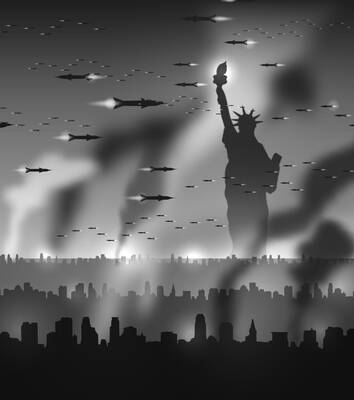
After declaring Iran’s military “gone,” US President Donald Trump appealed to the UK, France, Japan and South Korea — as well as China, Iran’s strategic partner — to send minesweepers and naval forces to reopen the Strait of Hormuz. When allies balked, the request turned into a warning: NATO would face “a very bad” future if it refused. The prevailing wisdom is that Trump faces a credibility problem: having spent years insulting allies, he finds they would not rally when he needs them. That is true, but superficial, as though a structural collapse could be caused by wounded feelings. Something
Former Taipei mayor and Taiwan People’s Party (TPP) founding chairman Ko Wen-je (柯文哲) was sentenced to 17 years in prison on Thursday, making headlines across major media. However, another case linked to the TPP — the indictment of Chinese immigrant Xu Chunying (徐春鶯) for alleged violations of the Anti-Infiltration Act (反滲透法) on Tuesday — has also stirred up heated discussions. Born in Shanghai, Xu became a resident of Taiwan through marriage in 1993. Currently the director of the Taiwan New Immigrant Development Association, she was elected to serve as legislator-at-large for the TPP in 2023, but was later charged with involvement
Out of 64 participating universities in this year’s Stars Program — through which schools directly recommend their top students to universities for admission — only 19 filled their admissions quotas. There were 922 vacancies, down more than 200 from last year; top universities had 37 unfilled places, 40 fewer than last year. The original purpose of the Stars Program was to expand admissions to a wider range of students. However, certain departments at elite universities that failed to meet their admissions quotas are not improving. Vacancies at top universities are linked to students’ program preferences on their applications, but inappropriate admission


 RSS
RSS