


Aweek before the Beijing Olympics began on Aug. 8, officials in Shijiazhuang, China, learned that baby formula made by one of the city’s biggest companies was tainted with a toxic chemical. They said nothing.
It wasn’t until five weeks later that they notified the provincial government, spurring the recall of Sanlu Group Co milk, says Andrew Ferrier, chief executive officer of Auckland-based Fonterra Cooperative Group, which owns 43 percent of Sanlu.
The scandal, now involving 22 dairies and at least four deaths, shows the extent to which local officials protect large employers to create jobs, tax revenue and momentum for their political careers, says Peter Cheung (張贊賢), a professor at the University of Hong Kong who studies policy making in China.
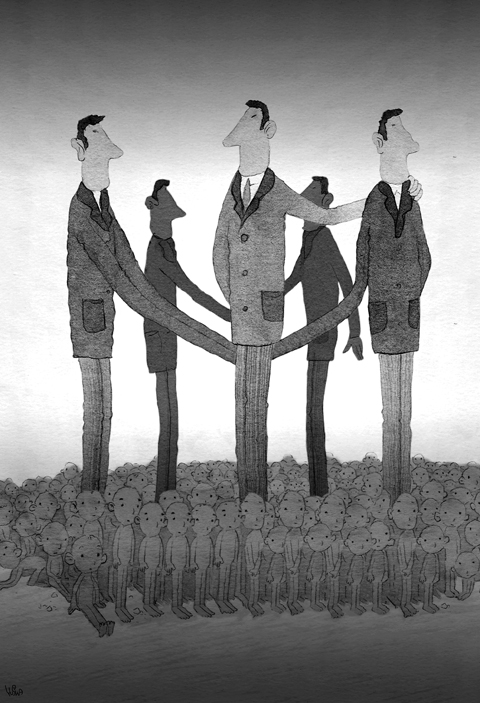
“Local governments are always watching out for their local companies, and the bigger the company, the bigger the sway they’ll have,” says Bruce McLaughlin, a Shanghai-based consultant who investigates patent infringement in China.
“We never go to the local government when we investigate a company. They’re no help or they’ll leak information to the company,” he said.
Authorities have arrested 18 people in connection with the milk scandal. Sanlu chairwoman Tian Wenhua (田文華) was detained by police, fired and removed from her Chinese Communist Party (CCP) post, Xinhua news agency reported last week. Five Shijiazhuang city officials, including the mayor, have been fired.
Sanlu apologized to consumers and promised to recall all milk powder produced before Aug. 6, Xinhua reported last Monday.
More than 1,300 children have been hospitalized after drinking milk formula contaminated with melamine, a toxic chemical normally used in making plastics and tanning leather.
“These companies are too disgusting,” Li Chunling, 60, said at a Shanghai market while returning milk powder she bought for her nine-month-old grandson. “I don’t have any sense of direction anymore about what to buy. I don’t trust any of these products.”
The CCP announced plans in June to fight corruption with increased scrutiny of state-owned companies and local officials.
“Firmly punishing and effectively preventing corruption relates to the popularity and survival of the party, and is a political task the party must fully grasp,” the party’s Central Committee said on June 22.
Corruption costs the Chinese economy as much as US$86 billion a year, or 3 percent of its GDP, the Washington-based Carnegie Endowment for International Peace said in a report last October.
In the run-up to the Beijing Olympics, international media featured several reports about fish spiked with antibiotics and cancer-causing chemicals; chicken and duck eggs laced with a carcinogenic red dye; and frozen dumplings injected with pesticide. Melamine-laced pet food from China was blamed for killing as many as 4,000 dogs and cats in the US last year.
This is the second time in four years that unsafe infant formula has killed children in China. Thirteen babies died of malnutrition in 2004 and almost 200 were hospitalized in Anhui Province after drinking milk powder with no nutritional content. Two Fuyang city officials received two-year and six-month jail terms for dereliction of duty in that case.
“I don’t doubt there is corruption and collusion at the local level between governments and companies,” Cheung said. “China needs to give more resources to regulators, and it needs more transparency.”
The milk scandal began in March, when Sanlu received complaints about its products, Ferrier said last Wednesday in Auckland. At the time, tests by outside firms didn’t find any melamine.
Melamine can be used to disguise diluted milk because it makes protein levels appear higher than they really are.
On Aug. 2, Sanlu’s board was informed that its formula was contaminated, Ferrier said. Sanlu’s board includes three members from Fonterra.
Fonterra urged Sanlu to go public “from day one,” Ferrier said.
The New Zealand company didn’t speak out earlier because it wanted “to work within the Chinese system.”
The New Zealand government was told about the contamination on Sept. 5 and three days later ordered its own officials to inform authorities in Beijing, New Zealand Prime Minister Helen Clark said, according to the New Zealand Press Association.
Officials in Shijiazhuang didn’t notify the Hebei provincial government until Sept. 9, provincial Vice Governor Yang Chongyong (楊崇勇) said last week at a briefing in Beijing. Yang’s administration informed the central government a day later.
Chinese government policy is driven by the 1992 credo of the late leader Deng Xiaoping (鄧小平): “To get rich is glorious.”
Local officials are considered for promotions based mainly on how they manage economic growth and maintain order, Cheung said.
In a nation where the World Bank says 207 million people live on about US$1.25 a day, bribery is rampant.
Last year, the former head of the nation’s food and drug regulator was executed for accepting 6.5 million yuan (US$950,000) in bribes and gifts. Six types of fake medicines were approved during his tenure, Xinhua said.
“It’s an impossible mission to keep away from poisoned food in China,” says Lu Erjia, 31, who uses imported milk powder for her seven-month-old son. “It is just another attack on our confidence in China’s food safety.”
ADDITIONAL REPORTING BY IRENE SHENI; NERYS AVERY, LEE SPEARS,
DUNE LAWRENCE AND GAVIN EVANS
A gap appears to be emerging between Washington’s foreign policy elites and the broader American public on how the United States should respond to China’s rise. From my vantage working at a think tank in Washington, DC, and through regular travel around the United States, I increasingly experience two distinct discussions. This divergence — between America’s elite hawkishness and public caution — may become one of the least appreciated and most consequential external factors influencing Taiwan’s security environment in the years ahead. Within the American policy community, the dominant view of China has grown unmistakably tough. Many members of Congress, as
After declaring Iran’s military “gone,” US President Donald Trump appealed to the UK, France, Japan and South Korea — as well as China, Iran’s strategic partner — to send minesweepers and naval forces to reopen the Strait of Hormuz. When allies balked, the request turned into a warning: NATO would face “a very bad” future if it refused. The prevailing wisdom is that Trump faces a credibility problem: having spent years insulting allies, he finds they would not rally when he needs them. That is true, but superficial, as though a structural collapse could be caused by wounded feelings. Something
Former Taipei mayor and Taiwan People’s Party (TPP) founding chairman Ko Wen-je (柯文哲) was sentenced to 17 years in prison on Thursday, making headlines across major media. However, another case linked to the TPP — the indictment of Chinese immigrant Xu Chunying (徐春鶯) for alleged violations of the Anti-Infiltration Act (反滲透法) on Tuesday — has also stirred up heated discussions. Born in Shanghai, Xu became a resident of Taiwan through marriage in 1993. Currently the director of the Taiwan New Immigrant Development Association, she was elected to serve as legislator-at-large for the TPP in 2023, but was later charged with involvement
Out of 64 participating universities in this year’s Stars Program — through which schools directly recommend their top students to universities for admission — only 19 filled their admissions quotas. There were 922 vacancies, down more than 200 from last year; top universities had 37 unfilled places, 40 fewer than last year. The original purpose of the Stars Program was to expand admissions to a wider range of students. However, certain departments at elite universities that failed to meet their admissions quotas are not improving. Vacancies at top universities are linked to students’ program preferences on their applications, but inappropriate admission


 RSS
RSS