


There have been cross-strait news exchanges for 20 years -- from significant to insignificant, from rarely to frequently. Recently, exchanges seem to have gone smoothly, but there are problems that we should take into consideration.
Looking back to 1987, Hsu Lu (
Although China sees the media as a propaganda tool, it is still willing to promote cross-strait news exchanges since the Chinese government still has absolute control over the media and can distort the final product. Even though Taiwanese media outlets and reporters can apply to gather news in China, they still have to comply with official arrangements.
A minority of Taiwanese media outlets that want to expand into the Chinese market cooperate with the local authorities and thus directly or indirectly, deliberately or inadvertently, dance to China's tune. For this privilege they abandon any media autonomy they might have.
Even if there are a few Taiwanese reporters brave enough to report on issues like government corruption, the reports can only be published in Taiwan. Chinese reporters who come to Taiwan also must follow the Chinese government's directives and arrangements, making it almost impossible for them to produce independent news coverage.
There have been cases where Chinese journalists have produced false or distorted reporting. Chinese reporters who can travel to Taiwan mainly come from media outlets belonging to the central government.
However, China is constantly accusing Taiwan of hindering news exchanges, including accusations of government-imposed restrictions on Chinese journalists in Taiwan and of pressure put on interviewees through intelligence agencies.
To mark the 20th anniversary of cross-strait news exchanges, China has put forward a proposal to establish a system for permanent reporting. It would appear that the Chinese government intends to deepen the exchange, but given the current situation this proposal will only increase bias and intensify China's unification propaganda. But if Taiwan doesn't agree, it will inevitably fall into the trap set by China's accusation of obstructing cross-strait news exchanges.
In order to correct the defects of cross-strait news exchanges, Taiwan should push for an equal expansion of exchanges to increase the frequency of Chinese local media outlets participating in the news exchange. Local media outlets in China will therefore have a higher level of autonomy.
Second, the government should suggest prioritizing which Chinese media outlets can base their reporters in Taiwan based on the outlet's circulations and viewer ratings.
Lastly, Taiwan should propose test exchanges between media outlets on each side of the Taiwan Strait. For example, media can conduct reciprocal sales of their publications at exhibitions and selected sales points. These suggestions are legitimate and sufficient ways of correcting the defects in current cross-strait news exchanges. They also represent democratic values and free market operations.
Weber Lai is an associate professor in the Graduate School of Applied Media Arts at National Taiwan University of Arts.
Translated by Ted Yang
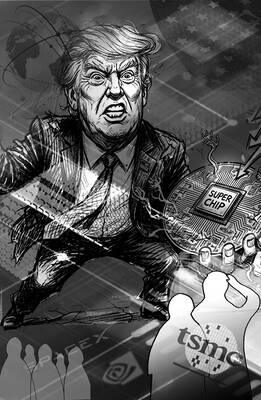
The White House’s decision to take a 9.9 percent stake in Intel Corp is looking like very shrewd business indeed. Since the government bought in at US$20.47 a share last August, the US chipmaker’s surging stock price has delivered the US a US$43 billion return. One of the reasons the investment has so far proved so sound is that the White House has made sure of it. According to The Wall Street Journal, Howard personally pushed deals on Intel’s behalf with some of the most lucrative clients imaginable. They include Nvidia Corp, the company at the heart of the AI
A single photograph can cut through a lot of noise, but it can also be used to misrepresent the truth. At the very least, it can concentrate the mind on something that requires further investigation. On Monday last week, Ma Ying-jeou Foundation CEO Tai Hsia-ling (戴遐齡) and former National Security Council secretary-general King Pu-tsung (金溥聰) held a news conference in which they showed a photograph of former foundation CEO Hsiao Hsu-tsen (蕭旭岑), now Chinese Nationalist Party (KMT) deputy chairman. In the image Hsiao is seated next to Xiamen Taiwan Businessmen Association chairman Han Ying-huan (韓螢煥). The two men were holding
I first met Professor Ray Jiing (井迎瑞) as a film and documentary student at Shih Hsin University’s (SHU) Department of Radio Television and Film in 1988. The following year, he went on to become the director of the Chinese Taipei Film Archive — forerunner of the Taiwan Film and Audiovisual Institute (TFAI). Over his eight-year tenure, Jiing rescued and restored over 200 classic Taiwanese films. In 1997, he established the Graduate Institute of Studies in Documentary and Film Archiving at Tainan National University of the Arts (TNNUA), and I joined the program in his third cohort of students. Beyond a
President William Lai Ching-te’s (賴清德) May 20 second-anniversary address was not just a routine policy review; it was damage control. US President Donald Trump’s remarks — that he did not want to see anyone move toward independence and that the delivery of a major Taiwan arms package could depend on the progress of US-China relations — unsettled Taiwan’s public and created an opening for opposition parties to question whether Taiwan was being treated as a bargaining chip in Washington’s dealings with Beijing. Lai’s speech was designed to close that opening. The address covered the expected ground: sovereignty, cross-strait relations, defense spending,


 RSS
RSS