


Jeremiah Norris, the author of a recent article published in your paper, works for the Hudson Institute, which is described in his bio as a think tank ("WHO: Long on agenda, but short on the facts," Nov. 4, page 8). This think tank is funded by pharmaceutical giants including Eli Lilly, Merck, Pfizer and the Pharmaceutical Research and Manufacturers of America, and its output regularly reflects the views of its corporate sponsors.
Norris' ill-conceived rant suggests it is health infrastructure, not drug prices, that matters in developing countries.
The reality, however, is that both factors are vital.
If AIDS drugs in developing countries still cost US$10,000 a year per person -- as they did at the beginning of the decade and before the introduction of effective generic drugs led to a 99 percent drop in prices -- mass treatment of people with AIDS in the developing world would be impossible.
Even with the massive infrastructure problems that beset developing countries, lowered prices for AIDS drugs has made it possible for more than 2 million people with AIDS to receive treatment -- and live rather than die.
Norris goes so far as to assert, against all evidence, that the system creates incentives for research and development into "neglected diseases," which predominantly affect people in developing countries. In this, his position is even more knee-jerk than the Hudson Institute's pharmaceutical industry funders. The brand-name industry is at least willing to concede the need for mechanisms to supplement patents.
Many public health advocates hope for something more far-reaching: that drug developers be generously compensated, but by mechanisms other than ultra-high drug prices.
Norris' fantastic claims notwithstanding, no one, least of all the WHO, says the agency should be placed in charge of global research and development.
But public health advocates do believe we can and must find ways to support R&D that do not result in the rationing of life-saving medicines in developing countries and the denial of life-saving treatment to people simply because they are poor.
Robert Weissman, WASHINGTON
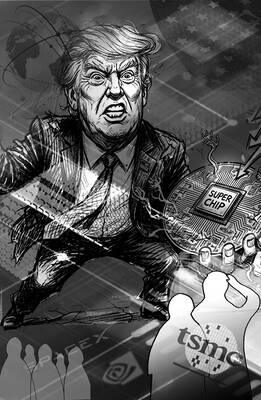
The White House’s decision to take a 9.9 percent stake in Intel Corp is looking like very shrewd business indeed. Since the government bought in at US$20.47 a share last August, the US chipmaker’s surging stock price has delivered the US a US$43 billion return. One of the reasons the investment has so far proved so sound is that the White House has made sure of it. According to The Wall Street Journal, Howard personally pushed deals on Intel’s behalf with some of the most lucrative clients imaginable. They include Nvidia Corp, the company at the heart of the AI
The Ministry of the Interior, working with the navy and coast guard, is organizing Taiwan’s first joint exercise simulating escort tankers carrying liquefied natural gas (LNG) and oil through a Chinese blockade. The drills simulate fuel transport along three maritime corridors leading toward Japan, the Philippines and the US. Deputy Minister of the Interior Sawyer Mars (馬士元) said that a blockade of the Taiwan Strait would amount to “almost a 100 percent blockade of the regional energy supply.” Minister of National Defense Wellington Koo said planning to counter a blockade is standard practice in Taipei. While the exercise is limited in
A single photograph can cut through a lot of noise, but it can also be used to misrepresent the truth. At the very least, it can concentrate the mind on something that requires further investigation. On Monday last week, Ma Ying-jeou Foundation CEO Tai Hsia-ling (戴遐齡) and former National Security Council secretary-general King Pu-tsung (金溥聰) held a news conference in which they showed a photograph of former foundation CEO Hsiao Hsu-tsen (蕭旭岑), now Chinese Nationalist Party (KMT) deputy chairman. In the image Hsiao is seated next to Xiamen Taiwan Businessmen Association chairman Han Ying-huan (韓螢煥). The two men were holding
I first met Professor Ray Jiing (井迎瑞) as a film and documentary student at Shih Hsin University’s (SHU) Department of Radio Television and Film in 1988. The following year, he went on to become the director of the Chinese Taipei Film Archive — forerunner of the Taiwan Film and Audiovisual Institute (TFAI). Over his eight-year tenure, Jiing rescued and restored over 200 classic Taiwanese films. In 1997, he established the Graduate Institute of Studies in Documentary and Film Archiving at Tainan National University of the Arts (TNNUA), and I joined the program in his third cohort of students. Beyond a


 RSS
RSS