


International construction and project consultation services are an important part of the global economy and trade.
The sector can contribute a lot of business and employment opportunities for Taiwanese construction companies and engineers.
However, it is very difficult for Taiwanese contractors and engineers to expand their activities to other countries.
The reason is that Taiwan is not a member of the UN, the World Bank and related global organizations.
Business opportunities from UN construction projects come mostly from loans provided by the World Bank and the International Development Association (IDA).
Both organizations have strict procurement guidelines that exclude non-member countries from bidding for their projects. The same applies to hiring and appointing consultants, with only consulting companies that are registered or established in member countries allowed to bid for their projects.
Are the World Bank and the IDA that important?
While the international construction market has its ups and downs, statistics show that last year, the World Bank lent a total of US$23.6 billion to "medium-developed countries" for expenditure on large-scale development projects. The IDA lends an average of US$10 billion per year to "least developed countries."
It's worth noting that capital lent out by the World Bank and IDA usually make up 25 percent to 35 percent of the entire investment project.
In other words, the two organizations create business opportunities worth between US$96 billion and US$135 billion each year. This is 10 to 14 times the average total amount of investment in construction in Taiwan per year.
But isn't competition for these projects difficult given that only several hundred projects are launched per year?
We have to consider that although the World Bank and IDA only invest in several hundred projects each year, hundreds and thousands of opportunities for bidding for participation in related projects can be derived from it.
The World Bank's Web site shows that there are currently 171 countries calling for bids on projects using the World Bank platform.
Projects open for bidding include 16,761 new construction, renovation and maintenance projects and 15,173 for architectural design and project consultation service.
Given Taiwan's technical expertise in construction as well as its strength in architectural design and special project consultation service, Taiwanese businesses stand a good chance of winning some of the bids -- if only they could participate.
When Taiwan joined the WTO in 2001, it was obliged to open up the domestic market to foreign construction and project consultation companies.
But when Taiwan's construction and project consultation businesses want to take their business to other countries through the WTO, they are confronted with rules that exclude them from the UN and its related organizations.
This constitutes an extremely asymmetrical development. It poses a serious threat not only to the the existence and development of Taiwanese construction companies, but also hinders the professional development of hundreds of thousands of Taiwanese engineers.
To break this bottleneck, Taiwan must join the UN. Only then can its construction industry be fully developed and contribute to continued economic progress.
Huang Yu-lin is an associate professor in the Department of Civil Engineering at National Chiao Tung University.
Translated by Anna Stiggelbout
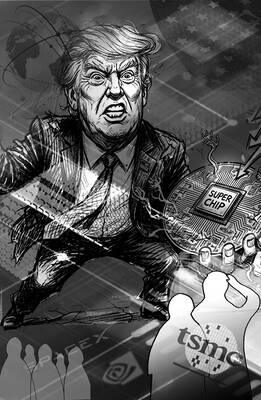
The White House’s decision to take a 9.9 percent stake in Intel Corp is looking like very shrewd business indeed. Since the government bought in at US$20.47 a share last August, the US chipmaker’s surging stock price has delivered the US a US$43 billion return. One of the reasons the investment has so far proved so sound is that the White House has made sure of it. According to The Wall Street Journal, Howard personally pushed deals on Intel’s behalf with some of the most lucrative clients imaginable. They include Nvidia Corp, the company at the heart of the AI
A single photograph can cut through a lot of noise, but it can also be used to misrepresent the truth. At the very least, it can concentrate the mind on something that requires further investigation. On Monday last week, Ma Ying-jeou Foundation CEO Tai Hsia-ling (戴遐齡) and former National Security Council secretary-general King Pu-tsung (金溥聰) held a news conference in which they showed a photograph of former foundation CEO Hsiao Hsu-tsen (蕭旭岑), now Chinese Nationalist Party (KMT) deputy chairman. In the image Hsiao is seated next to Xiamen Taiwan Businessmen Association chairman Han Ying-huan (韓螢煥). The two men were holding
I first met Professor Ray Jiing (井迎瑞) as a film and documentary student at Shih Hsin University’s (SHU) Department of Radio Television and Film in 1988. The following year, he went on to become the director of the Chinese Taipei Film Archive — forerunner of the Taiwan Film and Audiovisual Institute (TFAI). Over his eight-year tenure, Jiing rescued and restored over 200 classic Taiwanese films. In 1997, he established the Graduate Institute of Studies in Documentary and Film Archiving at Tainan National University of the Arts (TNNUA), and I joined the program in his third cohort of students. Beyond a
President William Lai Ching-te’s (賴清德) May 20 second-anniversary address was not just a routine policy review; it was damage control. US President Donald Trump’s remarks — that he did not want to see anyone move toward independence and that the delivery of a major Taiwan arms package could depend on the progress of US-China relations — unsettled Taiwan’s public and created an opening for opposition parties to question whether Taiwan was being treated as a bargaining chip in Washington’s dealings with Beijing. Lai’s speech was designed to close that opening. The address covered the expected ground: sovereignty, cross-strait relations, defense spending,


 RSS
RSS