


When it comes to road safety, the EU is in a bit of a jam.
National governments, eager not to become backseat drivers on this sensitive issue, allow their policies to be shaped by tradition and vested interests.
Car manufacturers still prefer to talk "horsepower" rather than "airbags" and pressure groups led by relatives of road accident victims are tempted to offer misguided advice based on emotion rather than reason.
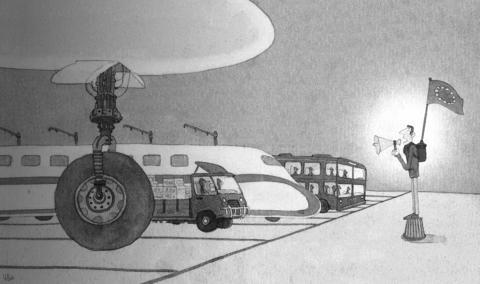
The result is a patchwork of at times contradictory rules and strategies pursued across the 27-member bloc.
Meanwhile, officials in Brussels have been forced to admit that their ambitious target of halving the number of casualties on Europe's roads by 2010 is unlikely to be met.
According to the latest available data provided by the EU's executive arm, the European Commission, road deaths totaled 41,600 in 2005, down just 17.5 percent from the 2001 figure of around 50,000.
Motorcyclist deaths actually rose by 5.6 percent between 2000 and 2003.
"At the present rate, road deaths in the European Union in 2010 are likely to stand at 32,500 and the target of a maximum of 25,000 will probably not be achieved," said the commission in a memo dated Feb. 22 last year.
Road-related deaths are not simply a matter of personal grief for the families and friends of the victims.
The socio-economic cost of road accidents is estimated at around 200 billion euros (US$288 billion) per year, or 2 percent of the EU's GDP.
And the wide variation in road-casualty data across the EU suggests national governments bear much of the responsibility for making their roads safe.
The countries with the best track record in this area are those in which the issue has long been perceived as an emergency.
In the Netherlands, Sweden and Britain, for instance, the annual number of victims per million inhabitants ranges between 50 and 60, well below the EU average of 95.
By contrast, this figure exceeds 200 in new member states Latvia and Lithuania.
"The problem is that road safety rules need to be enforced by national governments, which are also reluctant to spend money on better roads," says Ari Vatanen, a Finnish former World Rally Champion and a road safety advocate in his current role as a member of the European Parliament.
Though he was lucky to survive a major crash while racing a Peugeot 205 "Turbo 16" in the 1985 Argentinian Rally, Vatanen frowns at what he calls the "anti-car lobbies."
"Politicians need to understand that while wealthy nations do not necessarily make good roads, good roads certainly make the wealth of nations," Vatanen said.
Brussels has played a prominent role in promoting the so-called "passive safety" of vehicles.
The commission was the main driving force behind laws making it compulsory to wear seatbelts in all member states.
Now the executive wants every new car in Europe to be fitted with collision-preventing radar within the next 10 years.
But EU officials have enjoyed much less success in standardizing road safety rules, largely because these are still in the hands of national governments.
Speed limits on Europe's freeways, for instance, vary from 100kph in Cyprus to 130kph in Austria or France.
And while Britain is thinking about lowering the mandatory speed limit in built-up areas to 20mph (32kph) from the current 30mph, Chancellor Angela Merkel has no intention of introducing a 130kph limit on the autobahns of Germany.
Speeding at 180kph, German observers note, is seen as a natural right in the land of the Porsche, Mercedes, BMW and Audi.
In Italy, which has one of the worst European track records on road safety and where breathalyzers were virtually unknown until a few years ago, a debate is raging over whether to make it technically impossible for cars to go faster than 200kph.
"The speed limit on Italy's motorways is 130kph. What is the point of making cars that can travel at 200kph?" says Carmelo Lentino of Basta un Attimo (It can take just a moment), a pressure group campaigning for greater road safety awareness among Italy's youth.
Lentino, who lost a 16-year-old friend in a scooter accident, says that while alcohol and drug abuse remains a major cause of road accidents among his peers, imposing such a limit would send out "an important signal."
It is these kinds of proposals that people like Vatanen strongly object to.
And there is plenty of statistical evidence to back up their view.
According to EU data, 60 percent of road-related deaths occur outside built-up areas.
But freeways account for just 5 percent of accidents and 9 percent of fatalities.
In Germany, where a 130kph speed limit is only a "recommendation" in many stretches of its autobahns, 600 people lost their lives on the freeways last year, a relatively small figure when compared to the overall death total of 5,094.
Vatanen argues that instead of focusing their efforts on "popular but ineffective" measures, officials should spend time making sure drivers observe the rules that are already in place.
"Cars aren't dangerous, drivers are. After all, knives are very useful but they can also be used to kill. Does this mean we should stop making them?" the rally champion-turned-politician said.
From the Iran war and nuclear weapons to tariffs and artificial intelligence, the agenda for this week’s Beijing summit between US President Donald Trump and Chinese President Xi Jinping (習近平) is packed. Xi would almost certainly bring up Taiwan, if only to demonstrate his inflexibility on the matter. However, no one needs to meet with Xi face-to-face to understand his stance. A visit to the National Museum of China in Beijing — in particular, the “Road to Rejuvenation” exhibition, which chronicles the rise and rule of the Chinese Communist Party — might be even more revealing. Xi took the members
A Pale View of Hills, a movie released last year, follows the story of a Japanese woman from Nagasaki who moved to Britain in the 1950s with her British husband and daughter from a previous marriage. The daughter was born at a time when memories of the US atomic bombing of Nagasaki during World War II and anxiety over the effects of nuclear radiation still haunted the community. It is a reflection on the legacy of the local and national trauma of the bombing that ended the period of Japanese militarism. A central theme of the movie is the need, at
The Chinese Nationalist Party (KMT) and the Taiwan People’s Party (TPP) on Friday used their legislative majority to push their version of a special defense budget bill to fund the purchase of US military equipment, with the combined spending capped at NT$780 billion (US$24.78 billion). The bill, which fell short of the Executive Yuan’s NT$1.25 trillion request, was passed by a 59-0 margin with 48 abstentions in the 113-seat legislature. KMT Chairwoman Cheng Li-wun (鄭麗文), who reportedly met with TPP Chairman Huang Kuo-chang (黃國昌) for a private meeting before holding a joint post-vote news conference, was said to have mobilized her
Before the Chinese Communist Party (CCP) and its People’s Liberation Army (PLA) can blockade, invade, and destroy the democracy on Taiwan, the CCP seeks to make the world an accomplice to Taiwan’s subjugation by harassing any government that confers any degree of marginal recognition, or defies the CCP’s “One China Principle” diktat that there is no free nation of Taiwan. For United States President Donald Trump’s upcoming May 14, 2026 visit to China, the CCP’s top wish has nothing to do with Trump’s ongoing dismantling of the CCP’s Axis of Evil. The CCP’s first demand is for Trump to cease US


 RSS
RSS