


By coincidence, Japanese Prime Minister Shinzo Abe and Admiral Timothy Keating, commander of US forces in Asia and the Pacific, were in India at the same time last month and for the same reason: to entice India into closer security relations with their respective nations.
Then, US President George W. Bush, in Australia this weekend for the APEC leadership summit, conferred at length with Australian Prime Minister John Howard on Iraq and on wider issues of security in Asia.
Even as they spoke, warships from Australia, India, Japan and the US, plus Singapore, were training together in the Indian Ocean.
Taken together, Australia, India, Japan and the US are forging an informal defensive pact based on shared national interests and democratic values. An Indian commentator, Sudha Ramachandran, has called it a "quadrilateral axis of democracy" or "quad."
While he was in India, Abe was quoted in the Hindustan Times as saying: "A broader Asia, that broke away geographical boundaries, is now beginning to take a distinct form." He called it an "open and transparent network."
China was quick to assert that the quad was an attempt to contain Beijing's influence.
The Chinese contended that Japan in Northeast Asia, Australia in Southeast Asia, and India in South Asia were lined up against them, with US military power in the Pacific Command as backup.
Senior officials in all four nations were equally quick to deny they were engaged in a concerted plot against China.
"There's no, let me emphasize no, effort on our part or any of those other countries, I'm sure, to isolate China, to put them in a closet," Keating told reporters.
Indeed, each nation has sizeable trade relations with China that leaders are anxious not to jeopardize. Moreover, each has domestic political restraints that would crimp an anti-China stance. In India, for instance, nationalists rail against the possibility that India would be drawn into a security posture subordinate to the US.
No one in authority is talking about a formal alliance like NATO. Rather, officials indicated that they are building atop existing US-Japan and US-Australia treaties, plus newly fashioned US-India security relations.
Despite the constraints, leaders of the four nations have expressed concern that China's military modernization may eventually constitute a threat. They are walking on a razor's edge between engagement and deterrence as they hedge against that day.
In India, another commentator, Prem Shankar Jha, has written that "epochal changes in the international order" after Sept. 11 include India's emergence as an economic power and a spurt in international respect for its democracy.
Jha contended the major powers have felt a need "to broaden the base of the informal consensus among larger countries to cope with the progressive disintegration of the international order, the spread of new threats that require collective action, the rapid decline of US hegemony, and its need for friends after its misadventure in Iraq."
For its part, India has been lessening its reliance on Russia for weapons, remained unhappy with China's alliance with its archrival, Pakistan, and still has border disputes with China. Indian leaders have expressed unease over China's gradually increasing presence around the Indian Ocean.
Australian Minister of Defense Brendan Nelson justified Canberra's reliance on collective defense in a recent speech. He noted that dangers from weapons of mass destruction, the prospect of failing states, and transnational crime and terror required joint action. He was worried that the US would turn to isolationism after Iraq.
Nelson said that his nation of 20 million people was limited in providing for its own security.
"We need to work with other people," he said.
Collective defense, however, must be realistic, not just for show and talk.
Australians, he said, "are pragmatic. We don't generally believe in traveling dinner clubs."
In Japan, strategic thinkers have pointed to open hostility from North Korea, barely concealed hostility from South Korea, and anxiety over long-term threats from China despite recent moves by Beijing to take steps to reduce the antagonism.
Tokyo has begun to enhance its modest self-defense force and to revise its constitution to permit Japan to take part in a collective defense.
Nonetheless, for the foreseeable future, Japan will remain dependent on the US for much of its conventional defense and all of its nuclear defense.
For the US Pacific Command, the guideline for collective action set by several recent commanders has been: "No nation is so big it can go it alone, and no nation is too small to contribute."
Richard Halloran is a writer based in Hawaii.
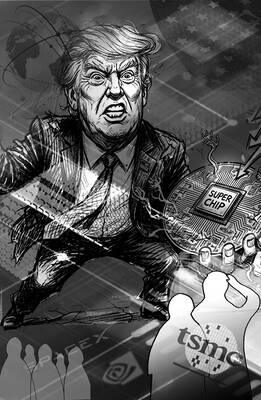
The White House’s decision to take a 9.9 percent stake in Intel Corp is looking like very shrewd business indeed. Since the government bought in at US$20.47 a share last August, the US chipmaker’s surging stock price has delivered the US a US$43 billion return. One of the reasons the investment has so far proved so sound is that the White House has made sure of it. According to The Wall Street Journal, Howard personally pushed deals on Intel’s behalf with some of the most lucrative clients imaginable. They include Nvidia Corp, the company at the heart of the AI
The Ministry of the Interior, working with the navy and coast guard, is organizing Taiwan’s first joint exercise simulating escort tankers carrying liquefied natural gas (LNG) and oil through a Chinese blockade. The drills simulate fuel transport along three maritime corridors leading toward Japan, the Philippines and the US. Deputy Minister of the Interior Sawyer Mars (馬士元) said that a blockade of the Taiwan Strait would amount to “almost a 100 percent blockade of the regional energy supply.” Minister of National Defense Wellington Koo said planning to counter a blockade is standard practice in Taipei. While the exercise is limited in
A single photograph can cut through a lot of noise, but it can also be used to misrepresent the truth. At the very least, it can concentrate the mind on something that requires further investigation. On Monday last week, Ma Ying-jeou Foundation CEO Tai Hsia-ling (戴遐齡) and former National Security Council secretary-general King Pu-tsung (金溥聰) held a news conference in which they showed a photograph of former foundation CEO Hsiao Hsu-tsen (蕭旭岑), now Chinese Nationalist Party (KMT) deputy chairman. In the image Hsiao is seated next to Xiamen Taiwan Businessmen Association chairman Han Ying-huan (韓螢煥). The two men were holding
I first met Professor Ray Jiing (井迎瑞) as a film and documentary student at Shih Hsin University’s (SHU) Department of Radio Television and Film in 1988. The following year, he went on to become the director of the Chinese Taipei Film Archive — forerunner of the Taiwan Film and Audiovisual Institute (TFAI). Over his eight-year tenure, Jiing rescued and restored over 200 classic Taiwanese films. In 1997, he established the Graduate Institute of Studies in Documentary and Film Archiving at Tainan National University of the Arts (TNNUA), and I joined the program in his third cohort of students. Beyond a


 RSS
RSS