


Should cash be used to spur children to do better on reading and math tests?
Suzanne Windland, a homeowner raising three children in a placid enclave of Queens, New York, doesn't think so. Her seventh grader, Alexandra, she said, had perfect scores last year. But she doesn't want New York City's Department of Education to hand her US$500 in spending cash for that achievement.
That's what Alexandra would earn if her school was part of a pilot program that will reward fourth and seventh graders with US$100 to US$500, depending on how well they perform on 10 tests in the next year.
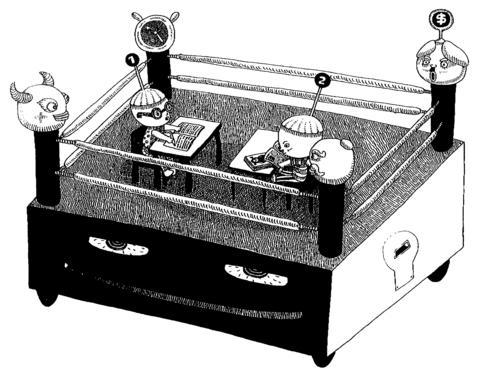
Windland wants Alexandra to do well for all the timeless reasons -- to cultivate a love of learning, advance to more competitive schools and the like. She has on occasion bought her children toys or taken them out for dinner when they brought home pleasurable report cards, but she does not believe in dangling rewards beforehand.
"It's like giving kids an allowance because they wake up every morning and brush their teeth and go off to school," she said. "That's their job. That's what they're supposed to be doing."
Actually, Alexandra will probably not be eligible for the reward because the program, which has been adapted from a similar Mexican cash incentives plan, is aimed largely at schools with students from low-income families. Windland, who grew up for a time on food stamps but now works as coordinator of volunteers for a social services agency, thinks it is unfair that Alexandra will see other seventh graders being rewarded for far lower scores, while she savors only the intangible plums of pride and satisfaction.
Windland predicts that the impact of the program may be paradoxical, with resentment depressing the achievement of hard workers.
"The kids who don't get reimbursed are going to say, `Why should I bother!'" Windland said.
There are parents who support the program. And Schools Chancellor Joel Klein responds to skeptics by arguing that no one has figured out how to get more poorer children engaged in learning. Trumpeting the long-term benefits of education, the better jobs and lives well lived has not worked. Cash just might.
"There are lots of kids who think education is not relevant to them, who think education is a waste of time," he said in an interview.
Still, critics warn Klein to be prepared for a backlash from families, both poor and more well off.
The program will foster "ill will," said Tim Johnson, chairman of the Chancellor's Parent Advisory Council, whose members include Windland.
"The word bribe comes to mind," he said. "You certainly don't want kids with identical abilities, where one gets paid and the other doesn't."
Some parents, like Nakida Chambers-Camille, a school administrative assistant, think the program should be given a shot.
Chambers-Camille has a seventh grader, Leana, at a school that probably won't qualify. Leana, she chuckled, may think that is unfair. But Camille believes such sweeteners may ultimately benefit her daughter.
"If that's going to help the child my child is playing with, then I'm all for it," she said. "I want my child associating with people who have education as a priority. If that child is not learning, that child will pull my child down with her."
But Klein also has some opponents in poorer communities that might benefit. Robert Reed, president of the parents' association of Public School 46 in Harlem, a school where nearly all students qualify for free lunches, called the program "dead wrong" in an e-mail interview, saying children learn "because they want it, not because they're getting paid."
Klein, who grew up in public housing, could recall nothing more in the way of carrots and sticks than an allowance raise or a grounding for one of his bad report cards. His interest in succeeding was quite conventional.
"I wanted my parents' approval," Klein said. "I found education interesting and exciting and I engaged it in those terms. I thought education would create opportunities my family didn't have."
My father said if you want to grow up and not live in public housing, pay attention in school," he said.
The crucial if amorphous role homes play in whether a child succeeds is why Johnson thinks the chancellor should come to grips with the limits of what schools can do.
Other critics of the new program, like Sol Stern, a senior fellow at the Manhattan Institute, think Klein should put the incentives into college funds, saying instant cash undermines the idea of learning for its own sake.
Another parent, Joan Rose Palacios, whose daughter Olivia is a fourth grader in Queens, wondered: "What happens when the money dries up? You pull a carrot away, do they stop working?"
But, she added, she is keeping an open mind because she feels that schools in poor neighborhoods need more aid.
The pilot, devised by Roland Fryer, a 30-year-old Harvard economist who has studied racial inequality in schools, is part of a wider program by New York Mayor Michael Bloomberg's administration that will offer cash to adults for keeping a job, maintaining health insurance, attending teacher conferences and getting children to show up at school.
Laura Rawlings, an economist for the World Bank, which finances US$1.2 billion worth of incentive programs in 12 countries like Mexico, says such programs have raised school attendance.
The programs can be favorably seen as a form of income maintenance that replaces pure entitlements by requiring parents to commit to behaviors society prefers. But the Mexican program does not reward children for passing tests. And it may be hard to explain to children, sensitive to any unfairness, why one child is getting money while another with better grades is not.
When Chinese President Xi Jinping (習近平) sits down with US President Donald Trump in Beijing on Thursday next week, Xi is unlikely to demand a dramatic public betrayal of Taiwan. He does not need to. Beijing’s preferred victory is smaller, quieter and in some ways far more dangerous: a subtle shift in American wording that appears technical, but carries major strategic meaning. The ask is simple: replace the longstanding US formulation that Washington “does not support Taiwan independence” with a harder one — that Washington “opposes” Taiwan independence. One word changes; a deterrence structure built over decades begins to shift.
Recently, Taipei’s streets have been plagued by the bizarre sight of rats running rampant and the city government’s countermeasures have devolved into an anti-intellectual farce. The Taipei Parks and Street Lights Office has attempted to eradicate rats by filling their burrows with polyurethane foam, seeming to believe that rats could not simply dig another path out. Meanwhile, as the nation’s capital slowly deteriorates into a rat hive, the Taipei Department of Environmental Protection has proudly pointed to the increase in the number of poisoned rats reported in February and March as a sign of success. When confronted with public concerns over young
Taipei is facing a severe rat infestation, and the city government is reportedly considering large-scale use of rodenticides as its primary control measure. However, this move could trigger an ecological disaster, including mass deaths of birds of prey. In the past, black kites, relatives of eagles, took more than three decades to return to the skies above the Taipei Basin. Taiwan’s black kite population was nearly wiped out by the combined effects of habitat destruction, pesticides and rodenticides. By 1992, fewer than 200 black kites remained on the island. Fortunately, thanks to more than 30 years of collective effort to preserve their remaining
After Chinese Nationalist Party (KMT) Chairwoman Cheng Li-wun (鄭麗文) met Chinese President Xi Jinping (習近平) in Beijing, most headlines referred to her as the leader of the opposition in Taiwan. Is she really, though? Being the chairwoman of the KMT does not automatically translate into being the leader of the opposition in the sense that most foreign readers would understand it. “Leader of the opposition” is a very British term. It applies to the Westminster system of parliamentary democracy, and to some extent, to other democracies. If you look at the UK right now, Conservative Party head Kemi Badenoch is


 RSS
RSS