


Growing up in New York City, I took the subway to school like most of my peers. I remember not quite understanding, as a 13-year-old, the looks I received from men my father's age -- or why they kept "accidentally" brushing up against me.
What was all that about? As the years went by, of course, it all became clear, and now, in my late 20s, when the topic comes up, I have yet to speak to a woman who hasn't had some experience of being groped on a train.
So I wasn't surprised by a recent report that showed that two out of every three subway riders in New York have been sexually harassed. The survey was of a mixed group, with almost 70 percent of respondents being women.
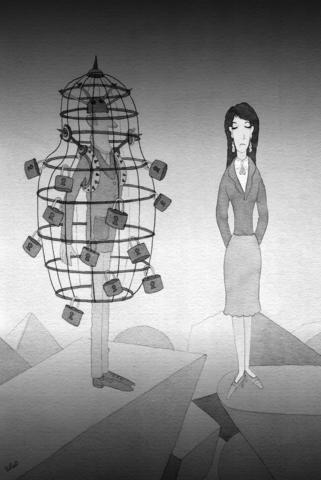
In Tokyo, the problem is just as bad -- 64 percent of women in their 20s and 30s reported being groped on the train or in transit stations. In fact, the problem is so well recognized in Japan, that there's even a specific name for subway harassment: chikan. And the city's answer to such large-scale harassment? Establishing a woman-only train carriage aimed at protecting potential victims.
Japan isn't the only country where a separate space has been set aside for women's safety. There are women-only train carriages in Rio de Janeiro, Moscow and Cairo. Italy has just established a women-only beach. And in the US a hotel recently announced that it is building a separate floor for female guests. All of which raises the question: Is this the latest in "girl power" or a sexist solution to a much bigger problem?
There's no doubt the harassment women face in public spaces needs to be addressed -- whether it is on the street, the train, or even the Internet.
We've been subjected to regular catcalls and groping for far too long. But while the idea of a safe space is compelling, this international trend -- which often comes couched in paternalistic rhetoric about "protecting" women -- raises questions of just how equal the sexes are if women's safety relies on us being separated.
After all, shouldn't we be targeting the gropers and harassers? The onus should be on men to stop harassing women, not on women to escape them.
Betsy Eudey, director of gender studies at California State University, says that while some single-sex environments could be beneficial -- locker rooms where people are expected to be naked are an obvious example -- she finds that "segregated spaces only enhance division by sex and prevent the necessary actions needed to make public spaces safe and welcoming to all."
Not all feminists are so skeptical though. American writer, Katha Pollitt, says she doesn't think that the rise of women-only spaces will excuse society from confronting harassment and violence. Instead, she believes they simply offer a small respite for women in a male-dominated world.
"Obviously, there would never be enough women-only space to accommodate all women all the time -- half the subway cars or half the hotels," Pollitt said. "Women-only space is just a little breathing place for a few women every now and then."
Pollitt said these women-only spaces aren't just about escaping harassment.
"Men just take up too much space. They judge women's bodies. They flaunt their own. This is not going to change in our lifetime, or possibly ever," she said.
For some women, single-sex areas can be a way to expand movement in public spaces, rather than limit it.
A women-only taxi service in Tehran, for example, has been touted as giving women more travel options, while, around the globe, women-only gyms provide a welcome space for religious women who wouldn't otherwise be able to work out.
Religious concerns aside though, I'm wary of how the governments and companies that have created many of these spaces are promoting them. Further evidence that this isn't so much about a feminist vision of women's safety as a short-sighted solution is the reliance on sexist staples to drive home the "women-only" point. Brazil's train cars are pink striped, for instance, as is the sign declaring "No Men" on Italy's beach -- which is known as the "pink beach." In fact, the only man allowed on the Italian beach is a lifeguard.
Beach owner Fausto Ravaglia has said, "You clearly need a man to save women in the sea. It's a question of muscles."
A women-only taxi service in Mumbai, India, features larger-than-normal mirrors, a makeup kit and a magazine rack; the soon-to-be-opened US hotel will have chenille throw blankets and special bath products (you know, stuff that girls like) on its women-only floor.
Of course, there are more serious concerns than complaints about the sugar-and-spice of it all. In cities that offer women-only train carriages, what happens if a woman is groped -- or worse -- in a carriage that isn't women-only? Will she be blamed for not taking advantage of the "safe" space provided? After all, women are all too used to being blamed when it comes to assault, questioned as to why they were out on their own/wearing a short skirt/drinking.
Not all women-only venues are mired in paternalism. Girls' schools, for example, are touted as places where pupils have the confidence to speak more openly than they would in a mixed class. Women-only networking events -- designed to build an "old girls' club" in industries where golf trips and other male-centric networking is the norm -- are gaining popularity in cities from New York to London. Even my publisher, Seal Press, devotes itself solely to publishing female authors.
The difference between these spaces and designated "no harassment" zones, however, is that all-girl schools and networking are positively supporting women and their endeavors rather than hiding us behind closed (or sliding) doors.
When I take the subway now, a bit older and certainly more jaded, I do my best to avoid crowded train cars and instead of silently rolling my eyes when someone brushes up against me, I make a fuss. (Grabbing the offending hand and holding it up, declaring, "Why was this hand on my ass?" seems to do the trick.)
If New York City was to create a woman-only carriage, I might use it occasionally, just for some breathing space. But I certainly wouldn't stop using the others. After all, women should have the right to be safe anywhere and everywhere.

The White House’s decision to take a 9.9 percent stake in Intel Corp is looking like very shrewd business indeed. Since the government bought in at US$20.47 a share last August, the US chipmaker’s surging stock price has delivered the US a US$43 billion return. One of the reasons the investment has so far proved so sound is that the White House has made sure of it. According to The Wall Street Journal, Howard personally pushed deals on Intel’s behalf with some of the most lucrative clients imaginable. They include Nvidia Corp, the company at the heart of the AI
The Ministry of the Interior, working with the navy and coast guard, is organizing Taiwan’s first joint exercise simulating escort tankers carrying liquefied natural gas (LNG) and oil through a Chinese blockade. The drills simulate fuel transport along three maritime corridors leading toward Japan, the Philippines and the US. Deputy Minister of the Interior Sawyer Mars (馬士元) said that a blockade of the Taiwan Strait would amount to “almost a 100 percent blockade of the regional energy supply.” Minister of National Defense Wellington Koo said planning to counter a blockade is standard practice in Taipei. While the exercise is limited in
A single photograph can cut through a lot of noise, but it can also be used to misrepresent the truth. At the very least, it can concentrate the mind on something that requires further investigation. On Monday last week, Ma Ying-jeou Foundation CEO Tai Hsia-ling (戴遐齡) and former National Security Council secretary-general King Pu-tsung (金溥聰) held a news conference in which they showed a photograph of former foundation CEO Hsiao Hsu-tsen (蕭旭岑), now Chinese Nationalist Party (KMT) deputy chairman. In the image Hsiao is seated next to Xiamen Taiwan Businessmen Association chairman Han Ying-huan (韓螢煥). The two men were holding
I first met Professor Ray Jiing (井迎瑞) as a film and documentary student at Shih Hsin University’s (SHU) Department of Radio Television and Film in 1988. The following year, he went on to become the director of the Chinese Taipei Film Archive — forerunner of the Taiwan Film and Audiovisual Institute (TFAI). Over his eight-year tenure, Jiing rescued and restored over 200 classic Taiwanese films. In 1997, he established the Graduate Institute of Studies in Documentary and Film Archiving at Tainan National University of the Arts (TNNUA), and I joined the program in his third cohort of students. Beyond a


 RSS
RSS