


Sara Mampane has been waiting for the African National Congress (ANC) to fulfil its promise of a new home -- what she calls a "proper house," where the only corrugated iron is on the roof and the walls are made of brick -- since the party came to power with the collapse of apartheid 13 years ago.
The 43-year-old mother of three watched from her rickety two-room shack with no electricity in a squatter camp on the edge of Mamelodi township as others moved to one of the new box houses built by the government. She was content to wait her turn and be grateful for what did arrive, principally access to clean water and a health clinic for her children. But her patience snapped last month when men in red boiler suits came to demolish her home.
The feared "red ants" descended on the camp to remove the thousands of illegally built corrugated iron shacks that have spread out from the edge of the township in recent years. The residents were so incensed that they stoned one of the men to death and injured others, and set fire to four trucks.
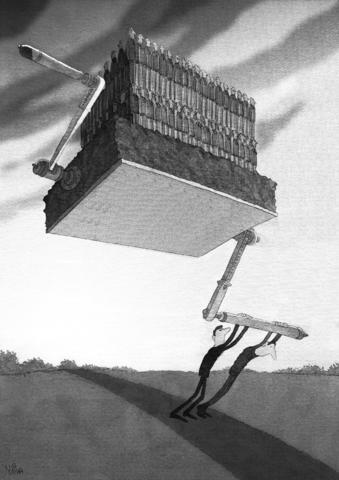
"They promised me a house but they say wait, wait, wait," Mampane said. "So I am waiting. But it is not right to come and knock down the house I have before they build me a new one. This is what we expected from apartheid, not from our own government. I think they have forgotten us."
Weeks of on-and-off rioting in Mamelodi over the demolitions and the lack of services have rekindled memories of the township as a hotbed of protest against the apartheid regime two decades ago.
Last week hundreds of angry protesters threw up barricades and burned tires in clashes with police. Last month the residents set fire to local council offices.
The disturbances are not limited to Mamelodi. Hundreds of similar protests have spread across South Africa, fueled by anger at the slow pace of change.
Thirteen years after the end of apartheid, the poverty gap in South Africa remains among the largest in the world -- second only to Brazil by some measurements. More than 40 percent of South Africans live on less than 8 rand (US$1.14) a day. More than one third of the working-age population is unemployed.
But it is the evident wealth of others, mostly white but including a small newly enriched black elite, that has contributed to bitter divisions within the ANC over the government's economic strategy. The issue is expected to dominate a party conference this week.
TIME BOMB
Some in the ANC are warning that the wealth gap is a time bomb for the country and the party, which is losing touch with the mass of its voters and "betraying the national democratic revolution" with too much focus on creating a liberal business climate.
Trade unions are leading the attack on economic priorities they say have principally benefited the emerging black elite and the old white one at the expense of the poor.
"It's like a doctor saying an operation has been successful when the patient is dead," Zwelinzima Vavi, secretary general of the Congress of South African Trade Unions, a partner in the ruling alliance with the ANC, told a rally in the Free State this month.
Few deny that the ANC has taken significant strides toward reducing poverty. According to figures released last week, the government has built more than 2 million new homes since 1994, although the numbers of people living in squatter camps has risen by half over the same period.
About 85 percent of households have access to fresh water, up from 61 percent when the ANC came to power. More than 71 percent have inside toilets attached to the sewage system, up from about 50 percent. More than 4 million homes have been connected to mains electricity over the same period, although the price of power has quadrupled and many people have been cut off because they cannot pay the bills.
Minister of Provincial and Local Government Sydney Mufamadi has said that the protests reflect the government's successes.
"As we make progress in some municipalities, the residents in other municipalities become impatient: They expect their public representatives to deliver in the same way as progress is made in other municipalities," he told a UN news agency.
The government's latest strategy, the accelerated and shared growth initiative, seeks to halve poverty and unemployment by 2014 by continuing the significant economic growth of recent years and creating millions of new jobs.
Charles Meth, a respected researcher on poverty at Cape Town University, says the government is working on "over-optimistic" predictions, and that though economic growth is crucial it will take decades to eradicate endemic poverty.
"The treasury is driving an agenda that says growth is going to rescue us," Meth says. "It's nonsense."
He continued: "Within the state there's a huge amount of tension over poverty policy. On the one hand you've got the minister of social development, Zola Skweyiya, very sensibly saying this is not going to be enough and we have to have some kind of basic grant for those people who are going to be left out by these anti-poverty policies and growth policies that you're looking at. The Cabinet rounds on him and says `bollocks.'"
The government concedes that though poverty has decreased since 2000, the gap between rich and poor has not narrowed.
FAULT LINE
The poor can see it only too well. Where the fault line between the haves and the have nots once ran almost exclusively along racial lines, the ANC's policy of black economic empowerment has created a new class of super-rich blacks driving the most expensive cars and living in mansions with servants and swimming pools. Many of the new elite have links to the ruling party.
The policy's defenders say that it is forcing a shift in economic power to the black majority that will trickle down to the poor. Some of its critics say that all too often blacks have merely become the public face of white interests.
Smuts Ngonyama, a former spokesman for President Thabo Mbeki, when asked to explain why he received shares in a private company while working for the government, said he did not join the struggle against apartheid to remain poor.
Tokyo Sexwale, one of the few ANC leaders to have declared he is running to succeed Mbeki, has also been forced to defend his extraordinary accumulation of wealth.
The unions and the ANC's left have an uphill struggle to change the policy at this week's party conference. The leadership wants an endorsement of a document that Johannesburg's Centre for Policy Studies has described as so "bland, uncritical and vague" that it leaves the impression that the ANC "just doesn't care for the poor and socially marginalized groups."
But Max Sisulu, one of the party's economic policy strategists, says the ANC is not disturbed by the criticism.
"We are not worried about differences. We welcome them," he says. "We can only benefit from differences."
Chinese state-owned companies COSCO Shipping Corporation and China Merchants have a 30 percent stake in Kaohsiung Port’s Kao Ming Container Terminal (Terminal No. 6) and COSCO leases Berths 65 and 66. It is extremely dangerous to allow Chinese companies or state-owned companies to operate critical infrastructure. Deterrence theorists are familiar with the concepts of deterrence “by punishment” and “by denial.” Deterrence by punishment threatens an aggressor with prohibitive costs (like retaliation or sanctions) that outweigh the benefits of their action, while deterrence by denial aims to make an attack so difficult that it becomes pointless. Elbridge Colby, currently serving as the Under
The Ministry of the Interior on Thursday last week said it ordered Internet service providers to block access to Chinese social media platform Xiaohongshu (小紅書, also known as RedNote in English) for a year, citing security risks and more than 1,700 alleged fraud cases on the platform since last year. The order took effect immediately, abruptly affecting more than 3 million users in Taiwan, and sparked discussions among politicians, online influencers and the public. The platform is often described as China’s version of Instagram or Pinterest, combining visual social media with e-commerce, and its users are predominantly young urban women,
Most Hong Kongers ignored the elections for its Legislative Council (LegCo) in 2021 and did so once again on Sunday. Unlike in 2021, moderate democrats who pledged their allegiance to Beijing were absent from the ballots this year. The electoral system overhaul is apparent revenge by Beijing for the democracy movement. On Sunday, the Hong Kong “patriots-only” election of the LegCo had a record-low turnout in the five geographical constituencies, with only 1.3 million people casting their ballots on the only seats that most Hong Kongers are eligible to vote for. Blank and invalid votes were up 50 percent from the previous
Alarm bells over a “hollowing out” of Taiwan’s semiconductor industry and US demands for “protection money” have fueled a panic over Taiwan. To understand how misplaced these fears are, consider the movements of global technology giants. Nvidia Corp CEO Jensen Huang (黃仁勳), Advanced Micro Devices Inc (AMD) CEO Lisa Su (蘇姿丰) and Taiwan Semiconductor Manufacturing Co (TSMC) chairman C.C. Wei (魏哲家) could undoubtedly understand the situation best, and they continue to make key investments in Taiwan. They do not make decisions on a whim. They are the architects of global computing power strategy and possess the highest levels of industry knowledge. No


 RSS
RSS