


Scientists believe they have discovered the biggest migration of wild animals on Earth, with an aerial survey revealing vast herds of gazelle and antelope on the move in southern Sudan in a region thought to have been denuded of its wildlife by years of civil war.
The Wildlife Conservation Society (WCS), together with the autonomous government of South Sudan, announced at a press conference in New York on Tuesday that a study of the area's fauna has revealed an abundance of antelope, particularly of white-eared kob, in breathtaking numbers.
Flying over an area of about 590,000km2, scientists witnessed a column of animals in their seasonal migration through grasslands and swamps that was 80km long and 48km wide. They estimated the population of the white-eared kob -- a chestnut colored and medium-sized antelope -- at about 800,000. Add to that other species including the topi and the Mongalla gazelle, and the total number of migratory animals is put at 1.3 million, approaching the scale of one of the world's greatest natural events, the Serengeti migration of wildebeest and zebra across east Africa.
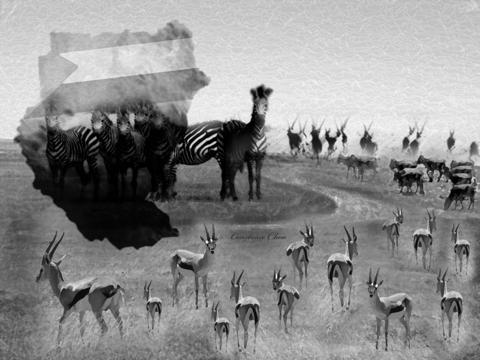
"This could represent the biggest migration of large mammals on Earth," said Michael Fay, a field scientist with the WCS, who conducted the survey. "I have never seen wildlife in such numbers, not even when flying over the mass migrations of the Serengeti."
The discovery of wildlife in such numbers astonished Fay and his fellow conservationists, because the Serengeti migration, which occurs between July and October each year as a way of avoiding the impact of the dry season, was considered to be unrivaled. The findings also came as a happy surprise as the region's long-running civil war was assumed to have led to environmental devastation.
AERIAL SURVEY
An aerial survey was last carried out in 1982, a year before fighting erupted between the Sudan People's Liberation Army and government forces backed by Arab militia from the north.
The fighting lasted for more than two decades and claimed 2 million lives. In 2005 a tentative settlement was reached between the warring parties which has led to autonomous status for the government of South Sudan, and calm has returned to the area with its population of about 11 million. A referendum is to be held on independence in four years' time.
In January, a team led by Fay set out to find out what had happened to the wildlife they had not been able to study for 25 years. Despite the natural richness of the territory, sandwiched between the Sahara and a belt of tropical forests, they expected the worst. There is a long and sorry history of devastation wrought by poachers and armies over the course of Africa's many wars. But as soon as the plane was up over the grasslands, at the start of 150 hours of flying, their hearts lifted.
"If you were a gold miner and hit a vein of gold, like we found in kob, you would have found El Dorado," Fay said.
In addition to the gigantic herds of kob, they produced estimates of 250,000 Mongalla gazelles, a small tan and white antelope with a black stripe on its flank; 160,000 topi, a horned antelope; as well as reedbuck and ostriches. The review of the wilderness' state of health was not universally positive. In the southwest of the region up to 90 percent of the species had been lost.
"We saw no buffalo whereas in 1981 there were estimated to have been 60,000 and only one group of elephants was sighted, where some 10,000 had been estimated to roam in the past," said Paul Elkan, head of the WCS program in southern Sudan.
POACHING
The southwestern zone is particularly prone to poaching, whereas the eastern area is protected to some degree by the natural barrier of the Nile and by its swampy terrain. In other parts, zebra populations also appear to have been wiped out.
The WCS, which has numerous global outreach projects but also runs the zoo in Manhattan's Central Park, now wants to build on the survey findings to preserve the extraordinary wildlife it found. It is calling for the creation of an international conservation mission to protect it. Under the scheme, former fighters with the Sudan People's Liberation Army would be retrained as wildlife activists, managing a network of parks and encouraging environmentally friendly practices among local villagers.
The project would be called the Sudano-Sahel Initiative, and it has been modeled on work done in the Congo basin, another abundant ecosystem under enormous pressure from civil war and conflict over natural resources.
In the case of southern Sudan, the natural resource that most poses a threat to the wildlife is oil.
Since the end of hostilities, oil companies have begun to show increasing interest, and several permits have been handed out for exploration -- right in the middle of the migratory path of the antelope.

Because much of what former US president Donald Trump says is unhinged and histrionic, it is tempting to dismiss all of it as bunk. Yet the potential future president has a populist knack for sounding alarums that resonate with the zeitgeist — for example, with growing anxiety about World War III and nuclear Armageddon. “We’re a failing nation,” Trump ranted during his US presidential debate against US Vice President Kamala Harris in one particularly meandering answer (the one that also recycled urban myths about immigrants eating cats). “And what, what’s going on here, you’re going to end up in World War
Earlier this month in Newsweek, President William Lai (賴清德) challenged the People’s Republic of China (PRC) to retake the territories lost to Russia in the 19th century rather than invade Taiwan. He stated: “If it is for the sake of territorial integrity, why doesn’t [the PRC] take back the lands occupied by Russia that were signed over in the treaty of Aigun?” This was a brilliant political move to finally state openly what many Chinese in both China and Taiwan have long been thinking about the lost territories in the Russian far east: The Russian far east should be “theirs.” Granted, Lai issued
On Tuesday, President William Lai (賴清德) met with a delegation from the Hoover Institution, a think tank based at Stanford University in California, to discuss strengthening US-Taiwan relations and enhancing peace and stability in the region. The delegation was led by James Ellis Jr, co-chair of the institution’s Taiwan in the Indo-Pacific Region project and former commander of the US Strategic Command. It also included former Australian minister for foreign affairs Marise Payne, influential US academics and other former policymakers. Think tank diplomacy is an important component of Taiwan’s efforts to maintain high-level dialogue with other nations with which it does

On Sept. 2, Elbridge Colby, former deputy assistant secretary of defense for strategy and force development, wrote an article for the Wall Street Journal called “The US and Taiwan Must Change Course” that defends his position that the US and Taiwan are not doing enough to deter the People’s Republic of China (PRC) from taking Taiwan. Colby is correct, of course: the US and Taiwan need to do a lot more or the PRC will invade Taiwan like Russia did against Ukraine. The US and Taiwan have failed to prepare properly to deter war. The blame must fall on politicians and policymakers


 RSS
RSS