


It falls to us to put Taiwan-watchers overseas on notice about a development that will have lasting repercussions.
International media outlets do a good job of reporting on events in Taiwan, as long as there is a sexy cross-strait or business angle.
But when it comes to pedestrian issues, such as political reform, most news outlets fall short. Correspondents for international wire, print or broadcast media who approach their overseas editors with a story lacking a "China angle" have a tough fight on their hands.
This is why almost no major media outlet has reported on the cross-party compromise that was reached on Wednesday over changes to electoral districts. It doesn't sound like a compelling story.
This would only be slightly irritating if it were not for the fact that perceptions and policy are in part driven by media coverage. So when the international media simply do not bother to report on significant changes to a country's political situation, it has a deleterious effect on the international community's understanding of, and policy toward, that country.
When policymakers from, say, the US are left in the dark about basic aspects of Taiwan's society and political system, they cannot be expected to formulate meaningful policy.
Much of the think-tanking and analyzing that goes on in Washington is mere regurgitation of what is reported in major media outlets. Only a handful of specialists possesses in-depth knowledge of Taiwan. Meanwhile, most "experts" who write or comment widely on the US' foreign policy toward Taiwan, China or East Asia have only superficial knowledge of Taiwanese politics.
This is not always a serious problem. However, it becomes worrying when the one-dimensional portrait painted by the international media begins to lead policymakers toward erroneous assumptions.
An example of this is how the international media generally treats Chinese Nationalist Party (KMT) Chairman Ma Ying-jeou (
Election returns over the past decade in no way support the conclusion that the KMT is going to glide to power next year. The electorate is almost evenly split between the KMT and the Democratic Progressive Party (DPP), and voters seem largely unperturbed when a scandal rocks their chosen party.
But with all of the fawning over Ma, a person outside of Taiwan could be forgiven for thinking that his presidency is inevitable.
Which brings us back to the development that the international media has ignored.
The changes to the legislature and electoral districts will have a profound effect on the political system. No one, not even the major political parties, is able to predict what kind of legislature the December elections will bring to power.
First, half of all sitting legislators will lose their jobs, as the legislative seats will be slashed from 225 to 113. Next, many popular and prominent figures will be left on the street, because politicians must now compete with each other for first place, rather than being guaranteed a seat by earning a high number of votes. In addition, small political parties face a fight for their survival.
Why will any of this matter outside of Taiwan? Given the changes, it is possible that a party could win a legislative super-majority, enabling it to do all kinds of things, such as write a new constitution.
Or declare independence. Even the international media would notice that.
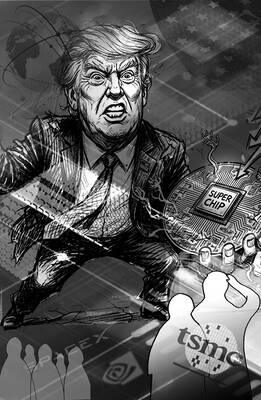
The White House’s decision to take a 9.9 percent stake in Intel Corp is looking like very shrewd business indeed. Since the government bought in at US$20.47 a share last August, the US chipmaker’s surging stock price has delivered the US a US$43 billion return. One of the reasons the investment has so far proved so sound is that the White House has made sure of it. According to The Wall Street Journal, Howard personally pushed deals on Intel’s behalf with some of the most lucrative clients imaginable. They include Nvidia Corp, the company at the heart of the AI
The Ministry of the Interior, working with the navy and coast guard, is organizing Taiwan’s first joint exercise simulating escort tankers carrying liquefied natural gas (LNG) and oil through a Chinese blockade. The drills simulate fuel transport along three maritime corridors leading toward Japan, the Philippines and the US. Deputy Minister of the Interior Sawyer Mars (馬士元) said that a blockade of the Taiwan Strait would amount to “almost a 100 percent blockade of the regional energy supply.” Minister of National Defense Wellington Koo said planning to counter a blockade is standard practice in Taipei. While the exercise is limited in
A single photograph can cut through a lot of noise, but it can also be used to misrepresent the truth. At the very least, it can concentrate the mind on something that requires further investigation. On Monday last week, Ma Ying-jeou Foundation CEO Tai Hsia-ling (戴遐齡) and former National Security Council secretary-general King Pu-tsung (金溥聰) held a news conference in which they showed a photograph of former foundation CEO Hsiao Hsu-tsen (蕭旭岑), now Chinese Nationalist Party (KMT) deputy chairman. In the image Hsiao is seated next to Xiamen Taiwan Businessmen Association chairman Han Ying-huan (韓螢煥). The two men were holding
I first met Professor Ray Jiing (井迎瑞) as a film and documentary student at Shih Hsin University’s (SHU) Department of Radio Television and Film in 1988. The following year, he went on to become the director of the Chinese Taipei Film Archive — forerunner of the Taiwan Film and Audiovisual Institute (TFAI). Over his eight-year tenure, Jiing rescued and restored over 200 classic Taiwanese films. In 1997, he established the Graduate Institute of Studies in Documentary and Film Archiving at Tainan National University of the Arts (TNNUA), and I joined the program in his third cohort of students. Beyond a


 RSS
RSS