


Comments by US Secretary of State Condoleezza Rice last week regarding the US' commitment to help Taiwan defend itself were nothing new. However, they came in the wake of regional tension over the nuclear test by North Korea and in response to questions over Taiwan's role in international efforts to deal with the crisis.
Most people in Taiwan do not see the nuclear test as something which will have an immediate effect on their lives. Nevertheless, if the crisis continues to escalate -- which at this point seems inevitable -- Taiwan cannot possibly stay clear out of it.
Leaving aside the immediate issue of potential environmental contamination caused by further nuclear tests or indeed a nuclear conflict, for the simple reason that China plays a key role in the North Korean crisis, any resulting shift or instability in the regional balance of power will inevitably affect the cross-strait relationship.
Since Taiwan is neither a member of the UN nor was invited to participate in the six-party talks on the issue, the nation is not expected to have a say on how the crisis should be managed. While many may decry the unfairness of this, it is a political reality that is not likely to change.
Under the circumstances, Rice's statement on the US' commitment to help Taiwan defend itself should help allay the sense of helplessness felt by some Taiwanese in the aftermath of the nuclear test.
On the other hand, it just so happens that Rice's comments were made at around the same time that the US-China Economic and Security Review Commission -- a US government advisory panel -- was getting ready to approve a report that highlights China's advanced military capabilities.
The report depicted Taiwan as becoming increasingly dependent on the US to deter Chinese aggression and to intervene should such aggression turn to use of force.
The situations described in the report are a cause for concern, especially in light of the fact that it also described a "window of vulnerability" from 2008 to 2015 in the military capability of Washington to intervene in the event of any cross-strait military crisis.
However, the politicians and people of Taiwan seemingly remain largely indifferent to world events -- not only with respect to the North Korean crisis but also to the implications of the US "window of vulnerability" and the increasing military threat posed by China.
Otherwise, it is hard to understand why pan-blue lawmakers, especially Chinese Nationalist Party (KMT) legislators, decided to break their promise -- which was made in a meeting organized by Speaker Wang Jin-pyng (
The supplemental budget was the product of a compromise between the ruling and opposition camps to begin with, approving greatly reduced funds in comparison with the funding initially requested for the arms procurement program.
In light of these events, the arms bill is likely to remain a hostage of the deadlocked legislature. The likelihood of the nation becoming less reliant on US protection is remote.
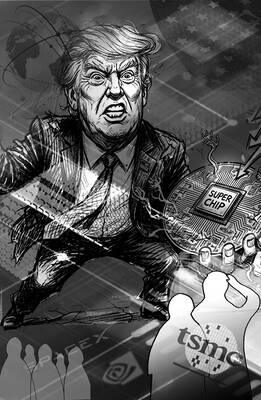
The White House’s decision to take a 9.9 percent stake in Intel Corp is looking like very shrewd business indeed. Since the government bought in at US$20.47 a share last August, the US chipmaker’s surging stock price has delivered the US a US$43 billion return. One of the reasons the investment has so far proved so sound is that the White House has made sure of it. According to The Wall Street Journal, Howard personally pushed deals on Intel’s behalf with some of the most lucrative clients imaginable. They include Nvidia Corp, the company at the heart of the AI
In a Taiwanese university classroom, a lecturer asks in English: “Can anyone give me an example from Taiwan?” Students look down. No one answers. After class, one student writes on the course platform in Mandarin: “I understood the concept, but I didn’t know how to answer in English.” That moment highlights a key issue in Taiwan’s English-medium instruction (EMI) reform: It is not just about more English-taught courses, but whether students can learn, participate and belong. EMI expansion is part of the Bilingual 2030 policy and the Ministry of Education’s BEST Program, aiming to improve English ability, support EMI teaching
The Ministry of the Interior, working with the navy and coast guard, is organizing Taiwan’s first joint exercise simulating escort tankers carrying liquefied natural gas (LNG) and oil through a Chinese blockade. The drills simulate fuel transport along three maritime corridors leading toward Japan, the Philippines and the US. Deputy Minister of the Interior Sawyer Mars (馬士元) said that a blockade of the Taiwan Strait would amount to “almost a 100 percent blockade of the regional energy supply.” Minister of National Defense Wellington Koo said planning to counter a blockade is standard practice in Taipei. While the exercise is limited in
A single photograph can cut through a lot of noise, but it can also be used to misrepresent the truth. At the very least, it can concentrate the mind on something that requires further investigation. On Monday last week, Ma Ying-jeou Foundation CEO Tai Hsia-ling (戴遐齡) and former National Security Council secretary-general King Pu-tsung (金溥聰) held a news conference in which they showed a photograph of former foundation CEO Hsiao Hsu-tsen (蕭旭岑), now Chinese Nationalist Party (KMT) deputy chairman. In the image Hsiao is seated next to Xiamen Taiwan Businessmen Association chairman Han Ying-huan (韓螢煥). The two men were holding


 RSS
RSS