


It is difficult for Taiwan to expect to be lauded as a nation that respects human rights when people like Lin Ting (
On Friday, Lin urged women diagnosed as HIV-positive to avoid getting pregnant. He then said that those who find themselves pregnant can seek help from the authorities in getting an abortion. He also urged doctors to encourage HIV-positive women to consider this option.
The background for his statement was that most women who have contracted AIDS in Taiwan are intravenous drug users, a large percentage of whom reside in prison, where the disease is identified via routine screening.
But what is Lin really trying to say, and what message do his words send to the rest of the world?
During his oration Lin admitted that, if treated early, a mother can be prevented from passing the disease on to her newborn child. Was Lin therefore making the announcement on behalf of the cash-strapped national insurance program to combat the cost of the expensive drugs these women would require, or was he suggesting that women who contract HIV forfeit the right to reproduce, and that drug addicts are not entitled to the same treatment as other people?
It is doubtful Lin would relay the same message to a businessman's wife who had contracted HIV from her husband after he had been philandering in China.
Whatever the reasons for Lin's announcement, this is not the kind of message that showers the authorities with glory, especially those who prattle on about Taiwan being a nation that respects human rights. These comments are the sort of thing we expect from across the Taiwan Strait, where discussion of AIDS is largely taboo, figures showing the true extent of the disease are fudged and activists who try to expose the truth are harassed and arrested.
What people with HIV/AIDS need more than anything is help: counseling so they can understand the reality of their predicament and ways that they can deal with it. They do not need a government official saying that they are inferior and telling them they must exterminate their unborn children.
Taiwan is one of the most forward-thinking nations in Asia in regard to equal opportunity, with women taking a strong role in many areas of society such as politics, business and commerce. But time and again the government has claimed to champion the cause of human rights while making little progress on important issues like human trafficking, abolishing the death penalty or improving the circumstances of disadvantaged groups like teenage mothers, HIV/AIDS sufferers and drug addicts.
With the pending abolition of the minimum wage for foreign workers, the government continues to allow foreign laborers to be treated like slaves, even after last year's Kaohsiung riots exposed the corruption, nepotism and cruelty endemic among labor brokers.
Politicians and government officials can talk about Taiwan being a human rights paradise until they are blue in the face, but until the government starts taking a more humane and committed approach to problems like HIV/AIDS and brings people like the CDC deputy director-general into line for making irresponsible comments, independent observers here and abroad will conclude that human rights in this country is a slogan as much as a reality.
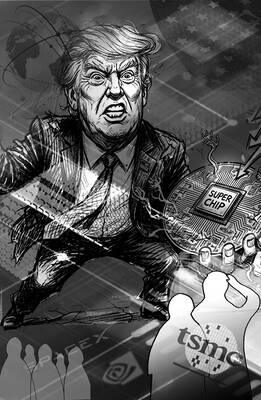
The White House’s decision to take a 9.9 percent stake in Intel Corp is looking like very shrewd business indeed. Since the government bought in at US$20.47 a share last August, the US chipmaker’s surging stock price has delivered the US a US$43 billion return. One of the reasons the investment has so far proved so sound is that the White House has made sure of it. According to The Wall Street Journal, Howard personally pushed deals on Intel’s behalf with some of the most lucrative clients imaginable. They include Nvidia Corp, the company at the heart of the AI
A single photograph can cut through a lot of noise, but it can also be used to misrepresent the truth. At the very least, it can concentrate the mind on something that requires further investigation. On Monday last week, Ma Ying-jeou Foundation CEO Tai Hsia-ling (戴遐齡) and former National Security Council secretary-general King Pu-tsung (金溥聰) held a news conference in which they showed a photograph of former foundation CEO Hsiao Hsu-tsen (蕭旭岑), now Chinese Nationalist Party (KMT) deputy chairman. In the image Hsiao is seated next to Xiamen Taiwan Businessmen Association chairman Han Ying-huan (韓螢煥). The two men were holding
I first met Professor Ray Jiing (井迎瑞) as a film and documentary student at Shih Hsin University’s (SHU) Department of Radio Television and Film in 1988. The following year, he went on to become the director of the Chinese Taipei Film Archive — forerunner of the Taiwan Film and Audiovisual Institute (TFAI). Over his eight-year tenure, Jiing rescued and restored over 200 classic Taiwanese films. In 1997, he established the Graduate Institute of Studies in Documentary and Film Archiving at Tainan National University of the Arts (TNNUA), and I joined the program in his third cohort of students. Beyond a
President William Lai Ching-te’s (賴清德) May 20 second-anniversary address was not just a routine policy review; it was damage control. US President Donald Trump’s remarks — that he did not want to see anyone move toward independence and that the delivery of a major Taiwan arms package could depend on the progress of US-China relations — unsettled Taiwan’s public and created an opening for opposition parties to question whether Taiwan was being treated as a bargaining chip in Washington’s dealings with Beijing. Lai’s speech was designed to close that opening. The address covered the expected ground: sovereignty, cross-strait relations, defense spending,


 RSS
RSS