


Everyone is under surveillance in Blair's Britain -- the Britain, that is, of Eric Blair, better known as George Orwell. Although the totalitarian dictatorship he envisaged has never arrived on these shores, the monitoring tools of an intrusive state most certainly have.
Closed circuit television (CCTV), still in its infancy in the real 1984, has become ubiquitous more than two decades on. We are filmed from the moment we climb into our cars or stroll down the road on to the main street.
"The UK would appear to have around 4.2 million cameras in operation," says Clive Norris, of the Center for Criminological Research at Sheffield University, England. "That's more than anywhere else in the world, with the possible exception of China. It's one for every 14 citizens."
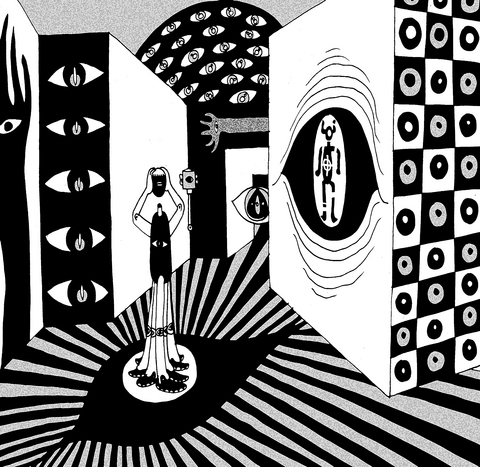
What is beginning to concern him even more than the sheer volume of those cameras is the use to which their digital images can be put -- how they can be fed into computers to build up profiles and keep records in a way that completely alters the relationship between the government and the individual.
"What we are seeing is the evolution of the information society into the surveillance society," he warns.
Keeping an eye on Big Brother has become Norris's life work. Not surprisingly, it provided a suitably catchy title for a conference he organized in Sheffield in the spring, attracting 120 academics from 18 different countries. Easy, perhaps, for those who spend much of their lives in the comparatively rarefied environs of university campuses to pontificate about crime and surveillance while cocooned from the threat felt by millions at street level.
That could be an argument put forward by any one of the past five or six home secretaries. But nobody could accuse Norris of avoiding life at the sharp end.
Back in the early 1980s, he spent months observing frontline police officers at first hand in a deprived part of London. He took part in car chases, dodged flying fists and furniture in pub brawls and endured the boredom of the canteen at three in the morning. How did all that come about?
"Fate," he says. "I was doing my MSc at Surrey [University] and we had to do a research placement. I couldn't hide my disappointment when I was seconded to the Institute of Education to look into aspects of classroom practice. My father was a head teacher [in Putney, west London], my brother was an educational researcher and my uncle and aunt were teachers. I wanted to do something other than education and, when I bumped into one of my lecturers, I told him so. By chance, he was able to offer me instead some research into neighborhood policing for the Police Foundation."
Norris quickly learned, as he puts it, to keep his mouth shut and his eyes open, especially during those long hours in the canteen when the conversation was predictably illiberal.
"The level of racial stereotyping was overt," he says, "but I wasn't there to impose my views."
Trust had to be built up. During the first few weeks, he would find himself "kiddie-locked" into the back of patrol cars.
"After a while," he recalls, "when they realized that I wasn't going to be a liability, somebody or other would rush in and say: `Clive, do you want to come out on this one?'"
Sometimes the invitation was a mixed blessing.
"I remember being on the 12th floor of a tower block with a very experienced policeman, politely suggesting that some partygoers turned down the noise. Suddenly the radio crackled into life, summoning all officers to a major incident at a nearby pub. He ran down the stairs with me in hot pursuit, five paces behind. I just about managed to fling myself into the car as it screeched off at breakneck speed. When we ar-rived at the scene, there was mayhem. But the officer I was with grabbed a man who was just about to hit someone else. He forced his arms down and calmed him down. Through that one action, he magically broke up the fighting in that part of the pub. Some officers have real presence."
A good old-fashioned piece of police work, then, that evidently impressed the young academic. The other lasting impression was of long periods of tedium. This was a very rundown part of London in the wake of riots in Brixton in the south of the capital and elsewhere.
"The image of inner cities is that they're constantly on the edge of chaos," he reflects. "But it doesn't feel like that when you're sitting in a patrol car waiting for something to happen."
Within a few years, however, CCTV was being touted as a panacea for what was seen as an epidemic of rising crime.
"When the number of cameras expanded rapidly in the early 90s, there was no systematic evidence of their effect," Norris maintains. "New Labour committed another ?169 million (US$306 million) to yet more expansion in 1998. At least, though, for the first time a government was putting aside a sizeable tranche for their evaluation. Professor Martin Gill, of Leicester University, England, concluded that CCTV was an ineffective tool if the aim was to reduce overall crime rates and make people feel safer. By the time his report came out, however, a new round of cameras had already been installed," he says.
These were not dismantled as a result of the evaluation, however.
"The reduction of crime and fear of crime are not what makes CCTV useful and attractive to policymakers. What does? The desire to see and know, and be in control where necessary," Norris maintains. "One of the major differences between ourselves and the rest of western Europe is that they have strong data protection laws based on a memory of totalitarianism. Part of the postwar settlement in Germany was to protect citizens from arbitrary state interference. In Berlin, it was illegal to film people on the street until very recently. Legislation has been brought in to allow cameras to be in place for the World Cup."
Although many authorities recognize that CCTV may have a limited effect in preventing crime, it can provide invaluable evidence for those trying to solve it.
"It has proved a hugely useful investigative resource in major incidents," Norris says. "However, it's not a silver bullet. Take the example of the Brixton bomber [David Copeland, who planted three bombs in London in 1999]. The police gathered all the CCTV footage from all the cameras in Brixton, but it took 50 detectives over 20 days to plough through all the tapes. As it turned out, forensic evidence from the bag he was carrying proved crucial."
The vast majority of citizens in the UK don't appear to share the professor's concerns about being under observation -- except when it comes to speed cameras.
"They interfere with the God-given right of the British male to drive faster than he should," says Norris.
"Personally, I don't have a problem with speed cameras. I have a 13-year-old son and I don't worry about him becoming a victim of crime -- maybe I should -- but I do worry about him being run over."
He has concerns, he says, about a policy document released last year by the Association of Chief Police Officers under the title Denying Criminals Use of the Road. It envisaged a network of automatic license-plate readers, linked to CCTV.
"Some are now in operation," Norris says. "Every vehicle that enters certain cities can have its number plate logged, with the ultimate aim of creating a national network. They've asked for information to be stored for two years so that there will be a permanent record that can be searched retrospectively. It would represent a huge shift in the records that the state holds against individuals and would seem to undermine one of the key planks of the data protection laws -- that we should consent to information held on us."
Norris quotes from his book The Maximum Surveillance Society: The Rise of CCTV: "The history of the 20th century should remind us that democratic institutions are not assured. They can be, and have been, captured by totalitarian regimes of both left and right. We should not be seduced by the myth of benevolent government, for while it may be only a cynic who questions the benign intent of their current rulers, it would surely be a fool who believes that such benevolence is assured in the future."
Blair would surely have agreed with that. Eric Blair, that is.

A gap appears to be emerging between Washington’s foreign policy elites and the broader American public on how the United States should respond to China’s rise. From my vantage working at a think tank in Washington, DC, and through regular travel around the United States, I increasingly experience two distinct discussions. This divergence — between America’s elite hawkishness and public caution — may become one of the least appreciated and most consequential external factors influencing Taiwan’s security environment in the years ahead. Within the American policy community, the dominant view of China has grown unmistakably tough. Many members of Congress, as
After declaring Iran’s military “gone,” US President Donald Trump appealed to the UK, France, Japan and South Korea — as well as China, Iran’s strategic partner — to send minesweepers and naval forces to reopen the Strait of Hormuz. When allies balked, the request turned into a warning: NATO would face “a very bad” future if it refused. The prevailing wisdom is that Trump faces a credibility problem: having spent years insulting allies, he finds they would not rally when he needs them. That is true, but superficial, as though a structural collapse could be caused by wounded feelings. Something
Former Taipei mayor and Taiwan People’s Party (TPP) founding chairman Ko Wen-je (柯文哲) was sentenced to 17 years in prison on Thursday, making headlines across major media. However, another case linked to the TPP — the indictment of Chinese immigrant Xu Chunying (徐春鶯) for alleged violations of the Anti-Infiltration Act (反滲透法) on Tuesday — has also stirred up heated discussions. Born in Shanghai, Xu became a resident of Taiwan through marriage in 1993. Currently the director of the Taiwan New Immigrant Development Association, she was elected to serve as legislator-at-large for the TPP in 2023, but was later charged with involvement
Out of 64 participating universities in this year’s Stars Program — through which schools directly recommend their top students to universities for admission — only 19 filled their admissions quotas. There were 922 vacancies, down more than 200 from last year; top universities had 37 unfilled places, 40 fewer than last year. The original purpose of the Stars Program was to expand admissions to a wider range of students. However, certain departments at elite universities that failed to meet their admissions quotas are not improving. Vacancies at top universities are linked to students’ program preferences on their applications, but inappropriate admission


 RSS
RSS