


Every time there is a drought, water companies can be found dusting off their plans for new reservoirs. After another dry winter in the UK, this year is unlikely to be an exception. Thames Water is preparing plans for the largest man-made structure in Britain -- a £700 million (US$1.22 billion) reservoir covering 10km2, with banks rising as high as a church tower above the flat farmland near Abingdon in Oxfordshire.
The scheme, designed to store water from the Thames in winter and release it downstream in summer, is due to be unveiled this week. Thames Water had booked the local village hall, but then canceled. The firm denies the story, but many believe that the delay is because Thames Water has been put up for sale by its German owners.
Even so, it has pencilled in a public inquiry for 2008 and, if it gets its way, the Vale of the White Horse will be under water by 2020. The alternative could be standpipes in the capital, say the firm's engineers.
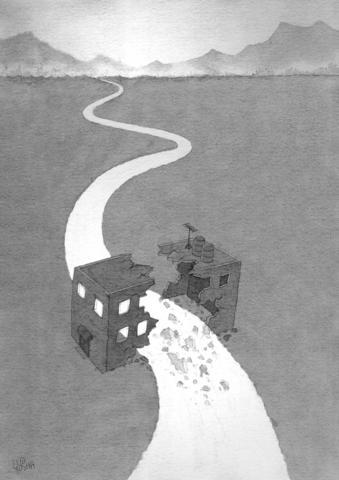
But few of those engineers will be aware that 30 years ago, before Thames Water was privatized, an economic study by their public sector predecessors concluded that saving water by plugging leaks in water mains and installing new valves for every toilet cistern in London would be cheaper and just as effective.
Britain is a modest user of water, consuming a sixth as much per head as Egypt, for instance. This is mainly because a moderate temperatures, reasonable rainfall and cloudy skies ensure that British crops mostly grow without artificial irrigation.
But water engineers in the UK share with their colleagues the world over an obsession with dams and pipes and concrete. They want to supply ever more water, and are deaf to calls for investment in demand management.
DRY BEDS
And, as I have discovered in a five-year investigation of the world's water, this supply-side fixation is creating a global hydrological crisis that threatens the survival of some of the world's largest rivers.
The world atlas no longer tells the truth. Today, dozens of the greatest rivers are dry long before they reach the sea. They include the Nile in Egypt, the Yellow River in China, the Indus in Pakistan, the Rio Grande and Colorado in the US, the ancient Oxus that once fed the Aral Sea in Central Asia, the Murray in Australia, and the Jordan, which is emptied before it reaches the country that bears its name.
The biggest demand on the world's water is irrigated farming, which takes two-thirds of all the water abstracted from rivers and underground reserves. This is largely due to the green revolution.
The "high-yielding" plant varieties that have kept the world fed as populations have doubled over the last 30 years turn out to be high-yielding only when measured against land area. Measured against water use, they are generally worse than the crops they replaced. They produce less crop per drop.
As a result, the world grows twice as much food as it did a generation ago, but abstracts three times as much water to do it.
The UN Food and Agriculture Organization says that on at least a third of the world's fields today, "water rather than land is the binding constraint" on production.
This profligacy is present in every supermarket trolley. The amount of water needed to grow our everyday food is staggering. To grow a kilo of rice takes between 2,000 and 5,000 liters of water -- more than many households use in a week. It takes 20,000 liters to fill a kilo jar of coffee, up to 4,000 liters to grow the fodder that will deliver a liter of cow's milk, and up to 11,000 liters to make a quarter-pound hamburger.
US environmentalist and agriculturalist Lester Brown talks of a "food bubble" -- a world awash with food grown using water that will never be replaced. One day, he says, the bubble will burst. And everywhere I went, I saw why.
I stood on the banks of the Rio Grande at Presidio, on the US- Mexico border, with Terry Bishop, bankrupt despite owning a large chunk of prime Texas farmland. His problem is that -- thanks largely to over-abstraction by upstream irrigators -- his legal entitlement to the river's water is useless. There is no water in the river.
In much of India, the rivers have long-since dried up, and the only water is underground. In the last decade, more than 20 million farmers have bought drills and cheap Yamaha pumps to bring water to the surface and irrigate their crops. As a result, water tables that were until recently only a few meters from the surface are now hundreds of meters down.
TRIP TO DISASTER
The pumping bonanza is "a colossal anarchy, a one-way trip to disaster," says Tushaar Shah, of the International Water Management Institute, whose headquarters is in Gujarat. He reckons farmers are taking from underground 100km3 of water more every year than the rains replace. India's green revolution is living on borrowed water and borrowed time.
Emptying the rivers brings ecological and social chaos in its wake. In northern Nigeria, the Hadejia wetland on the edge of the Sahara once provided fish and pastures and free irrigation water for a million people. But it is being dried up by inefficient and wasteful upstream irrigation schemes -- cruelly advertised by the government as "greening the desert." Now cattle herders and farmers fight for the last water. Every year now, there are dead bodies strewn across the wetland.
The death of the Aral Sea, as Uzbek cotton farmers plunder the rivers that once filled it, is a well-known ecological disaster. But I discovered that it is also a human disaster. The huge state cotton farms bring little wealth now, while the water running to waste from leaking canals and waterlogged fields is poisoning huge swaths of the country with salt.
The stuff is everywhere -- in drinking water, in soils, in the air during the huge dust storms that blow off the dried up sea, and ultimately in the bodies of the people.
Oral Ataniyazova, a local doctor and health campaigner, took me to hospitals in Karakalpakstan, the worst hit area, where more than 90 percent of the population have anemia, deaths in childbirth are endemic and cancer rates are among the highest in the world -- all because of the salt. This forgotten corner of the world is committing ecological suicide.
PRECIOUS RESOURCE
Around the Aral Sea they waste water on an unbelievable scale. But where water is treated as a precious resource, it is increasingly appropriated by the powerful.
Israel explains its refusal to let Palestinians sink new boreholes in the West Bank by saying water there is already being overused. But Israeli settlers in hilltop compounds have swimming pools and sprinklered lawns, while below, their Palestinian neighbors go thirsty.
Oxfam's Geoff Graves took me to Madama, a Palestinian village near Nablus, where neighboring Israeli settlers poisoned the village's only well and shot at aid workers who came to clean it.
Most villagers now buy water from passing tankers, but not all can afford it. Ahmed Qot, a poor farmer, told me he spends three hours every day carrying pots on his donkey to get water from a nearby village for his nine children and five farm animals.
In my travels, I found massive waste and misuse and misappropriation of water, but I also found huge potential to manage things better. I visited inspiring villages across India and China where they are reviving ancient methods of capturing the rain as it falls. I met farmers who use perforated bicycle inner tubes as a cheap method of irrigating their crops from meager water supplies.
And I went to communities in Syria that still rely on thousand-year-old tunnels, known as qanats, that deliver underground water by gravity. I met engineers who want to tear down the dams and give the water back to wetlands and fisheries. And I met citizens demanding a "new water ethic," based on ecology and sustainability and sharing.
I took to using the phrase wherever I went, and it seemed to strike a common chord from Spain to India and China to the US. Maybe it is time to hear it in Britain, too. We might start with the Vale of the White Horse.
Fred Pearce is the author of When The Rivers Run Dry.

The White House’s decision to take a 9.9 percent stake in Intel Corp is looking like very shrewd business indeed. Since the government bought in at US$20.47 a share last August, the US chipmaker’s surging stock price has delivered the US a US$43 billion return. One of the reasons the investment has so far proved so sound is that the White House has made sure of it. According to The Wall Street Journal, Howard personally pushed deals on Intel’s behalf with some of the most lucrative clients imaginable. They include Nvidia Corp, the company at the heart of the AI
A single photograph can cut through a lot of noise, but it can also be used to misrepresent the truth. At the very least, it can concentrate the mind on something that requires further investigation. On Monday last week, Ma Ying-jeou Foundation CEO Tai Hsia-ling (戴遐齡) and former National Security Council secretary-general King Pu-tsung (金溥聰) held a news conference in which they showed a photograph of former foundation CEO Hsiao Hsu-tsen (蕭旭岑), now Chinese Nationalist Party (KMT) deputy chairman. In the image Hsiao is seated next to Xiamen Taiwan Businessmen Association chairman Han Ying-huan (韓螢煥). The two men were holding
I first met Professor Ray Jiing (井迎瑞) as a film and documentary student at Shih Hsin University’s (SHU) Department of Radio Television and Film in 1988. The following year, he went on to become the director of the Chinese Taipei Film Archive — forerunner of the Taiwan Film and Audiovisual Institute (TFAI). Over his eight-year tenure, Jiing rescued and restored over 200 classic Taiwanese films. In 1997, he established the Graduate Institute of Studies in Documentary and Film Archiving at Tainan National University of the Arts (TNNUA), and I joined the program in his third cohort of students. Beyond a
President William Lai Ching-te’s (賴清德) May 20 second-anniversary address was not just a routine policy review; it was damage control. US President Donald Trump’s remarks — that he did not want to see anyone move toward independence and that the delivery of a major Taiwan arms package could depend on the progress of US-China relations — unsettled Taiwan’s public and created an opening for opposition parties to question whether Taiwan was being treated as a bargaining chip in Washington’s dealings with Beijing. Lai’s speech was designed to close that opening. The address covered the expected ground: sovereignty, cross-strait relations, defense spending,


 RSS
RSS