


Sir Gordon Conway is, by background, an applied ecologist. By profession, however, he is a pragmatist, a philanthropist, but, above all, an optimist. He lives and works on the upside of things. Not for him the headlines of the past few weeks, with doom everywhere. If the climate change don't get you, the avian flu must. The world, he insists, has got better and will get better still.
"I've been in the development business all my adult life," says Conway, who joined the UK government's Department for International Development (DFID) as its chief scientific adviser in January.
"I went to Borneo in 1960 and and I've seen countries like that transform themselves. I first went to Indonesia in 1968, just after the enormous uprising and the slaughter. It was a terrible place then. You go there now and it's got to the point now that the DFID won't be funding it because it sees Indonesia as a middle-income country. I've also worked a lot in Thailand and I've seen that country transform over time. But you've got to talk in terms of 10 to 20 years for a country to really progress," he said.
His job description in his last post, as president of the Rockefeller Foundation, the US-based philanthropic giant that seeks solutions to global poverty? Something not often seen in the classifieds: "The well-being of humanity throughout the world."
For Conway, that means, principally, feeding the world. At the Rockefeller Foundation he was derided by anti-GM campaigners for his belief -- backed by the foundation's money -- that the best way to do this was through biotechnology. He has described as "naive" by those who believe there is enough food in the world and that we simply need to redistribute it. But he also turned heads by telling the board of Monsanto they had generated the anti-GM backlash themselves by failing to pay attention to legitimate concerns about bioengineered food. Hence Fortune magazine's description of him as "the global food fight's leading centrist."
Does his new employer have an official view on genetic modification?
"We support biotechnology in general, but you need to make a distinction between that and genetic modification, which is just one application of biotechnology. A good example of what we support are the new varieties of rice and bananas in Africa, which are produced from tissue culture. Both crops are spreading rapidly and producing results. GM probably will deliver results but it'll take time," he said.
In this job, Conway firmly believes, "one can begin to make a difference to the lives of millions of people."
But the stress is on "begin." Money is needed but, even more crucially, so is time.
"That's one of the things I think people don't fully understand. There are no magic bullets. It takes time," he said.
That is something the media, with its love of apocalyptic headlines, rarely reflects.
Is Conway worried about a world population of 6 billion and growing? Have industrialization, the green revolution and the efforts of such bodies as DFID merely done what motorways do to cars on our roads -- increased numbers to bursting point?
"I don't think that's the right interpretation," he says, patiently (it's clearly the most frequent of FAQs). "I think that from everything we know, if you improve the lives of poor people, if you give them food security and access to health, they have fewer children. That works all the time with some few exceptions. The fertility rates start to come down."
It doesn't seem to be kicking in all that fast in India, though.
"In some places it has," he points out. "It's come down faster than anyone expected in Bangladesh."
He concedes that, even if things go as planned, world population will stabilize at a big number. What is that big number? It's slippery.
"You've got to factor in technology, which is hard to predict. The interconnectedness of the modern world is another complication. In one sense, it brings people into contact with each other; they can learn from each other, train each other, solve problems collectively. But in another sense, it introduces all kinds of threats -- such as avian flu."
Interconnectedness is also, as Conway sees it, the solution to those old Malthusian "checks" -- war, famine, disease.
"In the United States," he says, "I was chairman of one of the largest affordable housing projects in the country which was put together by a whole lot of private foundations working together."
At the DFID, Conway sees the public-private partnership as the way to handle, for example, vaccine research on HIV/AIDS for the third world, or the growth of higher education in Africa, or -- at a more practical level (he's a very practical man) -- supplying insecticide-impregnated bed-nets to east Africa, where they have brought down infant mortality rates dramatically.
The future well-being of mankind requires, as Conway sees it, effective co-operation between three very big players: governments, private foundations, and NGOs. He also believes strongly in the need for science to have a voice in policy-making in developing countries, something else he believes requires cooperation, a point he made to a UK parliamentary committee on science and technology earlier this year.
Few of us are charged with responsibility for the long-term fate of our species. Is he, through and through, an optimist? Or is there an inner Sir Gordon Conway who looks into the mirror from time to time and thinks perhaps not?
"No. If you asked my family they'd say the optimism goes right through. I get very depressed when I see suffering and tragedy -- whether it be New Orleans or Islamabad, or the countries ravaged by the tsunami. In all three cases we could have done a better job in protecting people. We know how to build buildings that are earthquake proof," he said. "New Orleans was a disaster waiting to happen. If warning systems had been in place there would have been many fewer people killed by the [hurricane]. So I don't get depressed, I get angry. I know there are answers. The world is very slow to respond but, in time, we usually put the answers in place."
A gap appears to be emerging between Washington’s foreign policy elites and the broader American public on how the United States should respond to China’s rise. From my vantage working at a think tank in Washington, DC, and through regular travel around the United States, I increasingly experience two distinct discussions. This divergence — between America’s elite hawkishness and public caution — may become one of the least appreciated and most consequential external factors influencing Taiwan’s security environment in the years ahead. Within the American policy community, the dominant view of China has grown unmistakably tough. Many members of Congress, as
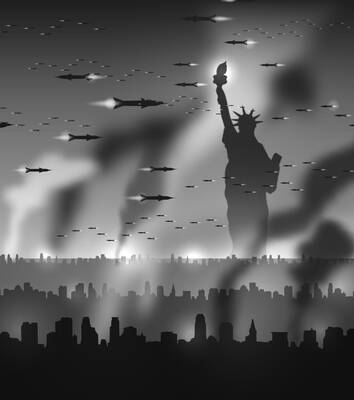
After declaring Iran’s military “gone,” US President Donald Trump appealed to the UK, France, Japan and South Korea — as well as China, Iran’s strategic partner — to send minesweepers and naval forces to reopen the Strait of Hormuz. When allies balked, the request turned into a warning: NATO would face “a very bad” future if it refused. The prevailing wisdom is that Trump faces a credibility problem: having spent years insulting allies, he finds they would not rally when he needs them. That is true, but superficial, as though a structural collapse could be caused by wounded feelings. Something
Former Taipei mayor and Taiwan People’s Party (TPP) founding chairman Ko Wen-je (柯文哲) was sentenced to 17 years in prison on Thursday, making headlines across major media. However, another case linked to the TPP — the indictment of Chinese immigrant Xu Chunying (徐春鶯) for alleged violations of the Anti-Infiltration Act (反滲透法) on Tuesday — has also stirred up heated discussions. Born in Shanghai, Xu became a resident of Taiwan through marriage in 1993. Currently the director of the Taiwan New Immigrant Development Association, she was elected to serve as legislator-at-large for the TPP in 2023, but was later charged with involvement
Out of 64 participating universities in this year’s Stars Program — through which schools directly recommend their top students to universities for admission — only 19 filled their admissions quotas. There were 922 vacancies, down more than 200 from last year; top universities had 37 unfilled places, 40 fewer than last year. The original purpose of the Stars Program was to expand admissions to a wider range of students. However, certain departments at elite universities that failed to meet their admissions quotas are not improving. Vacancies at top universities are linked to students’ program preferences on their applications, but inappropriate admission


 RSS
RSS