


China's lack of democracy and freedom is increasingly ignored or glossed over in nearly all international dealings. Today, international leaders dare not speak out against human-rights abuses lest they lose valuable contracts. It has become, in effect, a matter of etiquette. When French President Jacques Chirac visited China last year, Le Monde, one of France's leading newspapers, printed on its front page a cartoon of Chirac meeting his Chinese counterparts. Said Chirac, "My dictionary does not include the words `freedom' or `democracy.'" Responded the hosts: "You speak Chinese perfectly!"
Even worse, many have begun to rationalize China's continuing dictatorship as being somehow rooted in Chinese culture. Its people do not understand freedom, they need firm leadership, they argue; the alternative to Communism is chaos. All this said of the civilization that has excelled in every area of human endeavor from poetry to mathematics, and produced those classics of humane respect for the individual and of virtuous rule: Confucius and Mencius; not to mention an inspiring series of democratic leaders in the past century and this, from 1898 to the late Qing constitutionalists, to Sun Yat-sen (
Furthermore, China's economic development has gone some distance toward reviving the idea that an autocratic state is better at economic development than a democracy. Consider the common comparison between China, which allegedly got it right by concentrating on economics, and India, which it was long said, lagged behind, precisely because of its seemingly unmanageable democracy. Recent experience has shown how wrong this is, but the idea is still very common.
China's apparent economic success combined with dictatorship has given new life and hope to the world's dictatorships and their apologists, while harming the movement for world democracy. It has slowed its momentum, sapped its morale, placed obstacles in its path, and turned former democrats into apologists for dictatorship. Indeed the free world colludes with China by trading unconditionally, thus transfusing every year the hundreds of billions of dollars that give the appearance of health to her sick and moribund political system.
We were told that our engagement with China would change her. This it has by and large failed to do. Instead we are being corrupted and our values eroded.
Even here in Taiwan I sense the harmful effects [...]. In the 1990s this country's democratization was a source of pride domestically and of admiration abroad. Former presidents Chiang Ching-kuo (
So let me say something to every citizen of this great country, wherever you were born and whatever your political sympathies. You should swell with pride at what your nation has accomplished, not only economically, educationally and culturally, but also politically. In the 1980s, at the moment of greatest peril for your country, when Washington had abruptly discarded its long-time ally and when nearly everyone, Washington included, expected you to collapse or join China, the Chinese Nationalist Party (KMT) of former president Chiang Ching-kuo and the opposition worked together to refuse the expected surrender, and instead began the process that would free political prisoners, free the press, allow multiparty elections and so forth. This stunned the world -- which I should say remains stunned. Twenty years later the international community, including the US, still cannot decide how to deal with this reality.
What would Chiang say?
So what, I wonder, would former president Chiang Ching-kuo say today to those who criticize or underrate or abuse the democracy that he, his successors, and you, this country's people, have created? Chiang Ching-kuo could, after all, have gone to China easily and received a welcome to end all welcomes. He had the power and could easily have delivered this country to Beijing, while himself retiring to luxury and an exalted position. But he did not. Chiang Ching-kuo, as we all know, was a complex man, who long controlled the secret police and had plenty of blood on his hands. But having been a prisoner in the Soviet Union, he knew the truth about communism. Here he learned a great deal about Taiwan, growing wiser as he grew older. He once declared, "I am a Taiwanese." So when Deng Xiaoping (
As a foreigner, all I can say is value, nay treasure, the freedom and democracy that you have created; take pride in it. And defend it. I know that the parties here are deadlocked over arms purchases. Some argue that costs are too great or even suggest that the attempt to defend this country is futile. Yet what, I wonder, would Chiang Ching-kuo have said if he had been given the opportunity to buy submarines and other advanced weapons from the US? What would he have said of those who opposed doing so?
Let me speak once again to you. Above all be confident. China's economy will not grow to the sky nor will her military gobble up Asia. Her people will not be silent forever. Your democratic values will prevail -- in China and in the other countries where you struggle today. Sooner or later, China and these other countries will change. Remember that even Mao Zedong paid eloquent lip service to democracy. Who could forget his definitive statement on the topic, made on Sept. 25, 1945, when he responded in writing to questions placed to him by the Reuters correspondent in Chongqing. One question had asked what was the "Communist Party's understanding of a free and democratic China." Mao's response read: "A free and democratic China will have the following characteristics: Its governments at all levels, including even the central government, will all be chosen in universal, equal and secret elections, and will be responsible to their electors. It will carry out Sun Yat-sen's Three People's Principles, Lincoln's principle of `of the people, by the people, and for the people,' as well as Roosevelt's Atlantic Charter. It will guarantee the independence, solidarity and unity of the country, and its cooperation with other democratic powers." If even Mao could imagine democracy for China, can it really be impossible or inconceivable?
Here let me tell a story against myself, to show how deeply rooted is the false idea that China cannot be democratic. During the democracy movement of 1989 I spoke regularly with the then Wall Street Journal correspondent, then in Beijing, the great US journalist Claudia Rosett. One day, as the crowds in Beijing grew bigger and bigger, she asked me a typically blunt question. "So what should they do, Arthur? Should they hold elections?" My answer was instinctive. "No, they should not hold elections. That would be deeply destabilizing." Then I caught myself. I had always considered myself to favor freedom and democracy in China. Yet here I was, sounding just like a China pundit from the Washington stable, mouthing the usual lame analysis finding that China was not ready for elections; she still needed dictatorship. It was an acutely painful moment of unwitting self-revelation and self-discovery. I was set straight, and I thank Claudia for it.
The right answer is that of course China should have elections. And if she did, what would they yield? Opponents conjure up howling mobs of illiterate and violent poor, ready to destroy everything China has achieved. But this is a chimera designed to frighten us. The correct answer is that free elections would produce a parliament overwhelmingly dominated by farmers, for that is what most Chinese are. What do farmers want? Bright urban skylines? Limousines? Aircraft carriers? Maxim's French restaurant? Taiwan? Designer shoes? The Olympics? Nuclear war? I think none of these. China's farmers are poor and I think they would like more money for rural infrastructure, for rural schools, for transport, for health care, and so forth. They want laws and justice, fairness, opportunity. Just imagine how different a China ruled by such a parliament would be.
History has a way of surprising people. Until very recently, the consensus about China after 1989 has been that her government had succeeded in restoring its dictatorship. The favorite word was "resilience": China's dictatorship had proved resilient. Aspirations for freedom had been forgotten: things would stay as they were. But at the beginning of this month, we learned that Chinese President Hu Jintao (
Dictatorship
The danger, of course, is that as the dictatorship attempts to remodel itself it will collapse, with nothing to take its place but chaos, internal struggle and more dictatorship. That is a worrying possibility for China, and one that is made worse as the outside world colludes with the dictatorship instead of pressuring it to change, and fails to prepare for its end.
But causes exist for optimism. Democratic transition is now well-understood and thoroughly tested. This country provides an excellent example. Chinese are increasingly well educated. So China, which has hitherto provided a false model that suggested modernity and dictatorship could somehow be combined, may now consult that experience and show us, in the years and decades ahead, how her great civilization can transform itself into a modern constitutional state. When the curtain rises again on the drama of China's quest for freedom that was so abruptly halted in 1989, the whole atmosphere in Asia and the world will change. China's example will lift freedom's prestige and leave its current dictatorial friends isolated and contemplating where to flee.
I believe we will see this day, and soon. When it comes, China will redeem her honor, galvanize the forces for freedom globally, and more than recompense for the harm she has done and is doing to democracy today.
Arthur Waldron is the Lauder Professor of International Relations in the Department of History at the University of Pennsylvania. He is also vice president of the International Assessment and Strategy Center in Washington. The above article is the second part of the feature that appeared in yesterday's paper and has been taken from his speech delivered at the first Biennial Conference of the World Forum for Democratization in Asia in Taipei on Sept. 17.
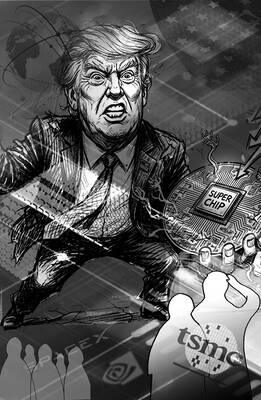
The White House’s decision to take a 9.9 percent stake in Intel Corp is looking like very shrewd business indeed. Since the government bought in at US$20.47 a share last August, the US chipmaker’s surging stock price has delivered the US a US$43 billion return. One of the reasons the investment has so far proved so sound is that the White House has made sure of it. According to The Wall Street Journal, Howard personally pushed deals on Intel’s behalf with some of the most lucrative clients imaginable. They include Nvidia Corp, the company at the heart of the AI
A single photograph can cut through a lot of noise, but it can also be used to misrepresent the truth. At the very least, it can concentrate the mind on something that requires further investigation. On Monday last week, Ma Ying-jeou Foundation CEO Tai Hsia-ling (戴遐齡) and former National Security Council secretary-general King Pu-tsung (金溥聰) held a news conference in which they showed a photograph of former foundation CEO Hsiao Hsu-tsen (蕭旭岑), now Chinese Nationalist Party (KMT) deputy chairman. In the image Hsiao is seated next to Xiamen Taiwan Businessmen Association chairman Han Ying-huan (韓螢煥). The two men were holding
I first met Professor Ray Jiing (井迎瑞) as a film and documentary student at Shih Hsin University’s (SHU) Department of Radio Television and Film in 1988. The following year, he went on to become the director of the Chinese Taipei Film Archive — forerunner of the Taiwan Film and Audiovisual Institute (TFAI). Over his eight-year tenure, Jiing rescued and restored over 200 classic Taiwanese films. In 1997, he established the Graduate Institute of Studies in Documentary and Film Archiving at Tainan National University of the Arts (TNNUA), and I joined the program in his third cohort of students. Beyond a
A recent report concerning a student who is suing his teacher posed the question in its headline: Does failing a student in two subjects constitute bullying? The college student in Chiayi County apparently sought NT$2 million (US$63,603) in state compensation, but a court dismissed the case. The first reaction of many might have been to ask: What has happened to students nowadays? Some say that teachers have lost their authority, while others say students are overindulged. Some even start reminiscing over the days when “whatever the teacher says goes.” However, the real issue might be overlooked if emotional reactions like that are the


 RSS
RSS